


Jackson Area Efforts Net New Officials
February 16, 2016
By Geoff Kimmerly
Second Half editor
Recruitment of new high school officials to eventually take the reins from those currently conducting MHSAA events is a challenge faced all over Michigan.
 The Jackson Area Officials Association is working to restock its ranks by recruiting directly from local schools and developing them with help from veteran mentors.
Eight new officials – ages 15 to 24 – who worked a series of youth and middle school games together earlier this month, are among those who have been introduced through a program that begins with a meeting at the end of the high school basketball season between JAOA official Bill Walker and local athletic directors, coaches, fellow officials and other young adults he’s made contact with over the course of a season. From that meeting, Walker builds a list of potential candidates to become officials and then invites them to the annual JAOA Legacy Camp in June.
The camp includes two days of scrimmages between local teams, plus classroom and mechanics teaching. Similar to the MHSAA Legacy program, new officials are paired with veterans, and clinicians evaluate their work during scrimmage play. Walker then keeps in touch with the new officials during the rest of the summer, plugging them in for local youth tournaments and scrimmages, and uses as many as possible while assigning officials for youth tournaments over the winter.
All eight officials who worked the event this month are part of the JAOA legacy partnering, and some of the group already are working games at the junior varsity level – with one, a 19-year-old, recently completing his first varsity game. They come from a variety of Jackson-area schools – Parma Western, Napoleon, Jackson Christian, Michigan Center, Concord and East Jackson. Walker said the recruiting effort has a 60 percent success rate so far. (This June’s legacy camp will be the third.)
“By next season, all (eight) will be official MHSAA registered officials,” he said, noting most currently are registered. “It’s great to have these schools support this program. We all benefit from added, good officiating.”
Passing it forward
Our Battle of the Fans trip to Charlotte on Friday included a conversation about a Feb. 2 game between the Orioles and Mason, which has a pair of athletes fighting cancer. The Charlotte student section dressed in blue that night in support of junior Storm Miller, and during halftime passed buckets to raise money for Miller’s GoFundMe account set up to help pay for his care.
Mason, in turn, provided support Friday to an Owosso alum, 2012 graduate Cody Greger, who remains hospitalized at University of Michigan’s hospital with injuries sustained during a house fire in November. Fans and students collected donations to assist Greger’s family with his care.
“This event was yet another example of the values that school sports teach young people,” Owosso athletic director Dallas Lintner wrote on the school’s website. “And it stands as a testament of the integrity of the young adults that represent our schools and the (Capital Area Activities Conference.)."
100 years of hoops
A decade before the formation of the Michigan High School Athletic Association, Eastern Michigan University – then known as Michigan State Normal College – hosted what is believed to be the first organized high school basketball tournament in state history.
EMU will celebrate this anniversary Saturday in conjunction with the Eagles men’s basketball game against Toledo. Game time is noon at EMU’s Convocation Center, and during a break in play the athletic department will recognize the 12 schools that took part in that 1916 tournament – Marine City, Dundee, Milan, Mancelona, Farmington, Elkton, Royal Oak, Middleville, Lansing, Mount Clemens, Wayne and Saline.
More history, courtesy of EMU:
The game of basketball was developed by James Naismith in 1891 at Springfield College in Massachusetts. As a means of promoting the game throughout the country, physical education professor and EMU's first athletic director Wilber Bowen asked his good friend Naismith to bring the game to the Michigan State Normal College (now known as Eastern Michigan University).
The first basketball game west of the Allegheny Mountains was played at Michigan Normal in 1894 to recognize the new physical education program and to dedicate the new gymnasium on campus.
Then in 1916, Bowen, along with instructors Elmer Mitchell and Lloyd Olds (who was also credited with the introduction of the striped referee jersey), organized the first high school basketball tournament in Michigan. A total of 300 invitations were sent out to all Class B schools in the state. Twelve schools responded, and the first high school boys tournament was held on the Ypsilanti-based campus on March 23-25, 1916.
Entrance to the tournament was free and (the event was) played at the Michigan State Normal School Gymnasium. However, expenses related to transportation, room, and board had to be provided by the participating schools. The MSNC's Physical Education Department made it easier for schools to participate by making arrangements with local residents to provide food at 20 to 25 cents a meal and lodging at 25 cents a night for each player.
That first tournament saw Marine City defeat Dundee in the championship game, 23-22.
The winning team was awarded a silver shield mounted on an oak base. Second prize was a silver cup, and the third place team received a banner. Individual participation awards to all players were also provided. The Ypsilanti Press at the time felt the Normal School "went first class with the awards."
For tickets to Saturday’s game and event, which will be followed by the EMU women’s team taking on Northern Illinois, call the EMU Ticket Office at (734) 487-2282 or visit EMUEagles.com/tickets.
Following up
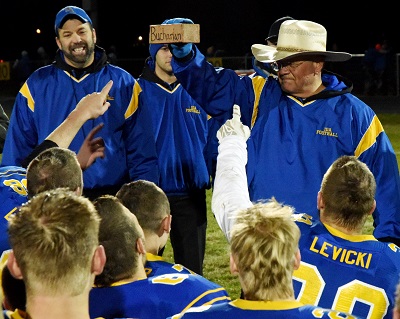 • Second Half’s Chip Mundy this fall wrote a story on the emergence of Ida’s football team on the way to making the Division 5 Semifinals and finishing its best season ever. A theme of that story was Ida’s philosophy of building “brick by brick,” coined by defensive line coach Gary Deland, who himself was building back after emergency triple-bypass heart surgery.
“From that very first practice in the summer to the last game as a senior, everything is built brick by brick,” Deland said for that story. “I can draw a correlation between that and my recovery, what I’ve gone through. It’s the same thing. It’s brick by brick.”
Kim Farver sent along this photo of Deland holding up a brick after the team’s 43-20 Regional Final win over Buchanan.
• We released the last batch of this year’s MHSAA-Farm Bureau Insurance Scholar-Athlete Award winners today, and one of the highlights during the 27 years of the contest came two years ago when we caught up with some of our winners from the first 25 years – including Bloomfield Hills Cranbrook-Kingswood’s Abby Cohen, who has gone on to co-found a company and help develop a smartphone application, Wing, to help asthma patients monitor their lung function.
Here’s a look at a video describing the technology she’s helped create:
Onekama Celebrates New Stadium, Legends Past with Eyes on Another Playoff Run
By
Tom Spencer
Special for MHSAA.com
October 23, 2026
Pretty much every player who has put on the Portagers football jersey over more than six decades of Onekama High School football knows the name Jim Taylor.
 And if they didn’t know it before the team’s 52-8 win over Holton on Oct. 10, they do now.
The community of Onekama honored their former coach, celebrated the 50th anniversary of the only undefeated squad in the Portagers’ history and dedicated the district’s new football stadium during the win over Holton – which also helped keep Onekama’s playoff hopes alive this fall.
The Portagers enter this weekend’s regular-season finale at Merrill ranked No. 14 on the 8-Player Division 2 playoff-points list. The top 16 qualify for the postseason, which begins next week.
“We love our history and traditions – all of the generations have just supported each other and built it into what it is today,” said fourth-year coach Justin Sedelmaier. “The former coaches are still involved, mentoring me. … Coach Jim Hunter and Coach Jim Taylor … still coming and seeing and saying hi to the team and stuff every now and then. The ’76 team, a lot of them like Jerry Brown, are always around supporting us.”
Brown, the quarterback of the only Onekama team to finish undefeated, was the primary organizer of the reunion. He was on hand for the celebration, along with Hunter and Taylor, and was even more excited about honoring Taylor than he was about the reunion.
“The motivation behind it for me anyway, personally, was to throw as much light on our coaching staff, and most specifically, the head coach, Coach Taylor, who had such a huge impact on so many lives – mine for sure,” Brown said. “This was all about shining a light on Coach Taylor and his wife, Lora – what a team. She's been right there with him all the way, supporting him.”
Lora Tayler was the school’s cheerleading coach during the first decade of football at Onekama. She was also on hand for the Oct. 10 festivities.
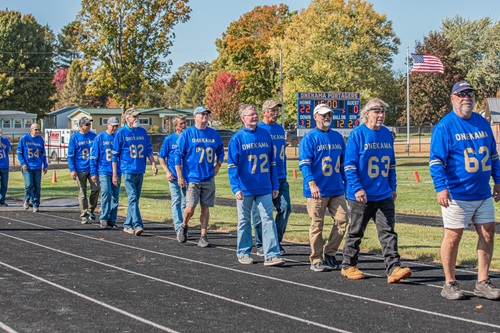
Brown was one of 14 players in attendance to honor the 1976 team, which finished 8-0 and won the Northwest Conference title but did not qualify for the MHSAA Playoffs, which were in only their second year and included only four teams statewide per Class at that time. (Other Onekama teams have since finished perfect for the regular season but lost in the playoffs.)
Taylor started the football program in 1964 and served as head coach until 1988. During his time guiding Onekama, Taylor compiled a 124–58–3 record with only two losing seasons over 22 years. He returned to coaching as an assistant at Onekama from 1997-2008 and was inducted into the Michigan High School Coaches Association Hall of Fame in 2005.
During Taylor’s early years, the Portagers played their home games at nearby Manistee High School while waiting for a home field of their own. The new stadium was built thanks to support of a successful 2024 bond proposal which also provided enhanced security technology, an updated gym, new playground equipment, pickleball courts, team rooms and a modernized press box.
The press box replaced the original built by students in a shop class at Onekama, including the grandfather of the current – and only fourth – coach in the Portagers’ history.
“The press box that just came down was built by the assistant coach, Mr. Foster's shop class, and my grandfather was part of that,” said Sedelmaier, who was the defensive coordinator for four years under John Neph, who with Taylor and Hunter has been the only other head coach Onekama varsity football. “The shop class built the press box and stuff on the first field and just finally now, 60 years later, we're able to make all these field upgrades. It's really been a vision for a long time, and something that I fought for, past players have fought for, the community fought for, and it's a vision that finally came together.”
Sedelmaier was a 2007 graduate of Onekama. Taylor was an assistant coach then. Sedelmaier’s grandfather, Phil Sedelmaier Sr., father Phil Sedelmaier, Jr. and uncle Todd Sedelmaier all played for Onekama during Taylor’s head coaching days.
Justin Sedelmaier has the Portagers primed for another playoff run. They are 6-2, a win tonight should guarantee them a spot in the playoffs and potentially an opportunity to host a game at the new stadium. A loss also won’t necessarily end the season for Onekama, which has reached the 8-Player Division 2 Semifinals the past two seasons. The Portagers’ strength of schedule is expected to boost their playoff chances, no matter the outcome in the regular-season finale.
Bennett Zeller leads the offense. The sophomore quarterback has completed 32 passes for 683 yards and eight touchdowns and picked up 762 yards and 12 touchdowns running the ball. His favorite target is junior Jason Sedelmaier, who has 11 catches for 260 yards and three touchdowns. The next rushing leader behind Bennett is Caleb Porter, also a junior, with five touchdowns while averaging 54 yards per game.
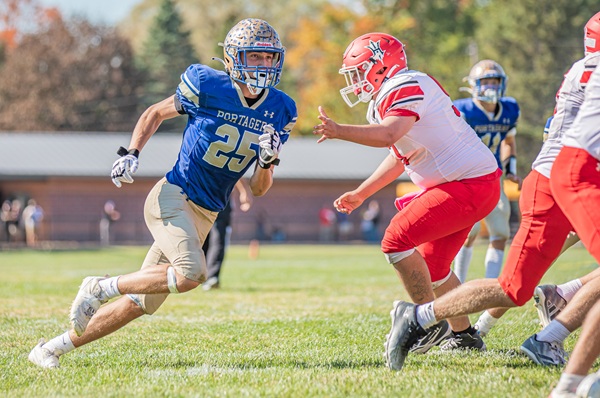
On the other side of the ball, Onekama is led once again by senior Ryan Hrachovina, an all-state defensive linemen last season. He has been credited 103.5 tackles this year – with 22 tackles for a loss and 18 sacks. He blocked a kick and ran it in for a touchdown earlier this fall. He’s also forced a fumble and recovered another.
Jason Sedelmaier also has been a big contributor defensively with 37 tackles, including four for a loss and one sack. He leads the team with 11 pass breakups and has an interception and a fumble recovery, along with a forced fumble.
The Portagers’ only loss last season came in a Division 2 Semifinal to Felch North Dickinson. Coach Sedelmaier is ready to build on the support of Onekama’s former players and coaches as his team prepares to make another run.
“To get to see them all coming back, wearing their replica jerseys and supporting us while we get a look back at some of the history and honoring that history was great for the kids to see,” Sedelmaier said. “That team was the first team to ever go undefeated in the regular season, and they're still the only team that's ever went the entire season total undefeated.”

Tom Spencer is a longtime MHSAA-registered basketball and soccer official, and former softball and baseball official, and he also has coached in the northern Lower Peninsula area. He previously has written for the Saginaw News, Bay County Sports Page and Midland Daily News. He can be reached at [email protected] with story ideas for Manistee, Wexford, Missaukee, Roscommon, Ogemaw, Iosco, Alcona, Oscoda, Crawford, Kalkaska, Grand Traverse, Benzie, Leelanau, Antrim, Otsego, Montmorency, Alpena, Presque Isle, Cheboygan, Charlevoix and Emmet counties.
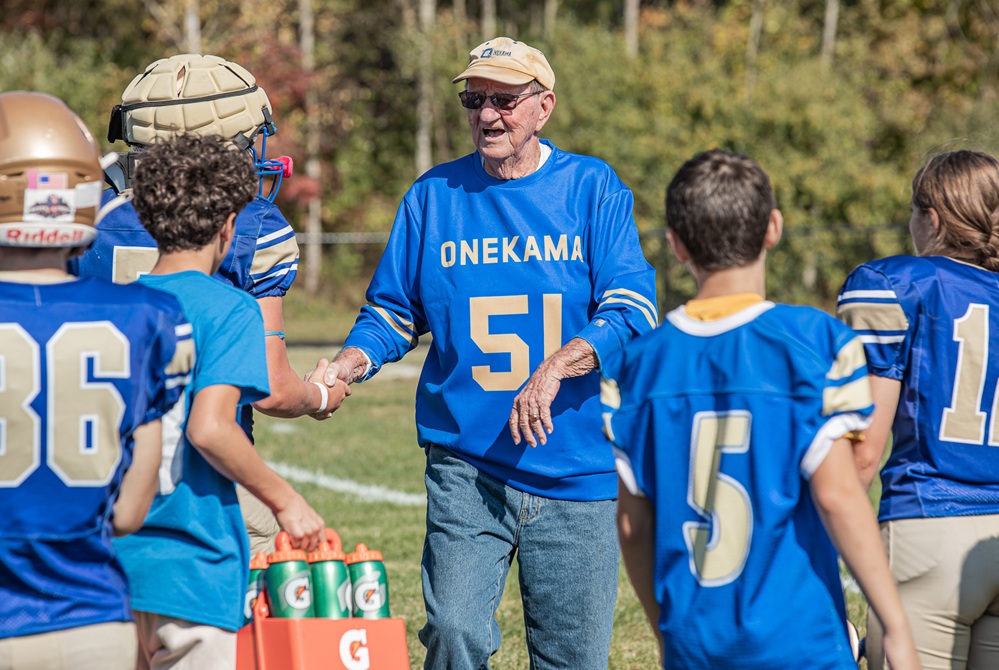
PHOTOS (Top) Longtime Onekama coach Jim Taylor shakes hands with current players during the football program’s reunion and recognition night Oct. 10. (Middle) Ryan Hrachovina (25) works to get around a Holton blocker. (Below) Members of the 1976 Onekama team walk toward the field at the new stadium. (Photos by Meredith McNabb Photography.)