


Jackson Area Efforts Net New Officials
February 16, 2016
By Geoff Kimmerly
Second Half editor
Recruitment of new high school officials to eventually take the reins from those currently conducting MHSAA events is a challenge faced all over Michigan.
 The Jackson Area Officials Association is working to restock its ranks by recruiting directly from local schools and developing them with help from veteran mentors.
Eight new officials – ages 15 to 24 – who worked a series of youth and middle school games together earlier this month, are among those who have been introduced through a program that begins with a meeting at the end of the high school basketball season between JAOA official Bill Walker and local athletic directors, coaches, fellow officials and other young adults he’s made contact with over the course of a season. From that meeting, Walker builds a list of potential candidates to become officials and then invites them to the annual JAOA Legacy Camp in June.
The camp includes two days of scrimmages between local teams, plus classroom and mechanics teaching. Similar to the MHSAA Legacy program, new officials are paired with veterans, and clinicians evaluate their work during scrimmage play. Walker then keeps in touch with the new officials during the rest of the summer, plugging them in for local youth tournaments and scrimmages, and uses as many as possible while assigning officials for youth tournaments over the winter.
All eight officials who worked the event this month are part of the JAOA legacy partnering, and some of the group already are working games at the junior varsity level – with one, a 19-year-old, recently completing his first varsity game. They come from a variety of Jackson-area schools – Parma Western, Napoleon, Jackson Christian, Michigan Center, Concord and East Jackson. Walker said the recruiting effort has a 60 percent success rate so far. (This June’s legacy camp will be the third.)
“By next season, all (eight) will be official MHSAA registered officials,” he said, noting most currently are registered. “It’s great to have these schools support this program. We all benefit from added, good officiating.”
Passing it forward
Our Battle of the Fans trip to Charlotte on Friday included a conversation about a Feb. 2 game between the Orioles and Mason, which has a pair of athletes fighting cancer. The Charlotte student section dressed in blue that night in support of junior Storm Miller, and during halftime passed buckets to raise money for Miller’s GoFundMe account set up to help pay for his care.
Mason, in turn, provided support Friday to an Owosso alum, 2012 graduate Cody Greger, who remains hospitalized at University of Michigan’s hospital with injuries sustained during a house fire in November. Fans and students collected donations to assist Greger’s family with his care.
“This event was yet another example of the values that school sports teach young people,” Owosso athletic director Dallas Lintner wrote on the school’s website. “And it stands as a testament of the integrity of the young adults that represent our schools and the (Capital Area Activities Conference.)."
100 years of hoops
A decade before the formation of the Michigan High School Athletic Association, Eastern Michigan University – then known as Michigan State Normal College – hosted what is believed to be the first organized high school basketball tournament in state history.
EMU will celebrate this anniversary Saturday in conjunction with the Eagles men’s basketball game against Toledo. Game time is noon at EMU’s Convocation Center, and during a break in play the athletic department will recognize the 12 schools that took part in that 1916 tournament – Marine City, Dundee, Milan, Mancelona, Farmington, Elkton, Royal Oak, Middleville, Lansing, Mount Clemens, Wayne and Saline.
More history, courtesy of EMU:
The game of basketball was developed by James Naismith in 1891 at Springfield College in Massachusetts. As a means of promoting the game throughout the country, physical education professor and EMU's first athletic director Wilber Bowen asked his good friend Naismith to bring the game to the Michigan State Normal College (now known as Eastern Michigan University).
The first basketball game west of the Allegheny Mountains was played at Michigan Normal in 1894 to recognize the new physical education program and to dedicate the new gymnasium on campus.
Then in 1916, Bowen, along with instructors Elmer Mitchell and Lloyd Olds (who was also credited with the introduction of the striped referee jersey), organized the first high school basketball tournament in Michigan. A total of 300 invitations were sent out to all Class B schools in the state. Twelve schools responded, and the first high school boys tournament was held on the Ypsilanti-based campus on March 23-25, 1916.
Entrance to the tournament was free and (the event was) played at the Michigan State Normal School Gymnasium. However, expenses related to transportation, room, and board had to be provided by the participating schools. The MSNC's Physical Education Department made it easier for schools to participate by making arrangements with local residents to provide food at 20 to 25 cents a meal and lodging at 25 cents a night for each player.
That first tournament saw Marine City defeat Dundee in the championship game, 23-22.
The winning team was awarded a silver shield mounted on an oak base. Second prize was a silver cup, and the third place team received a banner. Individual participation awards to all players were also provided. The Ypsilanti Press at the time felt the Normal School "went first class with the awards."
For tickets to Saturday’s game and event, which will be followed by the EMU women’s team taking on Northern Illinois, call the EMU Ticket Office at (734) 487-2282 or visit EMUEagles.com/tickets.
Following up
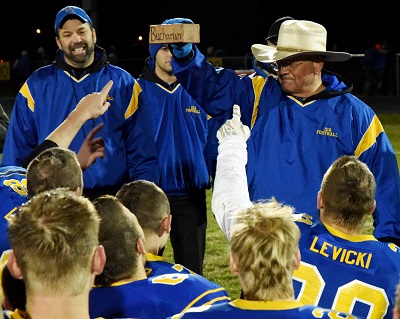 • Second Half’s Chip Mundy this fall wrote a story on the emergence of Ida’s football team on the way to making the Division 5 Semifinals and finishing its best season ever. A theme of that story was Ida’s philosophy of building “brick by brick,” coined by defensive line coach Gary Deland, who himself was building back after emergency triple-bypass heart surgery.
“From that very first practice in the summer to the last game as a senior, everything is built brick by brick,” Deland said for that story. “I can draw a correlation between that and my recovery, what I’ve gone through. It’s the same thing. It’s brick by brick.”
Kim Farver sent along this photo of Deland holding up a brick after the team’s 43-20 Regional Final win over Buchanan.
• We released the last batch of this year’s MHSAA-Farm Bureau Insurance Scholar-Athlete Award winners today, and one of the highlights during the 27 years of the contest came two years ago when we caught up with some of our winners from the first 25 years – including Bloomfield Hills Cranbrook-Kingswood’s Abby Cohen, who has gone on to co-found a company and help develop a smartphone application, Wing, to help asthma patients monitor their lung function.
Here’s a look at a video describing the technology she’s helped create:
Ovid-Elsie Running Legend Darling Seeking to 'Win the Day' on Trading Floor
By
Paul Costanzo
Special for MHSAA.com
August 13, 2024
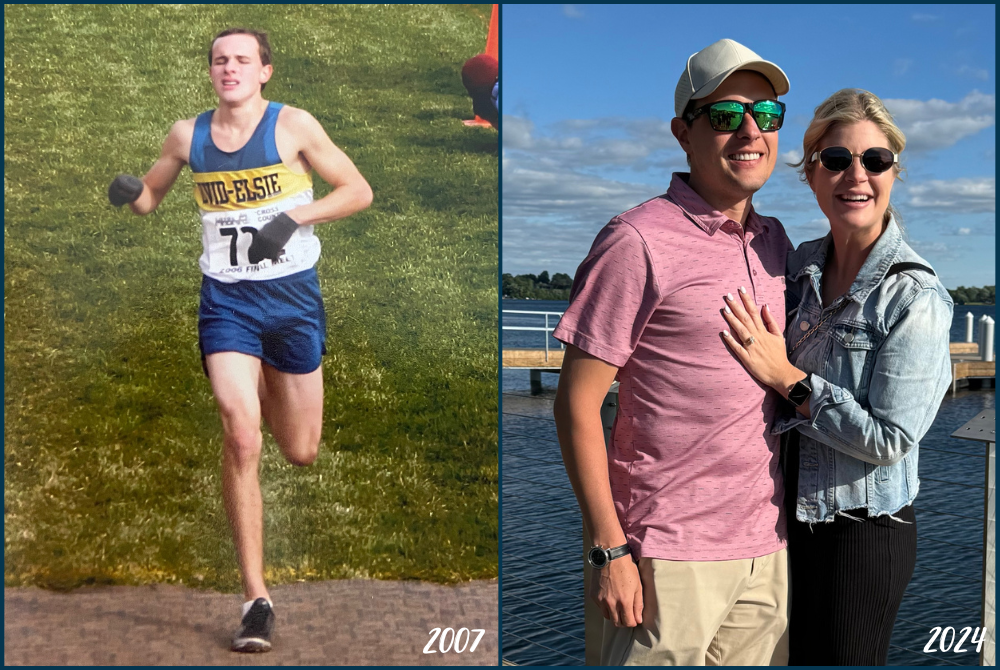
Maverick Darling’s competitive running days have been behind him for nearly a decade, but the eight-time MHSAA Finals champion from Ovid-Elsie isn’t done competing.
 Darling, who was also a five-time All-American at Wisconsin, is now fighting for wins on the Viking Forest Products lumber trading floor in Minnesota.
“Our trading floor is very unique,” Darling said. “We have 60 traders, and probably 30-35 of them are former student-athletes in college. It’s very competitive, but kind of like a locker room. It’s kind of a unique way for me to still be competitive even though I’m not in athletics. I really love it.”
Darling is a commodity trader at Viking Forest, trading mostly OSB, plywood and dimensional lumber to buyers throughout the United States. He lives with his fiancé Danielle and their two dogs in Plymouth, Minn., a suburb of Minneapolis.
Lessons learned while working toward Finals titles on the dirt roads of Ovid and national goals on the trails of Madison, Wis., are helping him find success again.
“My lessons I learned from running and the reward, whether good, great or OK, is that no matter the day, you have to go put in the effort and work, and it carries over to my work,” he said. “I now literally start over every day. We had a saying: ‘Win the day.’ And ‘Win the day’ kind of means something different for every day. I try to apply that to my life. It’s motivating to be successful every day.”
Friendly competition between teammates leading to greater success also carried over from cross country and track to the trading floor.
“We have a department where it feels almost like my cross country team in college,” he said. “One guy will put up 30 orders that day, and we’re all happy for that person. The synergy between the group is awesome. But it motivates me to be like, tomorrow that’s going to be me.”
Darling had spent his first three years out of Wisconsin running professionally and had coaching stops at Iona and Cal-Berkeley after that. But when the pandemic hit, he stepped away from coaching and made the move to trading.
 That ended a spectacular career in the sport, which was actually second choice for most of Darling’s childhood.
Growing up, he was a top snowmobile racer, along with his brother.
“My first (high school) cross country race, I took seventh,” Darling said. “I didn’t know better, but that’s pretty good. My mom was like, ‘Seventh? You know, we’re used to first or second (in snowcross).’ We’re not a running family. I started at about 18 minutes in the 5K, and at the state meet I finished eighth and ran 16:13. I was like, ‘OK, maybe this is something I can really be good at.’”
It was at the end of his junior year, after winning his heat at the Nike Outdoor Nationals, that Darling turned his entire focus to running. By that time, he had already won two Division 3 cross country titles, two 3,200-meter titles and one 1,600 at MHSAA Finals.
He was training often, but knew he was undertrained because of the limitations on where and when he could run during mid-Michigan winters. Colleges knew it, too, and that led to a barrage of communication as soon as they were able to reach out.
“I probably had 150 of those (hand-written letters) sent to the house,” Darling said. “I would get two to three phone calls a night after July 1. It wasn’t like overwhelming, because I was pretty confident at that point where I wanted to go to school.”
Darling committed to Wisconsin on the day of the Lower Peninsula Cross Country Finals his senior year. He also won his third Finals title that day with a then-Division 3 record time of 14:52. At the time, it was the third fastest time ever run in Michigan.
He would later win his second straight 1,600/3,200 double at the Track & Field Finals, running 8:58 in the 3,200 during the season, which was the 12th-best high school time in the country that year.
The choice to go to Wisconsin was based on his drive to be challenged as much as possible.
“I thought, ‘If I come into this room, I’m probably the eighth or ninth best runner in this room – maybe,’” Darling said. “I had such a great recruiting trip. I grew up in Ovid, and everything I ran there was pretty much dirt roads. Wisconsin has a lot of dirt trails, and I kind of loved that. I could run from our locker room and be on a trail in a mile, mile and a half.”
 Darling’s collegiate career proved he had made the right decision. He was the Big Ten Freshman of the Year for the 2009 cross country season, and an All-American in 2010 and 2012. He was a three-time All-American in track, as well.
The Badgers also had massive team success during Darling’s tenure, winning a cross country national title in 2011, four Big Ten cross country titles and two Big Ten track & field titles.
Darling was surrounded by great runners throughout his time in Madison, including close friend Mohammed Ahmed, who finished fourth in the 10,000 meters at this Olympics, one spot behind another Michigan distance star, Grand Blanc’s Grant Fisher.
Watching the results of a distance boom he was a big part of has been a joy for Darling this summer.
“I thought I was pretty good, then watching these guys – it’s jealousy,” he said with a laugh. “And also, it’s just cool to see. Michigan is one of the best distance states men’s and women’s-wise. It’s great to see them not only be on the international level, but to have that success.”
2024 Made In Michigan
August 8: Shores Star Walker Continues Drive for Hoops Greatness as College Coach - Read
August 6: MCC's Glover Fills Key Role as Athletic Trainer for Super Bowl Champions - Read
August 1: Lessons from Multi-Sport Experience Guide Person in Leading New Team - Read
July 30: After Successful 'Sequel,' Suttons Bay's Hursey Embarking on Next Chapter - Read
July 24: East Kentwood Run Part of Memorable Start on Knuble's Way to NHL, Olympics - Read
July 22: Monroe High Memories Remain Rich for Michigan's 1987 Mr. Baseball - Read
July 17: Record-Setting Viney Gained Lifelong Confidence at Marine City - Read
July 11: High School 'Hoop Squad' Close to Heart as Hughes Continues Coaching Climb - Read
July 10: Nightingale Embarking on 1st Season as College Football Head Coach - Read
June 28: E-TC's Witt Bulldozing Path from Small Town to Football's Biggest Stage - Read
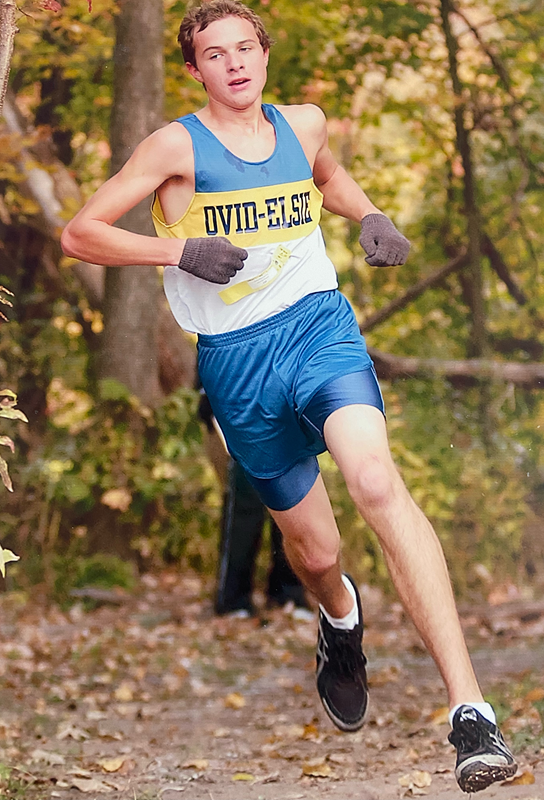
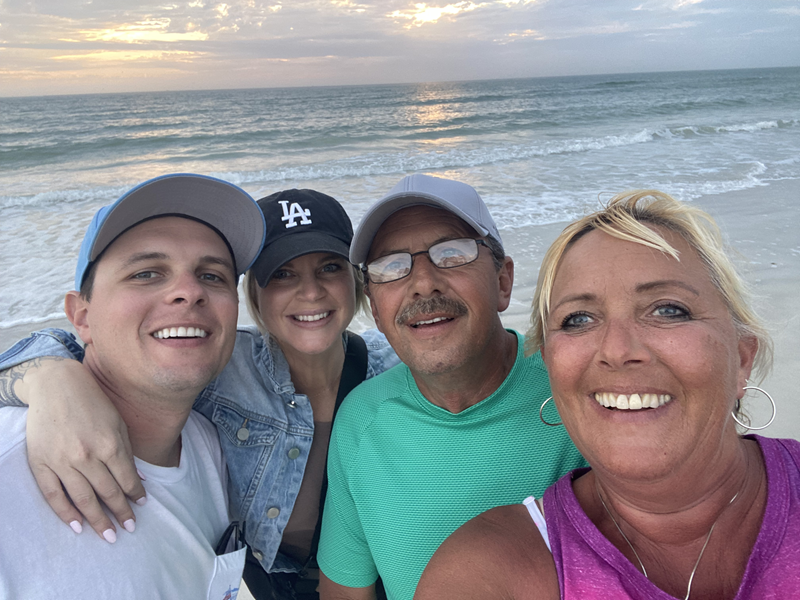
PHOTOS (Top) At left, Maverick Darling crosses the finish line during a race as an Ovid-Elsie senior in 2007; at right Darling poses with fiancé Danielle. (Middle) Darling rounds a turn during a high school race. (Below) Darling and Danielle enjoy a sunset over the water with her parents. (Photos courtesy of Maverick Darling.)