

Jackson Area Efforts Net New Officials
February 16, 2016
By Geoff Kimmerly
Second Half editor
Recruitment of new high school officials to eventually take the reins from those currently conducting MHSAA events is a challenge faced all over Michigan.
 The Jackson Area Officials Association is working to restock its ranks by recruiting directly from local schools and developing them with help from veteran mentors.
Eight new officials – ages 15 to 24 – who worked a series of youth and middle school games together earlier this month, are among those who have been introduced through a program that begins with a meeting at the end of the high school basketball season between JAOA official Bill Walker and local athletic directors, coaches, fellow officials and other young adults he’s made contact with over the course of a season. From that meeting, Walker builds a list of potential candidates to become officials and then invites them to the annual JAOA Legacy Camp in June.
The camp includes two days of scrimmages between local teams, plus classroom and mechanics teaching. Similar to the MHSAA Legacy program, new officials are paired with veterans, and clinicians evaluate their work during scrimmage play. Walker then keeps in touch with the new officials during the rest of the summer, plugging them in for local youth tournaments and scrimmages, and uses as many as possible while assigning officials for youth tournaments over the winter.
All eight officials who worked the event this month are part of the JAOA legacy partnering, and some of the group already are working games at the junior varsity level – with one, a 19-year-old, recently completing his first varsity game. They come from a variety of Jackson-area schools – Parma Western, Napoleon, Jackson Christian, Michigan Center, Concord and East Jackson. Walker said the recruiting effort has a 60 percent success rate so far. (This June’s legacy camp will be the third.)
“By next season, all (eight) will be official MHSAA registered officials,” he said, noting most currently are registered. “It’s great to have these schools support this program. We all benefit from added, good officiating.”
Passing it forward
Our Battle of the Fans trip to Charlotte on Friday included a conversation about a Feb. 2 game between the Orioles and Mason, which has a pair of athletes fighting cancer. The Charlotte student section dressed in blue that night in support of junior Storm Miller, and during halftime passed buckets to raise money for Miller’s GoFundMe account set up to help pay for his care.
Mason, in turn, provided support Friday to an Owosso alum, 2012 graduate Cody Greger, who remains hospitalized at University of Michigan’s hospital with injuries sustained during a house fire in November. Fans and students collected donations to assist Greger’s family with his care.
“This event was yet another example of the values that school sports teach young people,” Owosso athletic director Dallas Lintner wrote on the school’s website. “And it stands as a testament of the integrity of the young adults that represent our schools and the (Capital Area Activities Conference.)."
100 years of hoops
A decade before the formation of the Michigan High School Athletic Association, Eastern Michigan University – then known as Michigan State Normal College – hosted what is believed to be the first organized high school basketball tournament in state history.
EMU will celebrate this anniversary Saturday in conjunction with the Eagles men’s basketball game against Toledo. Game time is noon at EMU’s Convocation Center, and during a break in play the athletic department will recognize the 12 schools that took part in that 1916 tournament – Marine City, Dundee, Milan, Mancelona, Farmington, Elkton, Royal Oak, Middleville, Lansing, Mount Clemens, Wayne and Saline.
More history, courtesy of EMU:
The game of basketball was developed by James Naismith in 1891 at Springfield College in Massachusetts. As a means of promoting the game throughout the country, physical education professor and EMU's first athletic director Wilber Bowen asked his good friend Naismith to bring the game to the Michigan State Normal College (now known as Eastern Michigan University).
The first basketball game west of the Allegheny Mountains was played at Michigan Normal in 1894 to recognize the new physical education program and to dedicate the new gymnasium on campus.
Then in 1916, Bowen, along with instructors Elmer Mitchell and Lloyd Olds (who was also credited with the introduction of the striped referee jersey), organized the first high school basketball tournament in Michigan. A total of 300 invitations were sent out to all Class B schools in the state. Twelve schools responded, and the first high school boys tournament was held on the Ypsilanti-based campus on March 23-25, 1916.
Entrance to the tournament was free and (the event was) played at the Michigan State Normal School Gymnasium. However, expenses related to transportation, room, and board had to be provided by the participating schools. The MSNC's Physical Education Department made it easier for schools to participate by making arrangements with local residents to provide food at 20 to 25 cents a meal and lodging at 25 cents a night for each player.
That first tournament saw Marine City defeat Dundee in the championship game, 23-22.
The winning team was awarded a silver shield mounted on an oak base. Second prize was a silver cup, and the third place team received a banner. Individual participation awards to all players were also provided. The Ypsilanti Press at the time felt the Normal School "went first class with the awards."
For tickets to Saturday’s game and event, which will be followed by the EMU women’s team taking on Northern Illinois, call the EMU Ticket Office at (734) 487-2282 or visit EMUEagles.com/tickets.
Following up
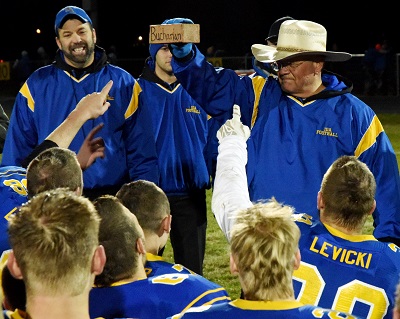 • Second Half’s Chip Mundy this fall wrote a story on the emergence of Ida’s football team on the way to making the Division 5 Semifinals and finishing its best season ever. A theme of that story was Ida’s philosophy of building “brick by brick,” coined by defensive line coach Gary Deland, who himself was building back after emergency triple-bypass heart surgery.
“From that very first practice in the summer to the last game as a senior, everything is built brick by brick,” Deland said for that story. “I can draw a correlation between that and my recovery, what I’ve gone through. It’s the same thing. It’s brick by brick.”
Kim Farver sent along this photo of Deland holding up a brick after the team’s 43-20 Regional Final win over Buchanan.
• We released the last batch of this year’s MHSAA-Farm Bureau Insurance Scholar-Athlete Award winners today, and one of the highlights during the 27 years of the contest came two years ago when we caught up with some of our winners from the first 25 years – including Bloomfield Hills Cranbrook-Kingswood’s Abby Cohen, who has gone on to co-found a company and help develop a smartphone application, Wing, to help asthma patients monitor their lung function.
Here’s a look at a video describing the technology she’s helped create:
This Week in High School Sports: 3/12/26
By
Jon Ross
MHSAA Director of Broadcast Properties
March 12, 2026
This week's edition recaps the Individual Wrestling and Competitive Cheer Finals, presents Game Balls to standouts in gymnastics and newly-announced NFHS Hall of Fame selection Alisha Glass Childress from Leland; and closes with a recap of Jackson cross country coach Nathan Martin's comeback win at the Los Angeles Marathon.
 The 5-minute program each week includes feature stories from MHSAA.com or network affiliates, along with "Be the Referee," a 60-second look at the fine art of officiating.
"This Week in High School Sports" is powered by MI Student Aid, a division within the Department of Lifelong Education, Advancement, and Potential (MiLEAP).
Listen to this week's show by Clicking Here.
Previous 2025-26 editions
March 5: Team Wrestling Finals review, Mio basketball's Mia McGregor - Listen
Feb. 26: Upper Peninsula Swimming & Diving Finals review, Brian Gordon Receives Hampton Award - Listen
Feb. 19: Boyne City's Exemplary Program Award, MHSAA Basketball Tournament Schedules - Listen
Feb. 12: MHSAA connections to this year's Winter Olympics & Super Bowl - Listen
Feb. 5: MHSAA personal branding activities rule, Bear Lake's Harless twins - Listen
Jan. 29: Women in Sports Leadership Conference, WISL Award winner Anika McEvans - Listen
Jan. 22: Multi-sport participation, MHSAA/Farm Bureau Insurance Scholar-Athlete Awards - Listen
Jan. 15: Genesee's Averie Zinn & Mio's Mia McGregor, MHSAA Winter Finals schedule - Listen
Jan. 8: 2024-25 MHSAA Tournament attendance, tribute to Vic Michaels - Listen
Dec. 11: MHSAA 2024-25 participation's national ranking, 2026 Wrestling Tournament - Listen
Dec. 4: 11-Player Football Finals review - Listen
Nov. 26: Girls Volleyball, 8-Player Football, Lower Peninsula Girls Swimming & Diving Finals review - Listen
Nov. 20: NFHS Network championship schedule, Sportsmanship Summits - Listen
Nov. 13: Performance of the Week, Shelby football - Listen
Nov. 6: Lower Peninsula Cross Country Finals, Boys Soccer Finals review - Listen
Oct. 30: Mendon football's Owen Gorham, MHSAA Girls Volleyball Tournament primer - Listen
Oct. 23: Lower Peninsula Girls Golf Finals review, LP Boys Tennis Finals - Listen
Oct. 16: MHSAA Football Playoff selection, Field Hockey Finals week primer - Listen
Oct. 9: Upper Peninsula Girls Tennis Finals review, 2025 Sportsmanship Summits - Listen
Oct. 2: 2026 MHSAA/Farm Bureau Insurance Scholar-Athlete Awards, Boys Soccer Tournament - Listen
Sept. 25: Saline's record-approaching performance, SAC sportsmanship statement - Listen
Sept. 18: Athletic director training, "Block Party" volleyball report - Listen
Sept. 11: Football coaching legend Al Fracassa, MHSAA Student Advisory Council - Listen
Sept. 4: MHSAA participation rising, Harbor Springs soccer's Henry Juneau - Listen
Aug. 28: Field hockey's first season, changes to Football Playoffs, Tennis Finals - Listen