


Jackson Area Efforts Net New Officials
February 16, 2016
By Geoff Kimmerly
Second Half editor
Recruitment of new high school officials to eventually take the reins from those currently conducting MHSAA events is a challenge faced all over Michigan.
 The Jackson Area Officials Association is working to restock its ranks by recruiting directly from local schools and developing them with help from veteran mentors.
Eight new officials – ages 15 to 24 – who worked a series of youth and middle school games together earlier this month, are among those who have been introduced through a program that begins with a meeting at the end of the high school basketball season between JAOA official Bill Walker and local athletic directors, coaches, fellow officials and other young adults he’s made contact with over the course of a season. From that meeting, Walker builds a list of potential candidates to become officials and then invites them to the annual JAOA Legacy Camp in June.
The camp includes two days of scrimmages between local teams, plus classroom and mechanics teaching. Similar to the MHSAA Legacy program, new officials are paired with veterans, and clinicians evaluate their work during scrimmage play. Walker then keeps in touch with the new officials during the rest of the summer, plugging them in for local youth tournaments and scrimmages, and uses as many as possible while assigning officials for youth tournaments over the winter.
All eight officials who worked the event this month are part of the JAOA legacy partnering, and some of the group already are working games at the junior varsity level – with one, a 19-year-old, recently completing his first varsity game. They come from a variety of Jackson-area schools – Parma Western, Napoleon, Jackson Christian, Michigan Center, Concord and East Jackson. Walker said the recruiting effort has a 60 percent success rate so far. (This June’s legacy camp will be the third.)
“By next season, all (eight) will be official MHSAA registered officials,” he said, noting most currently are registered. “It’s great to have these schools support this program. We all benefit from added, good officiating.”
Passing it forward
Our Battle of the Fans trip to Charlotte on Friday included a conversation about a Feb. 2 game between the Orioles and Mason, which has a pair of athletes fighting cancer. The Charlotte student section dressed in blue that night in support of junior Storm Miller, and during halftime passed buckets to raise money for Miller’s GoFundMe account set up to help pay for his care.
Mason, in turn, provided support Friday to an Owosso alum, 2012 graduate Cody Greger, who remains hospitalized at University of Michigan’s hospital with injuries sustained during a house fire in November. Fans and students collected donations to assist Greger’s family with his care.
“This event was yet another example of the values that school sports teach young people,” Owosso athletic director Dallas Lintner wrote on the school’s website. “And it stands as a testament of the integrity of the young adults that represent our schools and the (Capital Area Activities Conference.)."
100 years of hoops
A decade before the formation of the Michigan High School Athletic Association, Eastern Michigan University – then known as Michigan State Normal College – hosted what is believed to be the first organized high school basketball tournament in state history.
EMU will celebrate this anniversary Saturday in conjunction with the Eagles men’s basketball game against Toledo. Game time is noon at EMU’s Convocation Center, and during a break in play the athletic department will recognize the 12 schools that took part in that 1916 tournament – Marine City, Dundee, Milan, Mancelona, Farmington, Elkton, Royal Oak, Middleville, Lansing, Mount Clemens, Wayne and Saline.
More history, courtesy of EMU:
The game of basketball was developed by James Naismith in 1891 at Springfield College in Massachusetts. As a means of promoting the game throughout the country, physical education professor and EMU's first athletic director Wilber Bowen asked his good friend Naismith to bring the game to the Michigan State Normal College (now known as Eastern Michigan University).
The first basketball game west of the Allegheny Mountains was played at Michigan Normal in 1894 to recognize the new physical education program and to dedicate the new gymnasium on campus.
Then in 1916, Bowen, along with instructors Elmer Mitchell and Lloyd Olds (who was also credited with the introduction of the striped referee jersey), organized the first high school basketball tournament in Michigan. A total of 300 invitations were sent out to all Class B schools in the state. Twelve schools responded, and the first high school boys tournament was held on the Ypsilanti-based campus on March 23-25, 1916.
Entrance to the tournament was free and (the event was) played at the Michigan State Normal School Gymnasium. However, expenses related to transportation, room, and board had to be provided by the participating schools. The MSNC's Physical Education Department made it easier for schools to participate by making arrangements with local residents to provide food at 20 to 25 cents a meal and lodging at 25 cents a night for each player.
That first tournament saw Marine City defeat Dundee in the championship game, 23-22.
The winning team was awarded a silver shield mounted on an oak base. Second prize was a silver cup, and the third place team received a banner. Individual participation awards to all players were also provided. The Ypsilanti Press at the time felt the Normal School "went first class with the awards."
For tickets to Saturday’s game and event, which will be followed by the EMU women’s team taking on Northern Illinois, call the EMU Ticket Office at (734) 487-2282 or visit EMUEagles.com/tickets.
Following up
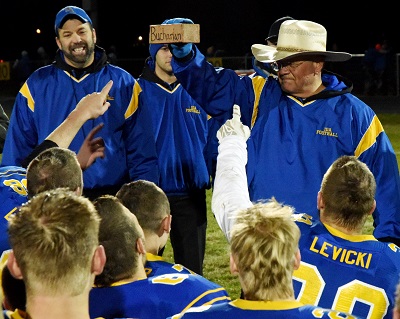 • Second Half’s Chip Mundy this fall wrote a story on the emergence of Ida’s football team on the way to making the Division 5 Semifinals and finishing its best season ever. A theme of that story was Ida’s philosophy of building “brick by brick,” coined by defensive line coach Gary Deland, who himself was building back after emergency triple-bypass heart surgery.
“From that very first practice in the summer to the last game as a senior, everything is built brick by brick,” Deland said for that story. “I can draw a correlation between that and my recovery, what I’ve gone through. It’s the same thing. It’s brick by brick.”
Kim Farver sent along this photo of Deland holding up a brick after the team’s 43-20 Regional Final win over Buchanan.
• We released the last batch of this year’s MHSAA-Farm Bureau Insurance Scholar-Athlete Award winners today, and one of the highlights during the 27 years of the contest came two years ago when we caught up with some of our winners from the first 25 years – including Bloomfield Hills Cranbrook-Kingswood’s Abby Cohen, who has gone on to co-found a company and help develop a smartphone application, Wing, to help asthma patients monitor their lung function.
Here’s a look at a video describing the technology she’s helped create:
1st & Goal: 2026 Week 7 Review
By
Geoff Kimmerly
MHSAA.com senior editor
October 12, 2026
One play does not decide a game. But one play also can make all the difference.
 Several Week 7 games showed that to be true once again, as a number of league champions were decided during the first full weekend of October, and multiple by one-score margins.
A few league races were reshuffled as well, and those results earned their places in our "Review" too as we move toward the final two weeks of the regular season.
Bay & Thumb
HEADLINER Almont 28, Macomb Lutheran North 27 Almont (7-0) has clinched a share of the Blue Water Area Conference title and can finish a fourth straight as outright champion this week against Croswell-Lexington. The Raiders have won 30 straight BWAC games, this the third by one point during that time. Lutheran North (6-1) has made a run at the title in its first season in the league after previously playing in the Catholic High School League. Click for more from the Macomb Daily.
Watch list Gladwin 26, Ogemaw Heights 20 The Flying Gs (5-2) capped a dramatic run to the Jack Pine Conference Division 1 title, falling to Midland Bullock Creek in Week 6 but bouncing right back to win this one on Jacob Pahl’s walk-off touchdown catch from Preston Newman. Ogemaw (5-2) had entered the night with the opportunity to clinch as well.
On the move Fenton 49, Linden 42 Fenton (6-1) finished an outright championship in the Flint Metro League Stripes with another of several close games against Linden (5-2) over the last two decades. Montrose 42, Ovid-Elsie 14 The Rams (6-1) clinched a share of a second-straight Mid-Michigan Activities Conference title and kept Ovid-Elsie (3-4) just outside the Division 6 playoff picture. Bay City Western 27, Traverse City Central 21 Western (3-4) jumped 13 spots to tied for No. 31 in the Division 3 playoff-points list with this first win over the Trojans (3-4) in five years of Saginaw Valley League play together.
Greater Detroit
HEADLINER Detroit Catholic Central 27, Orchard Lake St. Mary’s 20 This matchup definitely lived up to season-long anticipation, as Detroit Catholic Central came back from a 14-point fourth-quarter deficit to pull closer to a potential third-straight Catholic High School League Central title – the Shamrocks (7-0) can clinch a share this week against one-win Toledo St. Francis de Sales. Gideon Gash scored twice during the fourth quarter and Ryan Jaafar ran for the eventual game-winner with 10 seconds to play against the Eaglets (5-2). Click for more from the Detroit Free Press.
COMEBACK COMPLETE WITH 10 SECONDS LEFT! 🚨 Down 14 in the fourth quarter, No. 1 Detroit Catholic Central (@DCCfootball) storms back and takes the lead on Ryan Jaafar's (@ryanjaafar5) 4-yard touchdown against No. 4 Orchard Lake St. Mary’s! 🤯 Powered by @CallSam https://t.co/KmHK0oUIJk
— STATE CHAMPS! Michigan (@statechampsmich) October 10, 2026
Watch list Gibraltar Carlson 31, Brownstown Woodhaven 28 The Marauders (7-0) have won 17 straight Downriver League games and are working toward a potential sixth-straight conference championship with two games to play – including a Week 9 matchup with second-place Allen Park. Austyn Lawrence threw three touchdown passes to help send Woodhaven (5-2) into a tie for third place.
On the move Northville 30, Belleville 7 Three teams are tied for first in the Kensington Lakes Activities Association Black – these two and Dearborn Fordson – with one league game to play. Royal Oak Shrine Catholic 42, Allen Park Cabrini 21 Shrine (7-0) clinched a share of the CHSL Intersectional 2 title by winning this matchup of teams that entered the night undefeated in league play. Detroit Central 6, Detroit Denby 2 These two finished the conference schedule among three teams tied atop the Detroit Public School League Gold standings (with Detroit Cody) and will meet again this week in a city championship game.
Mid-Michigan
HEADLINER Howell 14, Brighton 13 This rivalry filed away another exciting chapter as the Highlanders clinched a share of the KLAA Gold title. Howell (7-0) has now defeated Brighton (4-3) in four straight, including twice in 2024, and can claim the league title outright this week against Dearborn Heights Crestwood. Click for more from State Champs! Sports Network.
Watch list Ithaca 48, Saginaw Valley Lutheran 7 The Yellowjackets (7-0) avenged last season’s one-point loss to Valley Lutheran (5-2) to this time clinch the Tri-Valley Conference Blue title outright. Ithaca this season has now given up only 26 points – fewer than four per game.
On the move Mason 45, Williamston 14 The Bulldogs (7-0) completed a similarly defense-dominated run through the Capital Area Activities Conference Red, clinching an outright title with this win while giving up no more than 17 points in any game this fall. Clare 48, Midland Bullock Creek 35 The Pioneers (3-4) are pushing back toward a potential spot in the Division 5 playoff field and gave Gladwin an assist in its outright championship by knocking Bullock Creek (4-3) out of the race for a share of the JPC1 title. Okemos 45, Lansing Waverly 12 From 2020-23, Okemos didn’t win a game, which helps explain how the Wolves’ five wins this fall equal their total from the last seven seasons combined.
Northern Lower Peninsula
HEADLINER Traverse City West 31, Mount Pleasant 29 The Titans (4-3) threw a curveball into the Saginaw Valley League North race as Mount Pleasant (6-1) entered this game with an opportunity to clinch a share of the title, but now has become one of three teams with a chance to win it outright. West is another, thanks in part to Landon Henfling’s last-minute go-ahead field goal. Click for more from the Traverse City Record-Eagle.
Watch list East Jordan 53, Johannesburg-Lewiston 16 The Red Devils (6-1) pulled to within one more win of clinching a share of the Northern Michigan Football Conference title but do face fourth-place Frankfort this week and second-place (tie) Harbor Springs in the regular-season finale.
On the move Maple City Glen Lake 33, Frankfort 0 Glen Lake (5-2) is tied for Harbor Springs for second in the NMFC and will be rooting for Frankfort (5-2) this week and hoping for an East Jordan misstep. Kingsley 55, Boyne City 12 Kingsley (7-0) clinched a share of the Northern Shores Conference title, but Boyne City (3-4) also moved up one spot to No. 36 on the Division 6 playoff-points average list. Petoskey 35, Alpena 0 The Northmen (5-2) kept themselves in play to clinch a share of the Big North Conference championship with a win over first-place Marquette this week.
Southeast & Border
HEADLINER Clinton 30, Ida 22 Amazingly, four teams are tied for first in the Lenawee County Athletic Association with one more week of league games to play, in part thanks to Clinton’s win over Ida (6-1) – with those two joined by Adrian Madison and Hudson at the top of the standings. Clinton (6-1) scored on a 66-yard pass midway through the fourth quarter to go ahead for good and play a major part in creating a scenario guaranteed to produce two co-champions. Click for more from the Adrian Daily Telegram.
Watch list Springport 28, Union City 14 The Spartans (6-1) still need one more win to clinch a share of the Big 8 Conference title, but now sit alone atop the standings after handing second-place Union City (6-1) its lone defeat.
On the move Hanover-Horton 52, Leslie 28 Hanover-Horton (6-1) won this matchup of Cascades Conference divisional champions, and now faces Manchester, which shared the North title with the Blackhawks (4-3). Napoleon 50, Brooklyn Columbia Central 15 The Pirates (6-1) won this matchup for second place in the Cascades Conference South, but also maintained valuable position in the Division 6 playoff hunt in case these two meet again in the postseason. Monroe St. Mary Catholic Central 27, Riverview 14 The Falcons (7-0) did their part to set up a winner-take-all this week in the Huron League against Monroe Jefferson, while also sending Riverview (4-3) out of the top 32 on the Division 3 playoff-points average list.
Southwest Corridor
HEADLINER Vicksburg 37, Niles 21 The Bulldogs had lost by 35, 35 and 50 points to Niles the last three seasons as Niles went on to win three straight Wolverine Conference championships. But with this win, Vicksburg maintained its share of first place heading into this week’s matchup with co-leader Edwardsburg. Click for more from the Kalamazoo Gazette.
Watch list Berrien Springs 35, Hopkins 0 Aside from clinching a share of the Lakeland Conference title, this has to be Berrien Springs’ most notable win this season as Hopkins also entered undefeated. The victory sent the Shamrocks (7-0) from No. 7 to No. 3 on the Division 5 playoff-points list, while dropping Hopkins (6-1) only two spots to No. 7.
On the move Constantine 39, Lawton 6 Constantine (6-1) will need help from Coloma this week against first-place Kalamazoo United to gain a share of the Southwestern Athletic Conference title, but downing third-place Lawton (5-2) did earn the Falcons that opportunity. Bronson 40, Quincy 24 Bronson (5-2) remains mathematically in the hunt for a share of the Big 8 Conference title, but more importantly at this point bumped up six spots to No. 20 in the Division 7 playoff-points list by downing Quincy (4-3). Stevensville Lakeshore 35, Kalamazoo Loy Norrix 0 The Lancers (6-1) jumped six spots to No. 4 on the Division 4 playoff-points list with a big win over Division 1 Loy Norrix (4-3).
Upper Peninsula
HEADLINER Marquette 49, Gaylord 13 Marquette has earned a share of the Big North Conference championship, its first since joining the league four years ago, and as noted above can clinch the title outright this week against Petoskey. The Sentinels (5-2) also avenged last season’s one-point loss to Gaylord (3-4) to move up two spots in the potential Division 3 playoff field to No. 21. Click for more from Upper Michigan’s Source.
Watch list Escanaba 21, Calumet 20 Escanaba (3-4) received a major boost to its playoff chances as this win bumped the team up four spots to No. 38 on the Division 4 playoff points list while Calumet (4-3) fell six spots in Division 6 to No. 20.
On the move Menominee 38, Negaunee 28 The Maroons (7-0) played their closest game of the season but held on to set up a winner-take-all in the Western Peninsula Athletic Conference Copper this week against Kingsford. Kingsford 15, Ishpeming Westwood 8 The Flivvers (7-0) did their part as well to set up that matchup, surviving only their second single-digit challenge this fall. Westwood (2-5) still moved up two spots to No. 38 on the Division 6 playoff points list despite the defeat. Bark River Harris 44, Hancock 14 The Broncos (6-1) secured a share of the West-PAC Iron title after withstanding Hancock (3-4), which is tied for third in the league.
West Michigan
HEADLINER East Kentwood 49, Caledonia 27 East Kentwood (7-0) still must win one of the next two games to clinch a share of the Ottawa-Kent Conference Red title, but this one was a major obstacle as Caledonia (5-2) also entered the weekend undefeated in league play. The Falcons face seventh-place Holland West Ottawa this week before closing against reigning champ Hudsonville. Click for more from the Grand Rapids Press.
Watch list Grand Rapids Christian 29, Grand Rapids West Catholic 28 (OT) The Eagles (2-5) still have work to do to climb into the playoff hunt, but this came off 37 and 22-point losses to West Catholic (5-2) over the last two years and pushed Forest Hills Eastern back into a tie for first with the Falcons in the O-K White with one week of league games to play.
On the move Muskegon Mona Shores 44, Muskegon 21 Mona Shores (6-1) clinched a share of the O-K Green title by avenging last season’s 16-point loss to the Big Reds (3-4). Zeeland West 36, Hudsonville Unity Christian 0 The Dux (6-1) will need a win by Zeeland East over Grand Rapids South Christian this week to pick up a share of the O-K Gold title, but set themselves up for that opportunity by sending Unity (4-3) into a tie for third. Muskegon Orchard View 19, Fremont 16 Orchard View (5-2) ended Fremont’s title chances in the West Michigan Conference Lakes and while doing so jumped seven spots to No. 12 on the Division 5 playoff points list.
8-Player
HEADLINER Blanchard Montabella 60, Merrill 20 Montabella (6-1) claimed this winner-take-all for the Mid-State Activities Conference Blue title with another stunning offensive performance, but may have been even more impressive on defense. Merrill (6-1) was averaging nearly 52 points per game entering the title decider. The Mustangs have won three straight league championships. Click for more from the Mount Pleasant Morning Sun.
Watch list Pittsford 60, Litchfield 54 Pittsford (5-2) bounced back from a big Week 6 nonleague loss to Concord to hand Litchfield (6-1) its only defeat this fall and clinch a share of the Southern Central Athletic Association Blue title. Pittsford has won 17 straight league games and can claim a third-straight outright championship this week against Waldron.
On the move Lake Linden-Hubbell 42, Crystal Falls Forest Park 38 Lake Linden-Hubbell (7-0) guaranteed itself a share of a second-straight league title and can claim the Great Lakes Eight Conference West outright by winning just one of its next two games. Forest Park (5-2) is one of three league teams with two league losses and slim hopes of still gaining a share. Pickford 36, Indian River Inland Lakes 30 (2OT) Pickford finished an outright championship in the Bridge Alliance Straits by navigating its most substantial league challenge, from Inland Lakes (4-3). St. Ignace 34, Rudyard 18 While the Saints (6-1) weren’t able to catch Pickford in the Straits, they did continue to strengthen their position in the Division 2 playoff chase with this win over the Bulldogs (5-2).
MHSAA.com's weekly “1st & Goal” previews and reviews are powered by MI Student Aid, a division within the Department of Lifelong Education, Advancement, and Potential (MiLEAP). MI Student Aid encourages students to pursue postsecondary education by providing access to student financial resources and information. MI Student Aid administers the state’s scholarship and grant programs that help make college Accessible, Affordable and Attainable for you. Click to connect with MI Student Aid and find more information on Facebook and Twitter @mistudentaid.
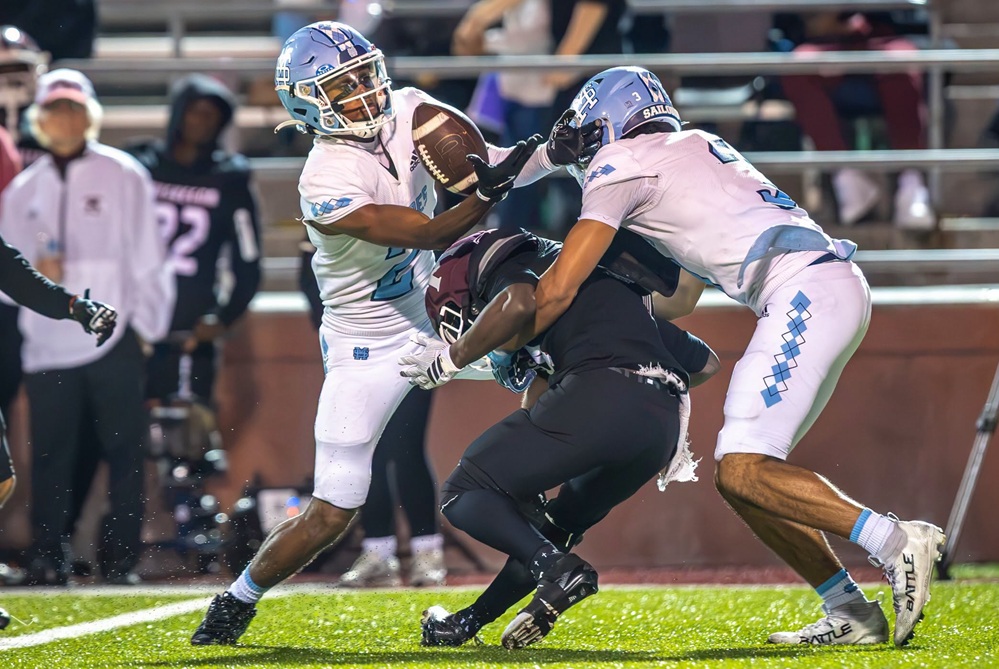
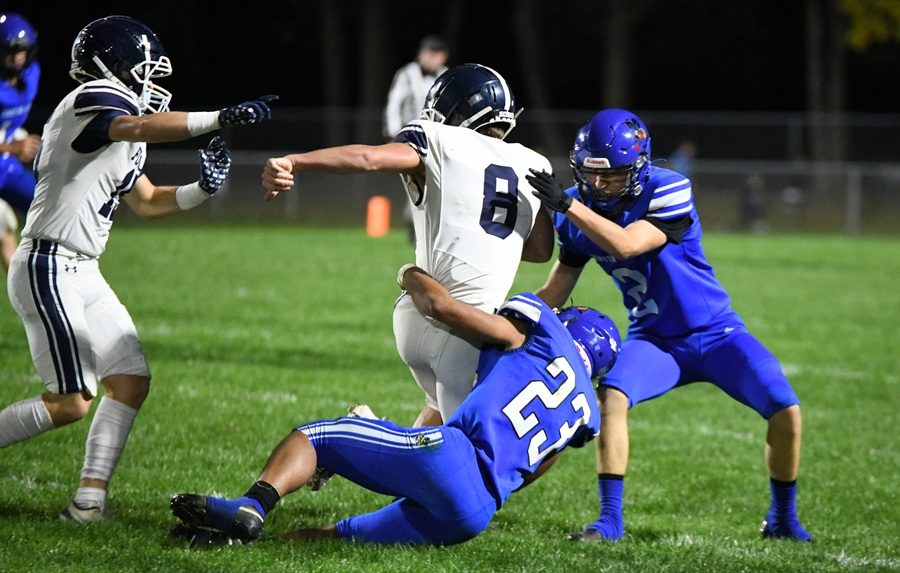
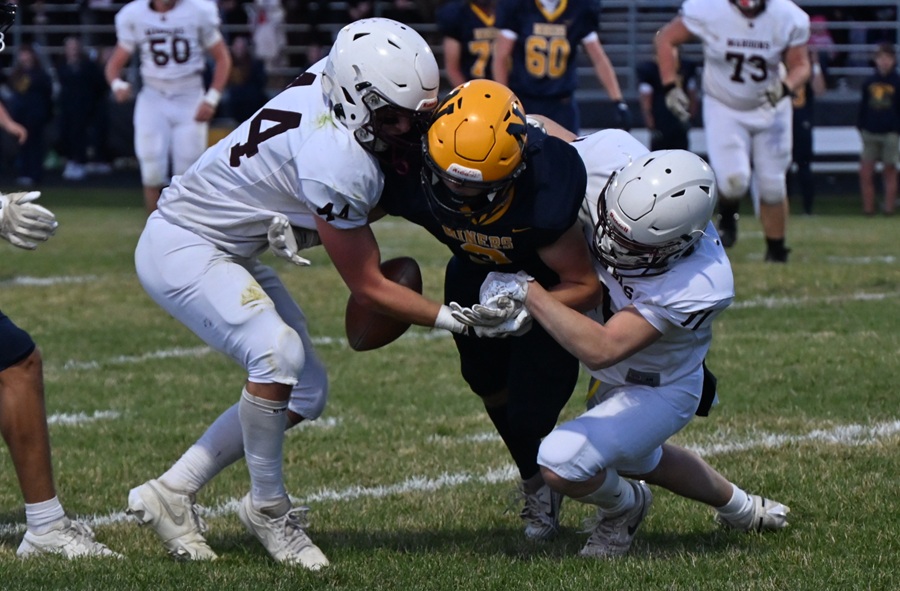
PHOTOS (Top) A pair of Muskegon Mona Shores players breaks up a play during their win against Muskegon. (Middle) Fowler’s Eli Thelen (8) is brought down by Bath’s Lorenzo Gonzalez (23) and Hunter Tolliver (2) during the Eagles’ 53-0 win. (Below) Menominee’s Kiefer Chouincard (11) gets a hand on the ball and dislodges it as he and Nathan Nelson (44) make a tackle against Negaunee. (Mona Shores/Muskegon photo by Tim Reilly. Fowler/Bath photo by John Johnson. Menominee/Negaunee photo by Cara Kamps.)