


Keep on Coaching
February 1, 2013
By Geoff Kimmerly
Second Half editor
A few weeks ago, I finally got my first chance this season to watch a friend coach his basketball team. After guiding some others at the lower levels, this is his first time running the varsity – something he wasn't sure he wanted to do with a 1-year-old just learning to walk, but a challenge he ended up taking on to the benefit of all those involved.
Simply put, he’s good. I've seen a lot of teams and a lot of coaches over the past 15 years, and although I wouldn't know much of what to do if I were walking the sideline, I felt pretty qualified in telling him I was impressed – even if he didn't buy that I was offering an unbiased opinion. The best news is he’s gone from not sure about this a few months ago to talking about next season.
We know, at least anecdotally, that coaching continues to get more challenging. The time commitment has grown substantially to make running a program a year-round endeavor in a lot of sports at a lot of schools.
That commitment – especially for coaches with children of their own – was a main reason referred to in a New Haven Post-Chronicle story Saturday that noted 23 football coaching openings in Connecticut at one point this offseason. That state has 146 football teams – meaning roughly 15 percent will have new leaders this fall.
And that got me thinking about my friend, about how glad I am he’s given this a shot, and how I've seen so many others either not do so, or not stick around long despite having some pretty nice success.
A study published last winter in Interscholastic Athletic Administration magazine – a product of the National Interscholastic Athletic Administrators Association – noted some predictable results of a study that sought to determine the biggest challenges faced by first-year high school coaches.
The toughest according to the study was balancing the demands of coaching and teaching, experienced by nearly half the respondents – 98 percent of which coached high school teams and 81 percent of which are teachers.
The next six reasons all were noted by at least 30 percent of those in the study – personal fatigue, securing community support, securing and caring for facilities and equipment, parental contact, keeping non-starting players motivated, dealing with schedule interruptions and motivating athletes to achieve consistent, peak performance.
Nothing there is earth-shaking, and most if not all of these challenges are faced by high school coaches regardless of how long they've been in the field. But I got a little more perspective from some of the 32 items that ranked as least challenging to the first-year leaders – keeping in compliance with state and league regulations, dealing with substance abuse issues, teaching sport skills and creating a positive team atmosphere – things that seem most important, and yet appear to be easiest to do. I’m not sure what that tells us – but I think it tells us something.
Click to check out the entire three-page breakdown of the study, plus the researchers’ recommendations to remedy some of what first-year coaches face.
Giving back to Saginaw
I love reading about high-level athletes – like a star-studded group of alums from Saginaw – giving back to where they got their starts.
Pittsburgh Steelers star LaMarr Woodley made a big impact before the start of this school year by donating $60,000 to cover all participation fees for athletes in his former school district. The Saginaw News’ Hugh Bernreuter writes today about how Woodley (Saginaw High), the Philadelphia 76ers’ Jason Richardson (Saginaw Arthur Hill) and former Oakland Raiders standout Stu Schweigert (Saginaw Heritage) have combined to give more than $865,000 back to their home communities.
Bernreuter also mentions the non-monetary contributions of the Golden State Warriors’ Draymond Green (Saginaw High) and former Indianapolis Colts receiver Blair White (Saginaw Nouvel).
Click to read more about it.
Quote(s) of the Week
While rifling through more papers on my desk, I found an article from the Washington Post from Sept. 2011 titled “How high school sports save our schools.” I was drawn to it in part because I spent more than a decade in a newsroom, and it was a piece by a reporter covering education who instead of reporting on school boards and the like, delved into the importance of interscholastic athletics to education as a whole.
He spoke of how participation continues to grow even as resources dwindle, and of data supporting that extracurriculars like sports are more effective than academic classes in teaching leadership, teamwork, time management and “other skills crucial for success in the workplace.” Later, he mentioned a study noting that those who participate in extracurriculars earned more a decade later.
Click here to read the entre piece. These passages struck me most.
“Coaches might be the only faculty members still allowed by our culture and educational practice to get tough with students not making the proper effort. They have the advantage of teaching what are essentially elective non-credit courses. They can insist on standards of behavior that classroom teachers often cannot enforce because the stakes of dismissing or letting students drop their courses are too high. …
“Students do better in activities they choose. If we provide more of them, led by committed adults … that can make a difference. We know the bad news about education. Dropout rates are high. Achievement scores are stagnant. But sports participation is going up, despite pressure to cut it back. Let’s cheer about that and look for a way to draw in more students.”
Century of School Sports: Good Sports Are Winners Then, Now & Always
By
Geoff Kimmerly
MHSAA.com senior editor
November 12, 2024
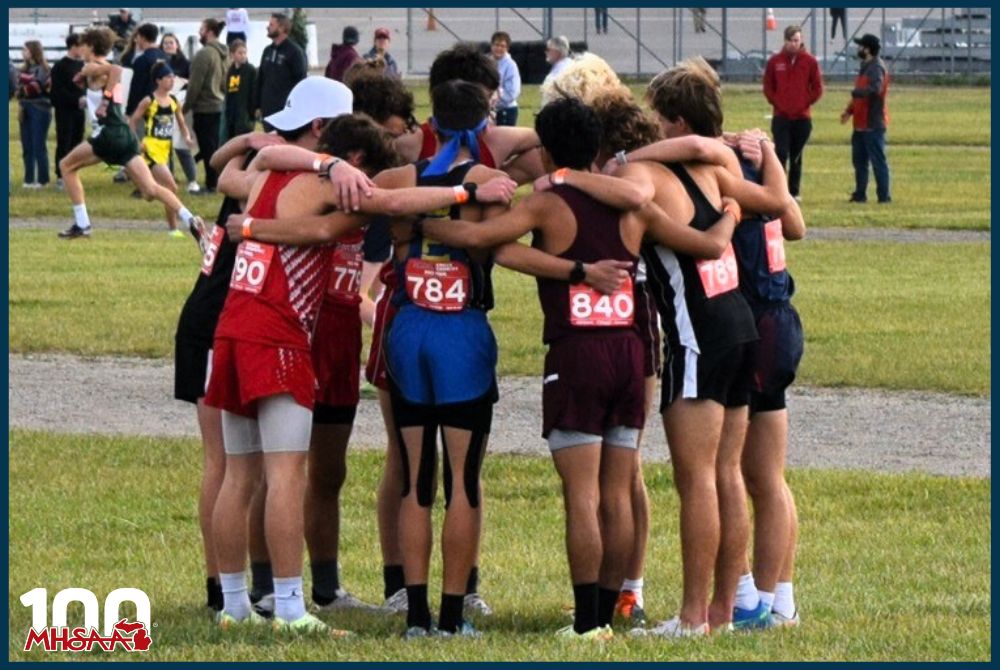
The above photo came to us two years ago this fall, from a now-retired athletic director, who was especially taken by these 10 runners from eight schools huddling together before their races during the 2022 Lower Peninsula Boys Cross Country Finals at Michigan International Speedway.
Representing Bloomingdale, Bridgman, Centreville, Coloma, Constantine, Parchment, Schoolcraft and Watervliet, these racers had competed against each other all season, and for some several seasons. But during these moments before what would be the most high-profile event of their athletic careers, they joined together for support, motivation and camaraderie.
Sportsmanship is one of the MHSAA’s core values – the “4 S’s” – of educational athletics. It has served as part of the bedrock of this organization from its beginning 100 years ago, and should remain so as long as school sports are considered a valued part of the educational experience.
Two weeks ago, we covered in this #MHSAA100 space the history of the MHSAA Sportsmanship Summit – first conducted in 1997 – and our latest statewide tour concludes Thursday in Grand Rapids. But those sessions welcoming student leaders every year are just one of many efforts the MHSAA has made to continue teaching sportsmanship through athletics over the last century.
An essay, “Athletics – Why and How” by Grand Rapids Union athletic director John Truesdale, was included with the November 1925 edition of the Bulletin of the Michigan High School Athletic Association and addresses how the creation of the MHSAA from its predecessor organization played a part in immediately improving sportsmanship in school sports during that first year:
“Because of (the creation and fulltime nature of the MHSAA), the standards of sportsmanship are more nearly approached. Bickerings have been reduced to a minimum. Better understanding exists between schools. The conducting of games has become the exhibition not only of skill, strength and wisdom, but of sportsmanship, obedience to accepted rules, and consideration of those who for the moment are in the position of enemies, although friendly.
“In fact, athletics in Michigan are in position now to accomplish the purpose for which they were designed – the building of character. … It is entirely reasonable that each, the player and spectator, emerges from a contest a better citizen because of his experiences.”
High Schools change over entire student bodies every four years. Freshman eventually become seniors, and when they leave take their parents and others who have spent a portion of time in the school sports space, to be replaced by the next classes of athletes and families playing, cheering and altogether carrying forward our time-cherished activities.
And as such, the lessons of sportsmanship are constantly in need of renewal.
After both arrived during the mid 1980s, retired MHSAA Executive Director John E. “Jack” Roberts and retired Communications Director John Johnson embarked on a mission to transform sportsmanship in Michigan school sports – and in doing so, made the MHSAA a national leader in that work, which continues today.
These MHSAA sportsmanship campaigns from the last 30 years should ring at least a few bells for those who have spent time around our games:
“Good Sports are Winners” – Beginning in 1989 and over the following two decades, the MHSAA (and with help from the Michigan Interscholastic Athletic Administrators Association and multiple sponsors) annually distributed 100+ page sportsmanship kits to member schools which included materials to assist in promoting good sportsmanship, including letters to be sent out to various stakeholders, public address announcements for events and other content for programs and publications.
An awards program celebrated teams best displaying these ideals from every season – Fall, Winter and Spring – with those winners receiving recognition across statewide media and MHSAA publications through the conclusion of this campaign during the 2010-11 school year.
“What Kids Wish Their Parents Knew About Sportsmanship” – This six-minute video produced for the start of the 1999-2000 school year featured students addressing adult behavior at their events. The video was designed to be shown as preseason meetings, booster clubs, school board meetings and similar athletic department or school gatherings.
“Battle of the Fans” Fast forward to 2012. The MHSAA’s Student Advisory Council, in an effort to affect sportsmanship especially among peers, created a statewide competition to promote positive cheering from the growing number of student sections across the state.
The “Battle of the Fans” continued for 10 years (skipping 2021 due to COVID-19 precautions) and annually recognized not only a champion but additional finalists with banners during the Basketball Finals at Breslin Center. The contest was almost entirely video and social media-driven, and during later years of the competition included multiple rounds that required sections to complete challenges to advance.
The BOTF program also was recognized nationally and copied by other states after seeing what Michigan’s student leaders were capable of influencing.
And that work continues.
The following was created this summer by the Student Advisory Council based on 10 pages of notes from their experiences at 2023 Sportsmanship Summits.
One of the most revealing truths in studying the 100-year history of the MHSAA is that many issues of the day then and now are remarkably similar. It’s not that there haven’t been improvements along the way. But rather, the process of educational athletics is ongoing as generations of students take their turns and continue on – and the work to keep sportsmanship at the heart of competition remains of great importance.
To that end, let’s allow Truesdale to close this latest history lesson.
“Let us then, in this year of 1925, demonstrate to the people as a whole that victory is not all we seek.
“Let each of us, whether superintendent, principal, coach, player or spectator, emphasize the point that to win is welcome, that to demonstrate superiority is one goal we are after. But let us not lose sight of the fact that the means employed are of great consequence, and that the results we seek are not championships alone but victory of the player and the team and the school over the temptations of unfair tactics.
“Championships will be forgotten but character is lasting.”
Previous "Century of School Sports" Spotlights
Nov. 5: MHSAA's Home Sweet Home - Read
Oct. 29: MHSAA Summits Draw Thousands to Promote Sportsmanship - Read
Oct. 23: Cross Country Finals Among MHSAA's Longest Running - Read
Oct. 15: State's Storytellers Share Fall Memories - Read
Oct. 8: Guided by 4 S's of Educational Athletics - Read
Oct. 1: Michigan Sends 10 to National Hall of Fame - Read
Sept. 25: MHSAA Record Books Filled with 1000s of Achievements - Read
Sept. 18: Why Does the MHSAA Have These Rules? - Read
Sept. 10: Special Medals, Patches to Commemorate Special Year - Read
Sept. 4: Fall to Finish with 50th Football Championships - Read
Aug. 28: Let the Celebration Begin - Read
PHOTO A group of Southwestern Athletic Conference runners huddle up before their races at the 2022 Lower Peninsula Boys Cross Country Finals at Michigan International Speedway, including Bloomingdale’s Jaden Barnes and Joe Stocchiero, Bridgman’s Andrew Mabry and John Sanderson, Centreville’s Logan Weis, Coloma’s Boden Genovese, Constantine’s Ethan Glick, Parchment’s William Winter, Schoolcraft’s Dante Pilot and Watervliet’s Daniel Mandujano. (Photo by Alan Bobalik/Bloomingdale cross country.)