


Keep on Coaching
February 1, 2013
By Geoff Kimmerly
Second Half editor
A few weeks ago, I finally got my first chance this season to watch a friend coach his basketball team. After guiding some others at the lower levels, this is his first time running the varsity – something he wasn't sure he wanted to do with a 1-year-old just learning to walk, but a challenge he ended up taking on to the benefit of all those involved.
Simply put, he’s good. I've seen a lot of teams and a lot of coaches over the past 15 years, and although I wouldn't know much of what to do if I were walking the sideline, I felt pretty qualified in telling him I was impressed – even if he didn't buy that I was offering an unbiased opinion. The best news is he’s gone from not sure about this a few months ago to talking about next season.
We know, at least anecdotally, that coaching continues to get more challenging. The time commitment has grown substantially to make running a program a year-round endeavor in a lot of sports at a lot of schools.
That commitment – especially for coaches with children of their own – was a main reason referred to in a New Haven Post-Chronicle story Saturday that noted 23 football coaching openings in Connecticut at one point this offseason. That state has 146 football teams – meaning roughly 15 percent will have new leaders this fall.
And that got me thinking about my friend, about how glad I am he’s given this a shot, and how I've seen so many others either not do so, or not stick around long despite having some pretty nice success.
A study published last winter in Interscholastic Athletic Administration magazine – a product of the National Interscholastic Athletic Administrators Association – noted some predictable results of a study that sought to determine the biggest challenges faced by first-year high school coaches.
The toughest according to the study was balancing the demands of coaching and teaching, experienced by nearly half the respondents – 98 percent of which coached high school teams and 81 percent of which are teachers.
The next six reasons all were noted by at least 30 percent of those in the study – personal fatigue, securing community support, securing and caring for facilities and equipment, parental contact, keeping non-starting players motivated, dealing with schedule interruptions and motivating athletes to achieve consistent, peak performance.
Nothing there is earth-shaking, and most if not all of these challenges are faced by high school coaches regardless of how long they've been in the field. But I got a little more perspective from some of the 32 items that ranked as least challenging to the first-year leaders – keeping in compliance with state and league regulations, dealing with substance abuse issues, teaching sport skills and creating a positive team atmosphere – things that seem most important, and yet appear to be easiest to do. I’m not sure what that tells us – but I think it tells us something.
Click to check out the entire three-page breakdown of the study, plus the researchers’ recommendations to remedy some of what first-year coaches face.
Giving back to Saginaw
I love reading about high-level athletes – like a star-studded group of alums from Saginaw – giving back to where they got their starts.
Pittsburgh Steelers star LaMarr Woodley made a big impact before the start of this school year by donating $60,000 to cover all participation fees for athletes in his former school district. The Saginaw News’ Hugh Bernreuter writes today about how Woodley (Saginaw High), the Philadelphia 76ers’ Jason Richardson (Saginaw Arthur Hill) and former Oakland Raiders standout Stu Schweigert (Saginaw Heritage) have combined to give more than $865,000 back to their home communities.
Bernreuter also mentions the non-monetary contributions of the Golden State Warriors’ Draymond Green (Saginaw High) and former Indianapolis Colts receiver Blair White (Saginaw Nouvel).
Click to read more about it.
Quote(s) of the Week
While rifling through more papers on my desk, I found an article from the Washington Post from Sept. 2011 titled “How high school sports save our schools.” I was drawn to it in part because I spent more than a decade in a newsroom, and it was a piece by a reporter covering education who instead of reporting on school boards and the like, delved into the importance of interscholastic athletics to education as a whole.
He spoke of how participation continues to grow even as resources dwindle, and of data supporting that extracurriculars like sports are more effective than academic classes in teaching leadership, teamwork, time management and “other skills crucial for success in the workplace.” Later, he mentioned a study noting that those who participate in extracurriculars earned more a decade later.
Click here to read the entre piece. These passages struck me most.
“Coaches might be the only faculty members still allowed by our culture and educational practice to get tough with students not making the proper effort. They have the advantage of teaching what are essentially elective non-credit courses. They can insist on standards of behavior that classroom teachers often cannot enforce because the stakes of dismissing or letting students drop their courses are too high. …
“Students do better in activities they choose. If we provide more of them, led by committed adults … that can make a difference. We know the bad news about education. Dropout rates are high. Achievement scores are stagnant. But sports participation is going up, despite pressure to cut it back. Let’s cheer about that and look for a way to draw in more students.”
FHN Earns 3rd Finals Championship in 4 Seasons, Dow's King Crowned Again
By
Scott Hassinger
Special for MHSAA.com
October 19, 2024
KALAMAZOO – Another Lower Peninsula Division 2 boys tennis championship trophy will be added to the showcase at Grand Rapids Forest Hills Northern.
After finishing as Finals runners-up two of the last three seasons, Steve Olson's Huskies totaled 26 points to win Saturday at Kalamazoo College’s Stowe Stadium.
Forest Hills Northern narrowly edged co-runners-up Midland Dow and Birmingham Seaholm, which tied at 24 points followed by Byron Center and Grand Rapids Forest Hills Central in fourth place with 21 and Mattawan sixth with 12 points.
Olson, who took over last year as head coach replacing the legendary Dave Sukup, guided Forest Hills Northern to its first Finals title since 2020. The Huskies had finished runners-up in 2021 and 2022.
"Tennis is a big sport at our school. We put a lot of time into this sport ,and we take it very seriously,” Olson said. “Our goal every season is to win a state championship, but there are a lot of great teams out there that make that a tough thing to do. We knew the tournament was going to be a close one.”
Olson pointed to the success of the Huskies' doubles flights as critical. All four of made the semifinal round.
 "Our success in doubles was huge. Our No. 4 doubles team of Markus Bernard and Will Hernly were unseeded and played above that. I'm very proud of how they stepped up for us," Olson said.
Junior Sebastian Madlangbayan was the only Forest Hills Northern player to win his respective flight. Madlangbayan captured the crown at No. 2 singles with a 7-6 (7-1), 6-4 win over Dylan Hodgman from Mattawan.
"There were a lot of ups and downs. I was just focused on opening up the angles on the court against him (Hodgman),” Madlangbayan said. “I can control court position with my forehand and give myself the chance to volley at the net."
Olson praised Madlangbayan's performance.
"Sebastian came in as the top seed, and he had some tight moments but he really dominated this tournament. But the reality is that our whole team contributed. To have six flights reach the semifinals, get those first-round byes and win a lot of early-round matches were also big for us," Olsen said. "We are senior and freshman heavy, but we have a good nucleus returning to build upon in the future."
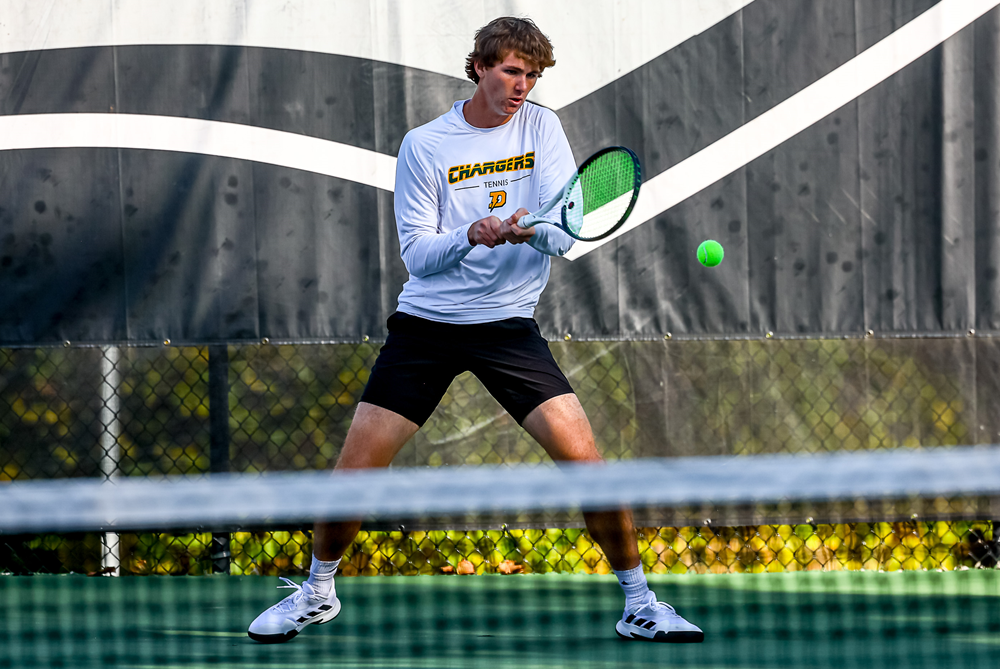
Midland Dow senior Austin King completed his season unbeaten at 38-0 after earning the No. 1 singles crown with his 6-4, 7-5 win over Portage Central sophomore Sam Schumacher. King breezed through his morning semifinal with a 6-1, 6-0 victory over Nolan Ackerman of Mattawan.
"I had already played (Schumacher) a couple times this year, so I knew he'd be one of my tougher opponents. I made sure I got a good warmup in before I got out there, but it turned out to be quite a battle. My ability to not give up was key. I was down twice today, once in each set, so I knew I could do this, especially after winning the title last year," said King, who despite receiving Division I full-ride scholarship offers from several schools, including Villanova, has decided to forgo playing at the next level to concentrate on his pre-medical studies at Michigan or Michigan State.
Schumacher complimented King on his performance.
"It just means a great deal to me to be able to share the court with a player like Austin. I have to give him a ton of credit. I really hung in there and played my best match of the season," Schumacher said.
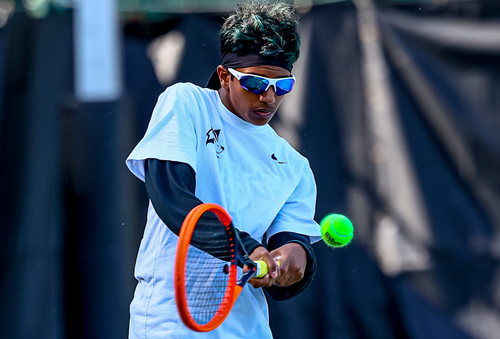
North Farmington senior Jack Weingarden came into the tournament unseeded, but won the No. 3 singles flight on a 5-3 injury default by Mattawan's Connor Schultz in the first set. Weingarden had defeated Forest Hills northern freshman Vikram Krishnan in the semifinals 6-4, 6-3.
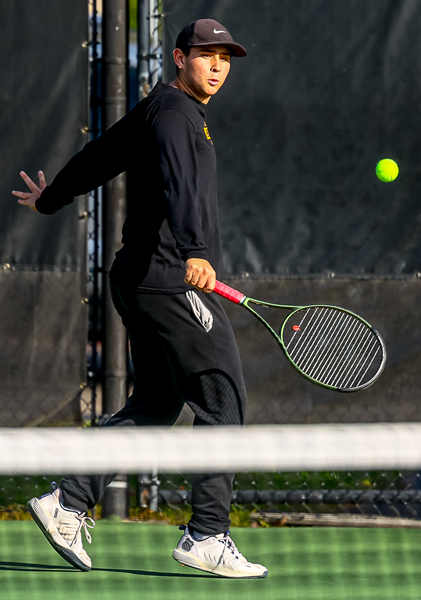 "My consistency helped me get through the semifinals and finals. I was definitely playing my best tennis of the season this weekend," Weingarden said.
Seaholm fourth seed Alex Ting topped Dow's Siddarth Venkatesan 6-2, 6-3 to win at No. 4 singles.
"My semifinals match went almost three hours. I started cramping up in both my legs, but I persevered through it. My team and family supported me through the whole day, and that really helps my mindset," Ting said.
Forest Hills Central's Willem Knoester and his partner Austin Rowland knocked off Forest Hills Northern's tandem of Tanav Shenov and Matthew Chan in the No. 1 doubles finale 7-5, 3-6, 6-3. At No. 2 doubles, FHC's Hayden Tanner and Joseph Song defeated Byron Center's duo of Rylan Vandenberger and Casey Schans 6-1, 7-6 (9-7).
Seaholm's No. 3 tandem of Britton Leo and Aaryan Senthilvanan disposed of FHC’s No. 3 tandem of James Notarnicola and Sawyer Jordan in the finals 3-6, 7-5, 6-2. The No. 4 doubles crown was also claimed by Seaholm's tandem of Connor Champion and Andrew Wachowicz with a 7-5, 6-2 win over Forest Hills Northern's Benard and Hernly.
PHOTOS (Top) Midland Dow's Austin King hits a backhand during an early No. 1 singles match Friday at Kalamazoo College. (Middle) Forest Hills Northern's Vikram Krishnan sends a forehand at No. 3 singles. (Below) North Farmington's Jack Weingarden volleys during his first match at No. 3 singles. (Click for more from High School Sports Scene.)