


Keep on Coaching
February 1, 2013
By Geoff Kimmerly
Second Half editor
A few weeks ago, I finally got my first chance this season to watch a friend coach his basketball team. After guiding some others at the lower levels, this is his first time running the varsity – something he wasn't sure he wanted to do with a 1-year-old just learning to walk, but a challenge he ended up taking on to the benefit of all those involved.
Simply put, he’s good. I've seen a lot of teams and a lot of coaches over the past 15 years, and although I wouldn't know much of what to do if I were walking the sideline, I felt pretty qualified in telling him I was impressed – even if he didn't buy that I was offering an unbiased opinion. The best news is he’s gone from not sure about this a few months ago to talking about next season.
We know, at least anecdotally, that coaching continues to get more challenging. The time commitment has grown substantially to make running a program a year-round endeavor in a lot of sports at a lot of schools.
That commitment – especially for coaches with children of their own – was a main reason referred to in a New Haven Post-Chronicle story Saturday that noted 23 football coaching openings in Connecticut at one point this offseason. That state has 146 football teams – meaning roughly 15 percent will have new leaders this fall.
And that got me thinking about my friend, about how glad I am he’s given this a shot, and how I've seen so many others either not do so, or not stick around long despite having some pretty nice success.
A study published last winter in Interscholastic Athletic Administration magazine – a product of the National Interscholastic Athletic Administrators Association – noted some predictable results of a study that sought to determine the biggest challenges faced by first-year high school coaches.
The toughest according to the study was balancing the demands of coaching and teaching, experienced by nearly half the respondents – 98 percent of which coached high school teams and 81 percent of which are teachers.
The next six reasons all were noted by at least 30 percent of those in the study – personal fatigue, securing community support, securing and caring for facilities and equipment, parental contact, keeping non-starting players motivated, dealing with schedule interruptions and motivating athletes to achieve consistent, peak performance.
Nothing there is earth-shaking, and most if not all of these challenges are faced by high school coaches regardless of how long they've been in the field. But I got a little more perspective from some of the 32 items that ranked as least challenging to the first-year leaders – keeping in compliance with state and league regulations, dealing with substance abuse issues, teaching sport skills and creating a positive team atmosphere – things that seem most important, and yet appear to be easiest to do. I’m not sure what that tells us – but I think it tells us something.
Click to check out the entire three-page breakdown of the study, plus the researchers’ recommendations to remedy some of what first-year coaches face.
Giving back to Saginaw
I love reading about high-level athletes – like a star-studded group of alums from Saginaw – giving back to where they got their starts.
Pittsburgh Steelers star LaMarr Woodley made a big impact before the start of this school year by donating $60,000 to cover all participation fees for athletes in his former school district. The Saginaw News’ Hugh Bernreuter writes today about how Woodley (Saginaw High), the Philadelphia 76ers’ Jason Richardson (Saginaw Arthur Hill) and former Oakland Raiders standout Stu Schweigert (Saginaw Heritage) have combined to give more than $865,000 back to their home communities.
Bernreuter also mentions the non-monetary contributions of the Golden State Warriors’ Draymond Green (Saginaw High) and former Indianapolis Colts receiver Blair White (Saginaw Nouvel).
Click to read more about it.
Quote(s) of the Week
While rifling through more papers on my desk, I found an article from the Washington Post from Sept. 2011 titled “How high school sports save our schools.” I was drawn to it in part because I spent more than a decade in a newsroom, and it was a piece by a reporter covering education who instead of reporting on school boards and the like, delved into the importance of interscholastic athletics to education as a whole.
He spoke of how participation continues to grow even as resources dwindle, and of data supporting that extracurriculars like sports are more effective than academic classes in teaching leadership, teamwork, time management and “other skills crucial for success in the workplace.” Later, he mentioned a study noting that those who participate in extracurriculars earned more a decade later.
Click here to read the entre piece. These passages struck me most.
“Coaches might be the only faculty members still allowed by our culture and educational practice to get tough with students not making the proper effort. They have the advantage of teaching what are essentially elective non-credit courses. They can insist on standards of behavior that classroom teachers often cannot enforce because the stakes of dismissing or letting students drop their courses are too high. …
“Students do better in activities they choose. If we provide more of them, led by committed adults … that can make a difference. We know the bad news about education. Dropout rates are high. Achievement scores are stagnant. But sports participation is going up, despite pressure to cut it back. Let’s cheer about that and look for a way to draw in more students.”
Edwardsburg 'Family' Dreaming Big Again Building On History-Making Run
By
Scott Hassinger
Special for MHSAA.com
September 9, 2026
EDWARDSBURG – “Family” was Edwardsburg boys soccer's mantra last fall as the Eddies enjoyed a historic season.
 Sean Jesse's team compiled the best record in school history at 17-2-1, while claiming an outright Wolverine Conference championship and raising a Division 2 District trophy before losing 4-1 in a Regional championship match to Hudsonville Unity Christian, the eventual Finals runner-up.
Even though a few key pieces are now gone who made last year's success possible, the bar still remains high at Edwardsburg.
Jesse's involvement with school’s soccer program goes back a long time. This autumn he’s begun his 15th year leading the boys and will serve his 16th campaign next spring as varsity girls coach.
The boys team has picked right back up where it left off last season with a 5-1-0 record so far this fall. Senior Brayden Fischer returns as the top scorer after totaling 22 goals and four assists last season.
"We lost some great players from last season, but we have lots of returners who can step up and fill those vacant positions and really help the team out," said Fischer, who has played soccer for 14 years and hopes to play baseball and study engineering at the college level. "Our goals this season are to become even closer as a team and to play better than we did the day before. Of course, we'd like to make it further than last year. Right now, we're just focused on growing as a group. I feel like my vision and physicality make me strong at the striker position. You have to be strong and be able to hold the team up. Last year's experience brought more of a family culture in soccer here."
Building a strong soccer culture hasn't happened overnight at Edwardsburg. It's been many years in the process.
"We've been kind of building towards this kind of family culture and atmosphere here at Edwardsburg for a while now. It's the result of having guys who are willing to put in a great deal of time outside of the regular season to become better players," Jesse said.
 When he arrived at Edwardsburg, the program had at most five players who played club soccer during the offseason. Now he has 15 who are involved in the sport year-round.
"That makes a huge difference. When you have the fundamentals down, we can work more on the strategy of the game during the high school season," Jesse said.
Edwardsburg graduated a few key seniors in the spring, including star center back Austin Leak, but a majority of the roster a year ago was comprised of younger talent. Eight of the Eddies' 11 starters are back this fall.
"If we can replace Austin, we feel we could be every bit as dangerous as we were last year or even better," Jesse said.
Sophomore Conner Fischer, Brayden's younger brother, has stepped up big so far to fill that spot. The Eddies also lost standout wings from last year in Maverick Gates (10 goals) and Logan Stubblefield, but Jesse has found capable replacements.
"Maverick and Logan were our captains and great leaders for us. They were kids who could just go continually," Jesse said.
Staying humble will be a key ingredient this season.
"This group knows they are a good team. Right now, we are trying to find that balance between confidence and arrogance. I don't like to lose, but the early loss to St. Joseph might've been a good thing to happen to us this early," Jesse said. "It gives us motivation to keep working hard and get better."
With another year of experience under his players' belts, Jesse expects the Eddies to have a much stronger attack on the offensive end of the field. "We actually struggled to score at times last year. Brayden was our only player who was able to finish consistently," Jesse said.
Junior wing/forward Collin Tefft returns to the Eddies' 30-man roster after playing club soccer last fall.
"Collin is that dynamic and dangerous that every team we face is going to be afraid of him. Finding his way in our system is going to take a few games, but he'll get there," Jesse said.
Tefft has played soccer for 13 years, starting at age 3.
"Our guys want to pick up the intensity and work on getting better and not look back on any losses and learn from them. Our goal is to push forward and be better soccer players every day," said Tefft. "We have good chemistry and are always picking one another up. Those are big positives."
Senior Landon Goetz returns at holding midfielder and likes being able to control the tempo of the game and getting the ball to the playmakers up top. "Landon is our vocal leader. When he's on the pitch, we are a very stable group," Jesse said.
"I was an outside back for quite a few years. Once I got to high school, Coach Jesse converted me to my current position,” said Goetz, who plans to attend Michigan State University next year and study finance or marketing. “Two years ago as a freshman, I feel our team was a bit cocky. I think last year's success brought more of a humble atmosphere. That really helped push us to that District championship and to the Regional Finals.
 "We're trying to remain close like a family again this season, but I think we're also more of a technical team ability-wise this time. That could help us go even further in this year's tournament. It's so early in the season. We have to just push one another each day in practice and build that connection. We're still trying to find that rhythm."
Returning for his third season as Edwardsburg's starting goalkeeper is junior Law Gates. He finished his sophomore season in goal with a 0.65 goals-against average and has made several saves already this fall, Jesse said.
Junior Aleck Rodriguez is a standout attacking midfielder and had four goals and 12 assists for the Eddies as a sophomore. "When Aleck is playing well, our whole team is doing well. A great deal of our attack goes through him," Jesse said.
Big contributions are also expected from senior outside back Chance Jacobs and junior Riley Szalai, who contributed six assists as a sophomore. "Chance is probably the most reliable player I've ever had here. He can play anywhere on the field and just doesn't make mistakes," Jesse said.
Jesse – previously a prep standout at Buchanan and a math instructor at Edwardsburg – understands how difficult it will be to duplicate the accomplishments of last year's squad. His team is the favorite on paper to win the Wolverine Conference, and Jesse expects the Eddies to battle St. Joseph for a District crown as well.
"It's always so tough because soccer is about different matchups. You might honestly be the better team in the state, and you come up against someone else who just matches up better against you,” he said. “Our goal is to win a state title, and I think we're good enough to do that. Obviously, things are going to have to fall into the right pattern for that to happen."
"Our Regional is a bit more manageable this year with some of the powers on the other side of the bracket. This is our year to attain some of these goals, but we will need a lot to fall in our favor too.”
 Scott Hassinger is a contributing sportswriter for Leader Publications and previously served as the sports editor for the Three Rivers Commercial-News from 1994-2022. He can be reached at [email protected] with story ideas for Berrien, Cass, St. Joseph and Branch counties.
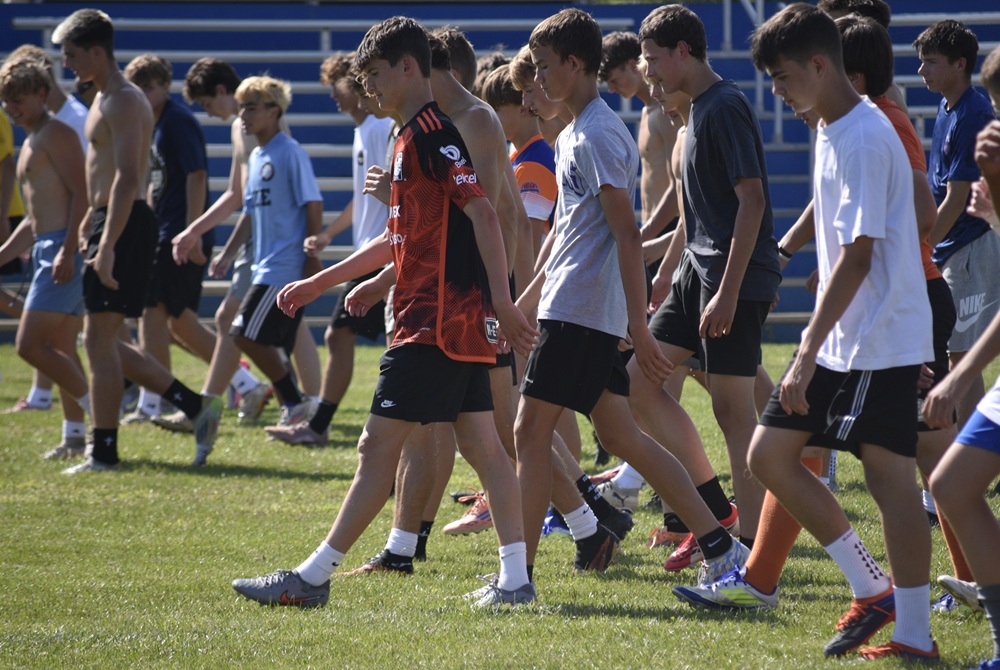
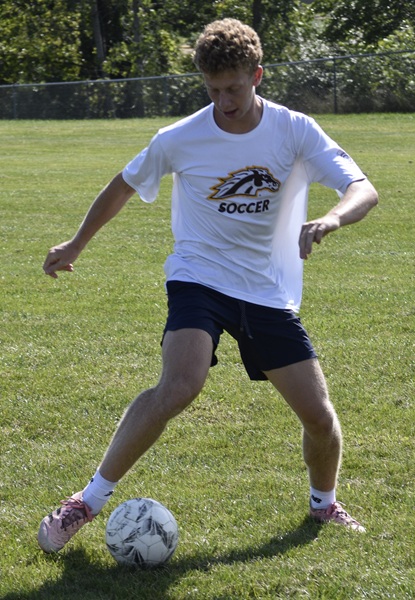
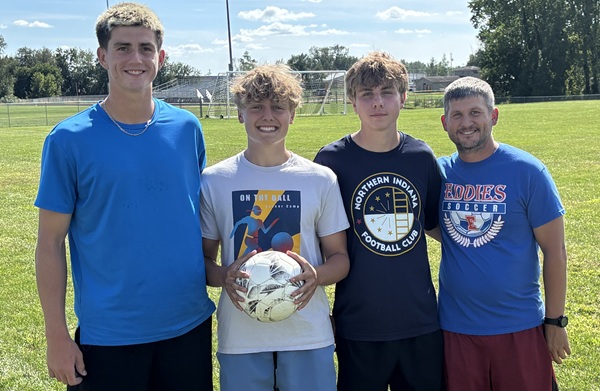
PHOTOS (Top) Edwardsburg soccer players warm up during a yoga and calisthenics session. (Middle) Senior Law Gates works on his ball control during a recent practice. (Below) Eddies boys soccer coach Sean Jesse, far right, poses for a photo with key returnees, from far left, Brayden Fischer, Landon Goetz and Collin Tefft. (Photos by Scott Hassinger.)