


Keep on Coaching
February 1, 2013
By Geoff Kimmerly
Second Half editor
A few weeks ago, I finally got my first chance this season to watch a friend coach his basketball team. After guiding some others at the lower levels, this is his first time running the varsity – something he wasn't sure he wanted to do with a 1-year-old just learning to walk, but a challenge he ended up taking on to the benefit of all those involved.
Simply put, he’s good. I've seen a lot of teams and a lot of coaches over the past 15 years, and although I wouldn't know much of what to do if I were walking the sideline, I felt pretty qualified in telling him I was impressed – even if he didn't buy that I was offering an unbiased opinion. The best news is he’s gone from not sure about this a few months ago to talking about next season.
We know, at least anecdotally, that coaching continues to get more challenging. The time commitment has grown substantially to make running a program a year-round endeavor in a lot of sports at a lot of schools.
That commitment – especially for coaches with children of their own – was a main reason referred to in a New Haven Post-Chronicle story Saturday that noted 23 football coaching openings in Connecticut at one point this offseason. That state has 146 football teams – meaning roughly 15 percent will have new leaders this fall.
And that got me thinking about my friend, about how glad I am he’s given this a shot, and how I've seen so many others either not do so, or not stick around long despite having some pretty nice success.
A study published last winter in Interscholastic Athletic Administration magazine – a product of the National Interscholastic Athletic Administrators Association – noted some predictable results of a study that sought to determine the biggest challenges faced by first-year high school coaches.
The toughest according to the study was balancing the demands of coaching and teaching, experienced by nearly half the respondents – 98 percent of which coached high school teams and 81 percent of which are teachers.
The next six reasons all were noted by at least 30 percent of those in the study – personal fatigue, securing community support, securing and caring for facilities and equipment, parental contact, keeping non-starting players motivated, dealing with schedule interruptions and motivating athletes to achieve consistent, peak performance.
Nothing there is earth-shaking, and most if not all of these challenges are faced by high school coaches regardless of how long they've been in the field. But I got a little more perspective from some of the 32 items that ranked as least challenging to the first-year leaders – keeping in compliance with state and league regulations, dealing with substance abuse issues, teaching sport skills and creating a positive team atmosphere – things that seem most important, and yet appear to be easiest to do. I’m not sure what that tells us – but I think it tells us something.
Click to check out the entire three-page breakdown of the study, plus the researchers’ recommendations to remedy some of what first-year coaches face.
Giving back to Saginaw
I love reading about high-level athletes – like a star-studded group of alums from Saginaw – giving back to where they got their starts.
Pittsburgh Steelers star LaMarr Woodley made a big impact before the start of this school year by donating $60,000 to cover all participation fees for athletes in his former school district. The Saginaw News’ Hugh Bernreuter writes today about how Woodley (Saginaw High), the Philadelphia 76ers’ Jason Richardson (Saginaw Arthur Hill) and former Oakland Raiders standout Stu Schweigert (Saginaw Heritage) have combined to give more than $865,000 back to their home communities.
Bernreuter also mentions the non-monetary contributions of the Golden State Warriors’ Draymond Green (Saginaw High) and former Indianapolis Colts receiver Blair White (Saginaw Nouvel).
Click to read more about it.
Quote(s) of the Week
While rifling through more papers on my desk, I found an article from the Washington Post from Sept. 2011 titled “How high school sports save our schools.” I was drawn to it in part because I spent more than a decade in a newsroom, and it was a piece by a reporter covering education who instead of reporting on school boards and the like, delved into the importance of interscholastic athletics to education as a whole.
He spoke of how participation continues to grow even as resources dwindle, and of data supporting that extracurriculars like sports are more effective than academic classes in teaching leadership, teamwork, time management and “other skills crucial for success in the workplace.” Later, he mentioned a study noting that those who participate in extracurriculars earned more a decade later.
Click here to read the entre piece. These passages struck me most.
“Coaches might be the only faculty members still allowed by our culture and educational practice to get tough with students not making the proper effort. They have the advantage of teaching what are essentially elective non-credit courses. They can insist on standards of behavior that classroom teachers often cannot enforce because the stakes of dismissing or letting students drop their courses are too high. …
“Students do better in activities they choose. If we provide more of them, led by committed adults … that can make a difference. We know the bad news about education. Dropout rates are high. Achievement scores are stagnant. But sports participation is going up, despite pressure to cut it back. Let’s cheer about that and look for a way to draw in more students.”
MHSAA Vault: MIS Rose to Challenges to Host 2020 LP Finals
By
Rob Kaminski
MHSAA benchmarks editor
November 12, 2021
The “MHSAA Vault” features stories from past publications and other documents in the MHSAA Library. This issue takes a look at the MHSAA Cross Country Finals at Michigan International Speedway, which celebrated 25 years in 2020 – although it was an event that nearly didn’t happen last fall …
In 1996, the MHSAA and Michigan International Speedway began a partnership the changed the course of the Lower Peninsula Cross Country Finals – quite literally.
The land in and around the track at Brooklyn would host the Finals for all classes of runners in one place on one day, an annual festival of nearly 2,000 runners competing for the MHSAA’s top honors.
Even skeptics – and there were several among running purists who thought the course was too flat, for example – can’t deny the results.
Finals attendance nearly doubled in that first year, and crowds in excess of 10,000 have enjoyed a day of racing several times, including a record 12,153 in 2011.
Enthusiastic crowds were the norm in recent years, with 11,232 in 2017, and nearly 11,000 in 2018 (10,989) and 2019 (10,873).
In fact, attendance failed to reach at least 8,000 only twice since the move to MIS.
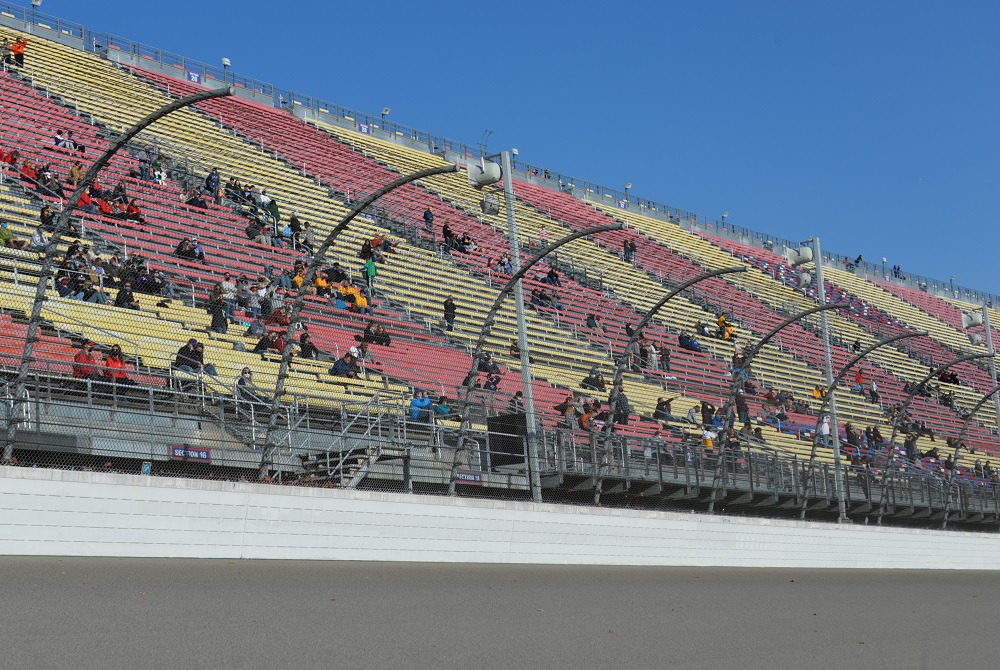
Of course, last year was an exception, when attendance was limited to 1,000 spectators per session due to the COVID-19 Pandemic. Fans also were restricted to the grandstands rather than following the action throughout locations on the course.
To reduce the number of runners in each race, the event was spread over two days, with each Division being run in two separate “sections” with times then combined at the end to determine team and individual champions.
While not ideal, the end result was another year of fantastic efforts at MIS – both from student-athletes and those behind the scenes.
“Even at the last hour, less than a week ahead of the Finals, we were closer to not having the Finals than we were to having them,” said MHSAA Assistant Director Cody Inglis, who coordinates the cross country postseason. “Rumors and challenges of mandated shutdowns, testing and other requirements were being discussed and caused a lot of unknowns. Even at the Regional level, we had schools, Regional courses and hosts shutting down their facilities; we had to relocate four Regionals 48 hours prior to race times. That scenario just could not happen at the Finals level where far more runners and much more travel would be involved.”
Among the many last-minute hurdles was the edict from NASCAR – which owns MIS – that all persons on site be temperature checked upon entry. That meant securing thermometers that were easy to operate in short order, along with personnel necessary to conduct the readings.
The attendance limitations certainly helped to implement the temperature screening, but brought their own issues.
“Limiting spectators was not a popular decision, but it really was the only way to have a race,” Inglis said. “We were taking direction and working with policies and protocols from the MDHHS, the Governor’s office, Lenawee County Health Department, MIS and NASCAR.”
Part of the solution was to utilize the grandstands as a “barrier” between participants and spectators. The reduced number of fans were dispersed over thousands of seats while still allowing them the chance to watch their student-athletes compete.
“It wasn’t the same, it wasn’t easy or perfect, but it was what we had to do to have a race,” Inglis said. “Separating the Finals into two days and different sections also allowed us to spread out the event and limit the number of people on site at any one time. This was a key part of the plan and worked well even though it separated races within a Division.”
The MHSAA, MIS and the cross country community never lost focus of the main goal: a culmination of the season for the student-athletes, who deserved something last year more than ever. And, more than ever, MIS once again displayed its advantage as a venue that could adapt to the fluid nature of the times to pull off the event.
“There were some thoughts of using four different sites, but as we learned during the Regionals, the climate of things was so tenuous from one area of the state to another that we couldn’t be 100-percent certain that there wouldn’t again be last-minute cancelations,” Inglis said. “MIS was wonderful to work and collaborate with, and was the best option to get it done. It was never mentioned once publicly about the possibility of not having the Finals – only how we could best do it under uncharted conditions.”
The moving parts and ever-changing scenarios created more complexity than ever in finalizing a season, but every decision was made with the complete desire to conduct the Finals as close to normal as possible.
“I firmly believe that a finish to the season, no matter the differences in race formatting and fan experience, was something everyone would have taken when the season began in August,” Inglis said.
Indeed, the finish line in Year 25 at MIS might have been the most gratifying of them all.