


Keep on Coaching
February 1, 2013
By Geoff Kimmerly
Second Half editor
A few weeks ago, I finally got my first chance this season to watch a friend coach his basketball team. After guiding some others at the lower levels, this is his first time running the varsity – something he wasn't sure he wanted to do with a 1-year-old just learning to walk, but a challenge he ended up taking on to the benefit of all those involved.
Simply put, he’s good. I've seen a lot of teams and a lot of coaches over the past 15 years, and although I wouldn't know much of what to do if I were walking the sideline, I felt pretty qualified in telling him I was impressed – even if he didn't buy that I was offering an unbiased opinion. The best news is he’s gone from not sure about this a few months ago to talking about next season.
We know, at least anecdotally, that coaching continues to get more challenging. The time commitment has grown substantially to make running a program a year-round endeavor in a lot of sports at a lot of schools.
That commitment – especially for coaches with children of their own – was a main reason referred to in a New Haven Post-Chronicle story Saturday that noted 23 football coaching openings in Connecticut at one point this offseason. That state has 146 football teams – meaning roughly 15 percent will have new leaders this fall.
And that got me thinking about my friend, about how glad I am he’s given this a shot, and how I've seen so many others either not do so, or not stick around long despite having some pretty nice success.
A study published last winter in Interscholastic Athletic Administration magazine – a product of the National Interscholastic Athletic Administrators Association – noted some predictable results of a study that sought to determine the biggest challenges faced by first-year high school coaches.
The toughest according to the study was balancing the demands of coaching and teaching, experienced by nearly half the respondents – 98 percent of which coached high school teams and 81 percent of which are teachers.
The next six reasons all were noted by at least 30 percent of those in the study – personal fatigue, securing community support, securing and caring for facilities and equipment, parental contact, keeping non-starting players motivated, dealing with schedule interruptions and motivating athletes to achieve consistent, peak performance.
Nothing there is earth-shaking, and most if not all of these challenges are faced by high school coaches regardless of how long they've been in the field. But I got a little more perspective from some of the 32 items that ranked as least challenging to the first-year leaders – keeping in compliance with state and league regulations, dealing with substance abuse issues, teaching sport skills and creating a positive team atmosphere – things that seem most important, and yet appear to be easiest to do. I’m not sure what that tells us – but I think it tells us something.
Click to check out the entire three-page breakdown of the study, plus the researchers’ recommendations to remedy some of what first-year coaches face.
Giving back to Saginaw
I love reading about high-level athletes – like a star-studded group of alums from Saginaw – giving back to where they got their starts.
Pittsburgh Steelers star LaMarr Woodley made a big impact before the start of this school year by donating $60,000 to cover all participation fees for athletes in his former school district. The Saginaw News’ Hugh Bernreuter writes today about how Woodley (Saginaw High), the Philadelphia 76ers’ Jason Richardson (Saginaw Arthur Hill) and former Oakland Raiders standout Stu Schweigert (Saginaw Heritage) have combined to give more than $865,000 back to their home communities.
Bernreuter also mentions the non-monetary contributions of the Golden State Warriors’ Draymond Green (Saginaw High) and former Indianapolis Colts receiver Blair White (Saginaw Nouvel).
Click to read more about it.
Quote(s) of the Week
While rifling through more papers on my desk, I found an article from the Washington Post from Sept. 2011 titled “How high school sports save our schools.” I was drawn to it in part because I spent more than a decade in a newsroom, and it was a piece by a reporter covering education who instead of reporting on school boards and the like, delved into the importance of interscholastic athletics to education as a whole.
He spoke of how participation continues to grow even as resources dwindle, and of data supporting that extracurriculars like sports are more effective than academic classes in teaching leadership, teamwork, time management and “other skills crucial for success in the workplace.” Later, he mentioned a study noting that those who participate in extracurriculars earned more a decade later.
Click here to read the entre piece. These passages struck me most.
“Coaches might be the only faculty members still allowed by our culture and educational practice to get tough with students not making the proper effort. They have the advantage of teaching what are essentially elective non-credit courses. They can insist on standards of behavior that classroom teachers often cannot enforce because the stakes of dismissing or letting students drop their courses are too high. …
“Students do better in activities they choose. If we provide more of them, led by committed adults … that can make a difference. We know the bad news about education. Dropout rates are high. Achievement scores are stagnant. But sports participation is going up, despite pressure to cut it back. Let’s cheer about that and look for a way to draw in more students.”
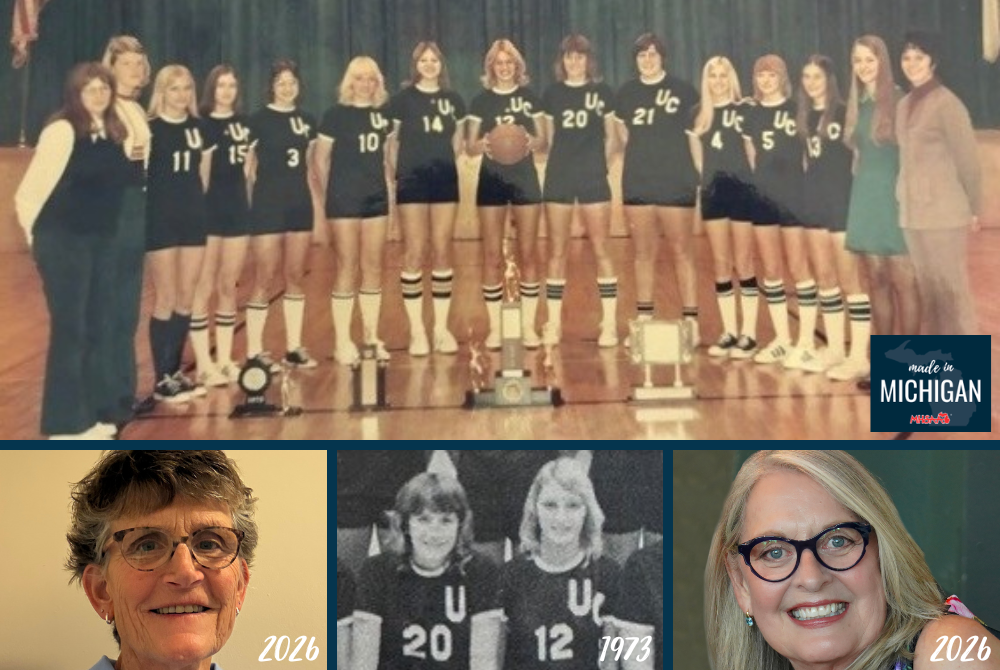
Significance of Historic Run, Relationships Formed Live On for 1973 Unity Champs
By
Dean Holzwarth
Special for MHSAA.com
August 7, 2026
It has been more than five decades, but Kim Hansen and Marcia (Visser) Beutel can still recall certain moments from a historic night in mid-December when their Hudsonville Unity Christian girls basketball team accomplished a tremendous feat.
 On Dec. 15, 1973, at East Kentwood High School, the teammates helped the Crusaders win the first MHSAA Girls Basketball Finals championship in Class B.
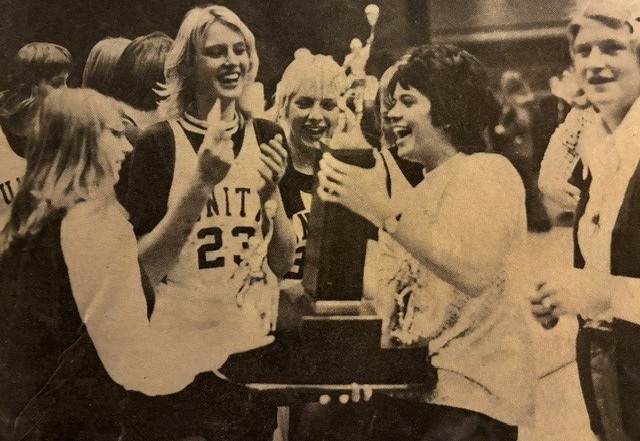
Unity Christian defeated Saginaw MacArthur 49-45 before a crowd of 1,000.
“i just remember the team, the bus ride out there, and I remember just how excited we were to be together and what we had accomplished as a group,” Hansen said. “Our parents and friends were such big supporters through the whole process, and when I think back I see faces of pure joy.”
A total of 629 schools participated in that first tournament, which like now lasted three weeks and was divided into four classifications.
Cindy Masselink scored 17 points and Deb Aukeman added 16 points to lead the Crusaders to the championship win.
“For us, it was an excitingly significant day because we had been working hard throughout the season, and we, as women, could be the first winners of a state championship for our school and the state,” Beutel said. “A lot of us had been playing together since the sixth grade, and that camaraderie, that friendship, that teamwork and the work we had put in was going to end with a state championship.
“We were very blessed to be there, and we also knew that we were pioneers and trailblazers in the game.”
The Crusaders consisted of 11 girls, three managers and head coach Susan Contant.
An interesting sidenote from the Class B title game: As the home team, Unity Christian was to wear white uniforms. But the Crusaders didn’t own those.
“There were limited resources for women's sports back then so we had to wear the boys uniforms for the state championship,” Beutel said. “They didn't fit well so we had to wear T-shirts underneath them.”
One thing the 1973 squad possessed was size, which proved to be a benefit as the 3-point shot didn’t yet exist.
“We took each tournament game as it came to us and just kind of did our thing,” Hansen said. “I look back at our pictures, and we were huge. We had a starting five of 6-foot plus, and we were a big team. That definitely worked in our favor, and I really don't think that we were going to be denied.”
Beutel and Hansen, both 69, are organizing a night to recognize this special group of women.
 It will take place Dec. 11 during a Unity Christian girls and boys varsity game night.
“We are all much older and lives have happened and we are in different places, but I’m hoping that many of the teammates will come back for that,” Hasen said. “I know our head coach and her husband are going to come back for that, and I think that is just amazing. I haven't seen Sue since 1973.
“I got to see some of my teammates when we were recognized at Central Michigan for the 30-year anniversary, and I’m looking forward to seeing who is going to be able to make it and hoping that many do.”
Beutel lives in Toronto with her husband, Robert. She recently visited her old high school.
“They had a list of all the state championships on the wall, and the first one was us,” she said. “That was very emotional for me to see that, to see that recognition.”
Beutel met her husband at the University of Michigan, and they had three kids. One of their daughters, Sophie, played Division I basketball at Brown.
Beutel moved to Toronto in 1987 and coached basketball in a recreational league while helping grow the game. She was president of the Toronto Basketball Association, which has surged to 1,000 athletes.
The country needed to push for basketball representation and now has the NBA’s Toronto Raptors and the Toronto Tempo, currently playing its inaugural season in the WNBA.
“Back then it was a hockey country, so I had to search for basketball in Toronto,” Beutel said. “I got involved in it and expanded it on the girls side and always coached my kids.”
Now retired after a career as a health care executive, Beutel and her husband love adventures and have traveled to several countries. “There is so much more to experience in life,” she said.
While she stays active by playing tennis, cycling and kayaking, Beutel also plays clarinet in a band and volunteers at a cancer support group as a peer counselor after enduring two bouts of breast cancer.
After high school, Hansen played four years of basketball at Grand Valley State University before being drafted by the San Francisco Pioneers of the Women’s Professional Basketball League.
She played there one season before being traded to the Chicago Hustle. She also spent time with the Minnesota Fillies before the league went bankrupt and disbanded in 1981.
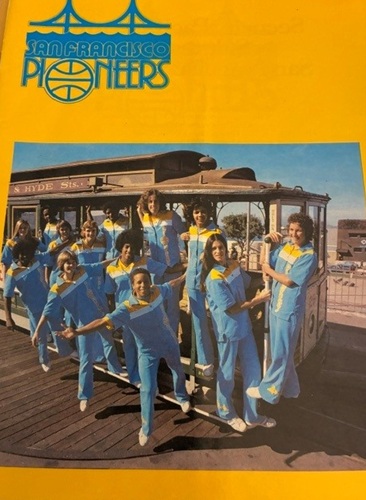 “I think I made $7,000 for my salary and the season was very short, but it was such an amazing experience and San Francisco was a very good franchise,” Hansen said. “They had good ownership and we flew all over the place and stayed in really nice hotels. They had a good practice facility, and we were treated really well.”
Prior to a game scheduled in Chicago on March 21, 1981, Hansen and her Fillies teammates walked off the court before the starting lineups were announced in a protest over unpaid salaries.
“We planned to do our warm-up, go back to the locker room and then get back in vans and drive back to Minnesota because we weren’t getting paid,” Hansen said. “That was our way of showing that we were not happy with ownership and the only way that we could make a stand.”
Despite the disbanding of the league, Hansen said lifelong relationships were formed.
“The beauty of playing sports is relationships, and even relationships that we developed at Unity are still so strong, and relationships I developed while playing pro ball are still very active and to me that is the beauty of playing sports,” she said.
After the WPBL, Hansen went to graduate school at Lamar University in Texas and eventually became an educator and coach at several colleges and high schools, including Wichita State and North Central College (Ill.).
Her final stop was Cleveland Heights High School, where she coached and taught physical education and health. She lives in Kirtland, Ohio, and retired from teaching and coaching in 2024 although she still works part-time in the transportation department.
“I love coaching and I always loved practice,” Hansen said. “I just finished working with four seventh-grade boys and helping them with fundamentals and skills. I just enjoy that part of it so much.”
2026 Made In Michigan
Aug. 4: Work Ethic Continues to Drive Van Dyk's Endeavors as Co-Owner of Family Farm - Report
July 24: Hackett Mentor's Care Sparked Lifetime in Hoops for BCAM President White - Report
July 24: Mackey Leaving Court with 500+ College Hoops Wins, Many More Lessons Shared - Report
July 16: Country Day Two-Time Champ Moore Building Perennial Winner at Harvard - Report
July 9: Multi-Sport Career at TC West Helps Gillis Thrive as Pro in Game She Once Left Behind - Report
July 2: Inspired by Home, Eager to Give Back, Spencer Hosts Hoop City Alumni Games - Report
PHOTOS (Top) The 1973 Unity Christian girls basketball team poses for a team photo with its championship trophy; Kim Hansen (20) and Marcia Beutel (12) then and now. (Middle) Unity coach Susan Contant holds the championship trophy surrounded by her players after the clinching victory. (Below) Hansen stands for a photo with her San Francisco Pioneers teammates during the 1979-80 season. (Photos provided by Kim Hansen and Marcia Beutel.)