


Let's Play 2 (or 3, or 4)
February 16, 2012
A few conversations I had at last week's Women In Sports Leadership conference further affirmed a point I've been making for years -- high school athletes, if they'd like, shouldn't hesitate to play multiple sports.
Doing so does not hurt, but might just help their chances at landing that prized college scholarship -- on top of adding another layer to the high school sports experience.
Reaffirming this for me last week was Michigan State softball coach Jacquie Joseph, who spoke on that subject at the WISL conference. She's heading into her 24th season as a head coach at the Division I college level -- so she's been around for some of the evolution of both high school sports specialization and college recruiting. Plus, she coaches a sport that sees its share of athletes playing just that one.
Later, I spoke with a high school coach who leads teams in three sports and also played one at the Division I college level. She's a believer in this as well.
Some of the things I've been told over the years about playing more than one sport:
- It allows an athlete to learn more skills and hone more parts of his or her athleticism.
- Using another range of movement further helps condition an athlete's body and make it more resistant to injury.
- It's hardly rare to see a college football coach watching a prospect's basketball game -- coaches like to see how athleticism transfers across sports, and sometimes will see something from an athlete playing basketball that he didn't show on the football field. (Football and basketball are used in this example, but the same applies to a number of similar situations.)
- Athletes get an opportunity to play whatever they'd like only this once (unless they turn out to be that rare college athlete who takes on more than one sport at that level).
These are hardly new arguments. But they are always worth repeating -- especially when the people frequently making them (college coaches) are the ones single-sport athletes often are trying to impress.
Success Comes with Stories as Portage Central Surges Toward Postseason
By
Pam Shebest
Special for MHSAA.com
May 21, 2025
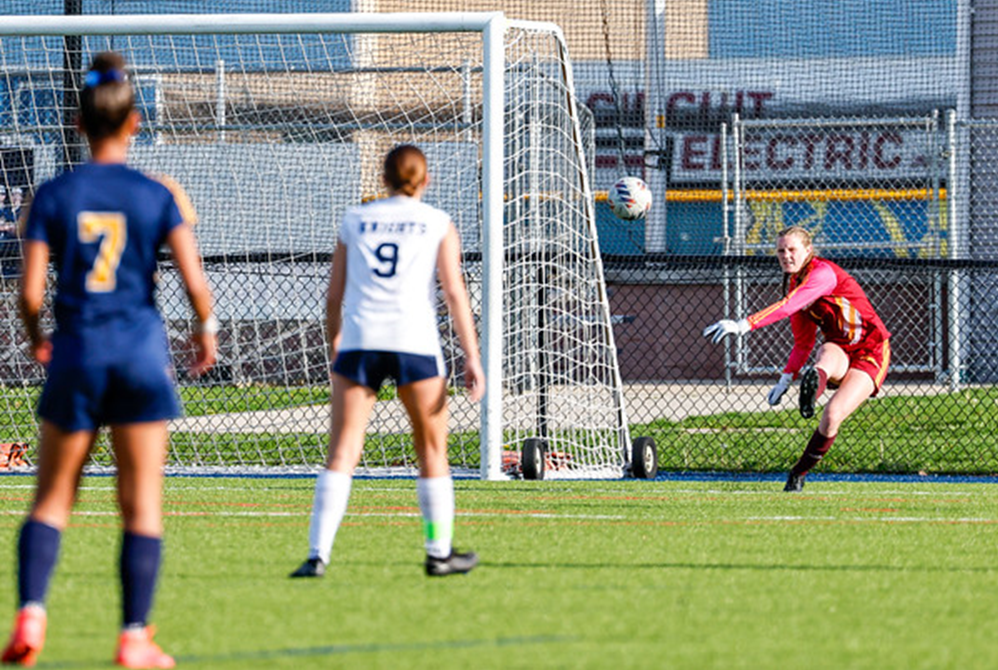
PORTAGE — The urge to play varsity soccer was so strong for Allison “Ricky” Rearick that as a sophomore she agreed to become an obstacle while opponents tried to boot balls past her into the net.
 A defender all her life, the Portage Central senior had to completely change her game to become a goalkeeper, using her hands instead of her head to advance the ball.
She also had a problem trying not to duck when the ball came blitzing at her.
“That was my biggest problem coming in,” she laughed.
Three years later, Rearick is an old hand in net for Portage Central, allowing just 11 goals over 14 games this spring while leading the Mustangs to a 12-3 record. She has seven shutouts.
As Portage Central readies for its Division 1 District opener Tuesday against Mattawan at Kalamazoo Loy Norrix, Rearick's story is among those that have made this a special season.
Her comfort in net was not always the case.
“We were just joking with her the other day,” coach Tim Halloran said. “Her first game was against Hudsonville, at Hudsonville, the No. 1 team in the state at the time.
“She had been training for six or seven days. Right before the game, she went to my assistant, Ashleigh Garrod, and said ‘Can I practice punting the ball? I don’t know how to punt the ball,’ which is a big part of the game.”
That’s when the team’s goalkeeper coach, Brad Conway, stepped in.
"He helped me my whole sophomore year,” Rearick said. “When we got to Districts and Regional time, I was starting to feel pretty comfortable.”
Halloran said he knew Rearick would be able to handle the new position.
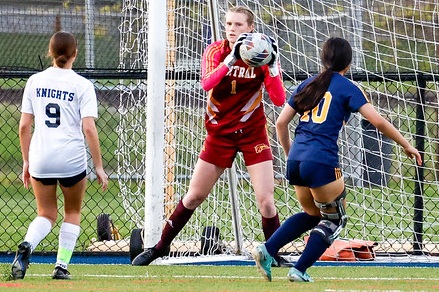 “Through her freshman year she played defense,” he said. “She’s tall (5-foot-9) and she played basketball, so she can use her hands.”
Rearick said the transition from defense to goalkeeper was easier because “after basketball, I knew how to catch a ball, which was good. The jumping aspect of basketball also helped.”
It all came together in that first game at Hudsonville, a 2-1 Portage Central win.
“I was so nervous, probably the most nervous I’ve ever been in my life,” she said. “I was so scared. I was still very nervous the next couple games, but it was so much fun.”
Even more fun was being named all-state honorable mention her junior year after giving up just eight goals all season.
As she winds down her senior campaign, Rearick said, “This group of girls, playing with them has been amazing. I’ve actually learned to enjoy the position.
"It’s a lot of pressure at times, but when you have a big game you’re able to help your team with a big save. It feels amazing.”
Senior teammate Kaeli Mason appreciates having her buddy in goal.
“Ricky’s just amazing,” Mason said. “She saves us so much. She’s an overall great person, so it’s great to have her back there.
“We all talk a lot on the field. Communication is a big part of defense on the field.”
Building a family bond
Portage Central certainly appreciates that back-line bond. Mason has had to work her way back into soccer shape after breaking her leg and missing all of last season.
She played in two scrimmages last spring but knew something wasn’t right.
“Maxing in my weightlifting class and tryouts were the same week,” Mason said. “I think it was just overload.
 “I limped and had to keep going back to the doctor until they finally figured it out with an MRI.”
Mason was anxious to get back on the pitch.
“It was a struggle, but going through all our preseason stuff and playing travel helped me get back (into shape), and working out on my own,” she said.
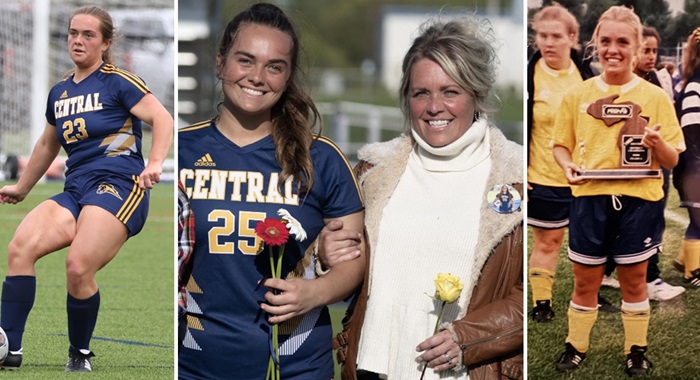
Mason also had her soccer-playing family to support her, including her mom, Tami Mason, who is a 1993 Portage Central grad.
The senior said her mother encouraged her not only to play, but also to make the team a family.
Tami Mason was also a defender in her day, “although they called it stopper back then,” she said, noting that team pictures still line the halls at the school.
“It’s kind of funny because all my kids have gone there and they say, ‘Oh, there’s Mom,’” she laughed.
Looking back at her high school days, Tami Mason said soccer was the highlight.
“The camaraderie with all my teammates, they were like family,” she said. “It was such a high going out on that field, knowing you had to do whatever you could to win those games and do your best.
“It was literally my favorite part of school. I’m still pretty close to a lot of the kids I grew up playing with. I still have a photo album with all the clippings from back in the day.”
One part of this year’s Mustangs team is a throwback to Mason’s era.
“It’s funny because (this year’s team) calls themselves the P.C. Bad Boys," she said. “Back in the day, there’s a cop song “Bad Boys” so we used to walk out on the field back then with a jambox on our shoulders playing that.
“It’s so funny to see that now they have T-shirts and refer to themselves as that. I’m like, that started back in the day with us. It’s kinds of surreal.”
In a quirky twist, Halloran also coached Tami Mason, although it was on a travel team, not at Portage Central.
Reality check
While Kaeli Mason worked her way back to the team after rehabilitating her broken leg, Halloran has returned from a scare that was much more serious.
 Doctors discovered he had kidney cancer in August 2021.
“They took the whole kidney, so I am cancer-free on the inside and I have skin cancer on the outside from 30-some odd years of being out in the sun,” he said. “Luckily, I didn’t have to do any radiation or chemo. It was just learning to live with one organ fewer than I had.”
That also changed his perspective on life.
“I got married (in December, 2021, to Tammy Dykema-Halloran) and I think I’ve taken a step back,” he said. “We were together for 12 years and we said, ‘Hey, cancer is something we’re not going to mess with.’
“You don’t know what’s going to happen. So we got married, and it’s been a very calming influence. I’m still very passionate about being out here and I love doing this, but I’m sure I took it way too seriously in other points in my career and lost a lot of sleep and a lot of hair and have a lot of gray hair from worrying about stuff.”
***
Besides Rearick and Mason, Halloran has five other seniors on the team: Lauren Tooley, Anna Pellegrini, Kyra Gardner, Katie McLaughlin and Madison Cutler.
Juniors are Sophia Sanborn, Janelle Yao, Claire Pierce, Delaney O’Reilly, Ella Bish and Maya Moulton. Sophomores are Ally Areaux, Kaitlyn Lam, Lily Dimick, Addison Giebel, Lily Grueter, Jenna Dietzel, Jillian Mills, and Claire VanderRoest; and the two freshmen are McKinley O’Reilly and Marley Righter.
 Pam Shebest served as a sportswriter at the Kalamazoo Gazette from 1985-2009 after 11 years part-time with the Gazette while teaching French and English at White Pigeon High School. She can be reached at [email protected] with story ideas for Calhoun, Kalamazoo and Van Buren counties.
PHOTOS (Top) Portage Central keeper Allison Rearick, far right, prepares to launch the ball during a game against Kalamazoo Loy Norrix. (2) Rearick considers her options with a teammate and opponent in front of her. (3) At left, Kaeli Mason plays this season and walks arm-in-arm with her mother Tami, also holding the trophy at far right during her playing days. (4) Portage Central coach Tim Halloran. (Rearick photo by Jim Cottrell. Mason photos courtesy of Tami Mason. Halloran photo by Pam Shebest.)