


Lots of Fight in Pontiac Notre Dame Irish
June 7, 2012
Last week was the busiest on the MHSAA school schedule. And it was a great one for Pontiac Notre Dame Prep.
Over three days, the Fighting Irish won three District and one Regional championship, plus two more track and field individual Finals titles.
Successes were celebrated across six sports.
Thursday: Notre Dame’s boys golf team won its District, led by individual medalist Aaron Knutson; the senior shot a 71.
Friday: The boys lacrosse team won its third straight Regional title with an 11-2 win over Warren DeLaSalle in Division 2. (The Irish since have lost to Grand Rapids Forest Hills Central in a Semifinal.)
Saturday: Senior Sara Barron finished an outstanding track career by winning the 1,600-meter run with a Division 2 Finals record time of 4:51.67. She also won the 800 in 2:15.83 and teamed with Taylor Timko, Sarah LewAllen and Candice Mark to finish third in the 1,600 relay.
Timko also scored the game-winning goal as Notre Dame’s girls soccer team beat Detroit Country Day 1-0 in a Division 3 District championship game.
The Irish’s softball team beat Bloomfield Hills Lahser and Detroit Country Day by a combined score of 25-1 to win its sixth straight District title. Notre Dame had only one error on the day and didn’t give up a hit in the five-inning win over Lahser.
Finally, the girls tennis team posted its best MHSAA Finals finish to cap its best season ever. Notre Dame placed seventh in Division 4, keyed by runner-up finishes by Erin Moncrief (No. 4 singles) and Maddie Riley and Gabby Bering (No. 4 doubles). Notre Dame ended with a 10-1 dual record, losing only to eventual Division 4 champion Bloomfield Hills Academy of Sacred Heart.
PHOTO: Pontiac Notre Dame Prep’s softball team won its sixth-straight District championship Saturday. (Photo courtesy of Lynn Wroubel).
How To Warm Up Correctly Before Playing Different Sports
July 10, 2024
When you see professional athletes gearing up to race or getting ready to take the field, you’ll notice that they’re always in motion. That’s because they are warming up in preparation for going all out.
 And there’s a good reason why you’ll never see a pro go straight from the bench into a full sprint. “You need to allow your muscles to gradually accept the demands of your activity,” says Jennifer Burnham, a certified athletic trainer at Henry Ford Health. “Otherwise you risk causing an injury.”
Why You Should Warm Up
As the name implies, a warmup is a series of movements designed to warm up your muscles. “You want to increase blood flow to your muscles and loosen up and lubricate your joints,” says Burnham. “And you need to do it gradually, so that your body has time to adapt to the increasing intensity.”
Warming up involves more than just stretching. According to Burnham, studies have actually shown that holding a static stretch when muscles are cold can decrease performance. “Instead, before activity you want to do a dynamic warmup that incorporates movement as well as some gentle stretching."
Your warmup only needs to take 5 to 10 minutes. When deciding what to do, think about the movements you’ll be doing in your activity and which muscles and joints are most involved. Then choose movements that slowly get them warmed up and primed for more intense action.
How To Warm Up For Different Activities
No matter your sport, the warmup before your workout should include some exercises to activate and engage your core (the abdominal and back muscles). “Waking up those muscles helps decrease injury potential,” says Burnham. She suggests incorporating bridges and mini squats (no deeper than 45 degrees) into your warmup routine. To do a bridge, lie on your back, knees bent, feet flat on the floor. Tighten your stomach muscles and squeeze your butt as you lift your hips up to form a straight line from knees to shoulders.
The rest of your warmup can be more specific to muscles and movements of your planned activity.
Running
Before a run, or even a jog, you want to warm up all the muscles and joints from the waist down.
- Rotate your hips (lift your knee up and do some circles in both directions to move the joint) and ankles (circle one foot at a time both clockwise and counter-clockwise).
- Get powerful muscles like your glutes and quads ready with high knees and butt kicks.
- Walk on your toes and then on your heels to warm up shin and calf muscles.
- When you’re ready to run, start off slowly and gradually increase your speed.
Racquet sports
You still need to warm up your lower body using the same moves as the running warmup. But you’ll want to add in others specific to the upper body movements of tennis, pickleball or other racket sports.
- Warm up shoulders with big arm circles both forwards and backwards
- Circle your hands in both directions to get wrists ready for action
- Lunge forward and rotate your upper torso to increase your spine mobility
Basketball, soccer and football
You want to make sure your lower body has time to adapt to the demands of sports that require bursts of sprinting and quick shifts of direction. Your warmup should gradually increase in speed and intensity as you move your body in all directions:
- Side shuffles while swinging your arms (shuffle in both directions)
- Grapevines in both directions
- Skip forward, lifting knees high, then skip backward
Swimming
Prepping your body for a swimming workout means warming up your arms, shoulders and upper back.
- Circle arms backwards and forwards
- Use a light resistance band to do shoulder rows
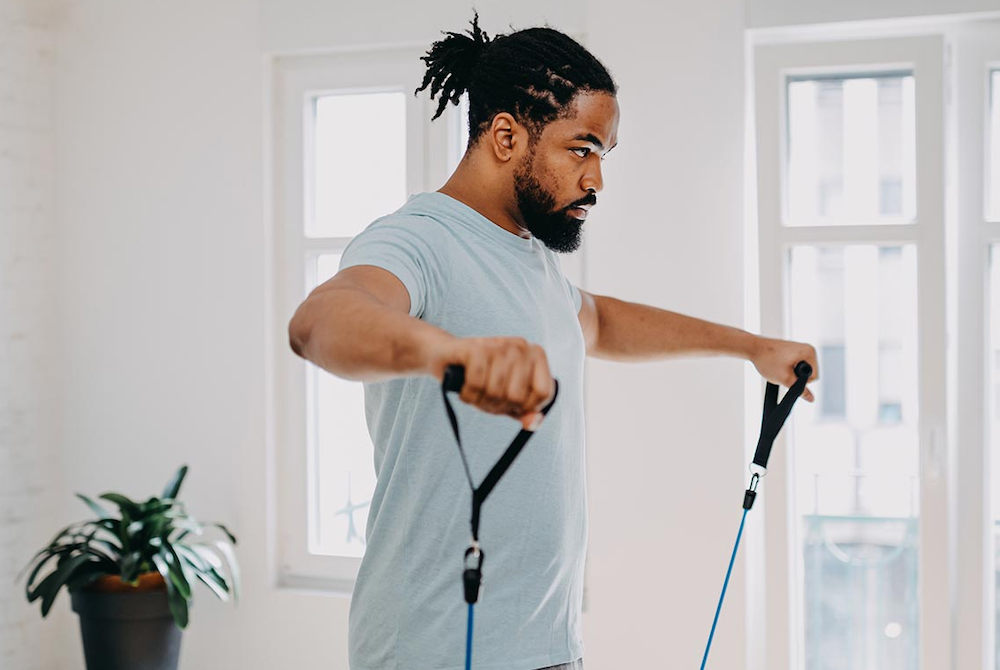
- Use a light resistance band or light dumbbell and lift straight arms up to shoulder height in front and to your sides
- Start with an easy tempo freestyle swim before going into more dynamic strokes like butterfly
Jennifer Burnham is an athletic trainer who sees patients at the Henry Ford Center for Athletic Medicine in Detroit.
To find a sports medicine provider at Henry Ford Health, visit henryford.com/athletes or call 313-651-1969.