

MHSAA Historian Picks 10 to Remember
August 9, 2016
By Rob Kaminski
MHSAA benchmarks editor
It sounded simple and fun, the theme for the MHSAA's spring issue of benchmarks: a history of MHSAA tournaments.
It certainly was the latter, but simple? Not so much.
There’s no way to do justice to nearly a century’s worth of history in some sports. Complicating matters was the abundance of information and photographs for some, and the scant amount of detailed data and images for others.
MHSAA historian Ron Pesch was given an equally challenging task: recount a “Top 10” list from his days covering various MHSAA Finals. He shares them here and, he adds, they are in no order of favorites.
The Shot: 1986 Class B Boys Basketball Final at Crisler Arena – Saginaw Buena Vista’s Chris Coles’ desperation shot, launched at the buzzer from well beyond half court, dropped through the hoop to give the Knights a 33-32 win over defending champion Flint Beecher in a rematch of the 1985 Class B title game. The shot was Coles’ first of the second half and his only points in the contest.
The Smurfs: 1986 Class A Football Final at the Pontiac Silverdome – The "Smurfs" – Muskegon Coach Dave Taylor's nickname for his small, quick swarming defensive linemen – limited heavily favored Sterling Heights Stevenson to four yards rushing and 73 yards of total offense in a 10-0 win. As a 1979 graduate of Muskegon High School, I was elated.
The Drive: 1989 Class B Football Final at the Pontiac Silverdome – I slid down from the press box into the stands at the Silverdome for the end of this one. With 2:20 remaining, the atmosphere was simply electric, as Farmington Hills Harrison’s lauded quarterback Mill Coleman took the reins with his team down 27-21 to DeWitt. The senior executed a flawless two-minute drill, guiding his team to the DeWitt 9 before scampering into the end zone for the tying points. Steve Hill added his fourth PAT for the lead, then secured the victory with an interception on the next series.
King Kool: 2005 Class B Boys Basketball Final, Breslin Center, East Lansing – David Kool was a flawless 20 for 20 from the free-throw line and scored 43 points as Grand Rapids South Christian downed Muskegon Heights 67-60.
The Parade: 2004 Individual Wrestling Finals, The Palace of Auburn Hills – In 2004, I traveled to Auburn Hills to watch the MHSAA Individual Wrestling Finals for the first time. The pageantry of the Grand March, the skills on display, the roar of the massive crowd, and the ensuing beauty and chaos of a wrestling extravaganza of this scale is truly a sight to see.
A Marathon: 2007 Division 3 Football Final, Ford Field, Detroit – East Grand Rapids and Orchard Lake St. Mary’s ended regulation tied 14-14, and this would turn into a five overtime battle that required an extra hour of play. No previous football playoff game, from Districts up, had ever gone beyond four overtimes. After exchanging field goals, touchdowns, extra points and two-point conversions, East Grand Rapids emerged with a 46-39 victory.
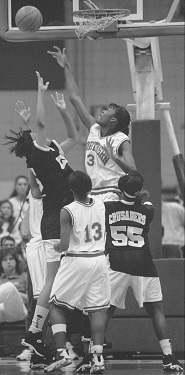
Tawana Towers: 1994 Class A Girls Basketball Final at Kellogg Arena, Battle Creek – Flint Northern, coached by Leteia Hughley and led by 6-4 freshman Tawana McDonald, defeated 1993 runner-up Detroit Martin Luther King, 46-32, for the Class A championship. McDonald batted down an MHSAA-record 10 shots, pulled down 13 rebounds and added five points and seven assists in a stellar performance.
Never Quit: 2008 Division 2 Football Semifinal, Spartan Stadium, East Lansing – Unbeaten, No. 1-ranked and heavily favored Muskegon trailed Davison by 22 late in the third quarter and 16 with less than five minutes to play. In perhaps the greatest comeback in playoff history, Muskegon recovered two onside kicks and scored 19 points in the final 4:31 to escape with a 38-35 victory and its third trip in five years to an MHSAA Final.
MHSAA Legends: 1998-2008 – For 10 years, the MHSAA showcased great teams from the past with their Legends of the Game series. From a historian’s perspective it was a chance to meet and learn more about folks I had often known only from the pages of microfilm. It was quite the treat to see years fall away as coaches, team managers and players reunited, in many cases for the first time after decades apart.
The MHSAA Record Books: Online, 1994 – One of my first efforts as state historian was to expand the record books beyond their primary focus on football, basketball, track & field and swimming & diving. With the arrival of the internet, an enhanced version of the record books was brought online. Coaches and fans were quick to respond with letters and e-mails, happily listing entries that had been “missed.” Soon, five category headings in a sport grew to 20, then to 50 and beyond.
Kids: 2004 Football Finals, Pontiac Silverdome – (OK, this is No. 11 ... consider it an extra point). For the first time, my sons joined me for my annual excursion to Metro Detroit for a Thanksgiving Day football weekend. They got to see the Silverdome before the move of the MHSAA Football Finals to beautiful Ford Field. Future Big Reds, they also got to see their future alma mater win another title.
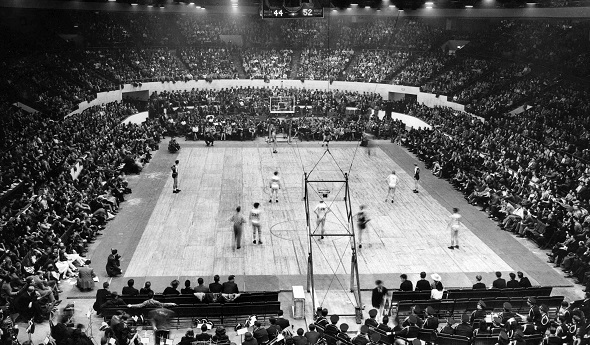
PHOTOS: (Top) An MHSAA boys basketball tournament game is played at Olympia Stadium in Detroit. (Middle) Flint Northern's Tawana McDonald blocks a shot during the 1994 Class A Final.
Caledonia Football Set to Open Season by Welcoming Fans to New Home
By
Ron Pesch
MHSAA historian
August 25, 2025
Community banter dated back to April 1948, or before. Caledonia football followers were anxious for “an athletic plant of their own.” Members of the local Commercial Club were pushing to build a true place to call home.
At the time, home games were played on a clearing at Lakeside, a local county park in the heart of the village near Emmons Lake. Thanks to the success of the team and the popularity of games, locals felt the Scotties had outgrown the site.
Members of the Class C Bar-Ken-All league, coach Thornton K. Auwater’s squads started to win consistently, grabbing conference championships in 1945, 1946 and 1947. The league began in 1937 with the school as a charter member, along with Byron Center, Hopkins, Kelloggsville, Martin, and Wayland.
The Club proposed building a lighted field to the PTA with the thought that it could be done for between $12,000 and $15,000. According to an article in the area newspaper, the Grand Rapids Press, “It is expected the money will be raised by the sale of bonds locally.”
In 1949, a design was approved. However, in hopes of significantly lowering the cost, the plan was for volunteers to assist in the layout and construction of the site. According to the Press in April 1950, the race was on to finish the project before the arrival of the upcoming season:
“Sod, trucks, and tractors for the job have been donated by local residents. It is estimated that at least 100 more volunteers will be required to complete the field in time for regular season play.”
Auwater’s crew was expected to do well during the fall of 1950. The football team had fallen to Kelloggsville, 19-0, in the second game of the 1949 season, and the defeat meant the Scotties finished second in the league standings to the Rockets. But, of particular note, in the games that followed, Caledonia’s defense was flawless, shutting out its final six opponents. By all measures, it was an exciting time.
Come the new school year, and thanks to the efforts by the community, the field was ready for the team’s nonconference season home opener with Grant on Sept. 15.
Changes
The 1935 season was Caledonia’s first playing football, marking this as the school’s 91st year on the gridiron. Since the fall of 1970, the team has competed in the Ottawa-Kent Conference, and in 2016, moved to the league’s Red division.
Prior to the 1970s, the Scottish terrier – a breed of dog popularly known as the Scottie, originally bred to hunt vermin – was Caledonia High School’s mascot. Around 1974, students decided to change the nickname to the Fighting Scots – depicted by a Scottish warrior dressed in the school colors of purple and gold.
Fast forward to this 2025-26 school year and Caledonia is Class A and among the largest 65 high schools in the state based on enrollment. And 75 years after unveiling their first true home field, Caledonia Community Schools is debuting the team’s reimagined home.
Approved bond issues from 2020 and 2023 have funded the latest updates and renovations to the site. “Preserving the heritage” of the district, a synthetic turf system was added to the current site in 2023. This season, heated team rooms, updated seating, concessions, and restrooms will be unveiled.
For fans, the curtain opens Thursday when the team squares off against Holy Names Catholic from Windsor, Ontario.
“This stadium tells the story of Caledonia. It is a story of community, tradition, and pride,” said Kelly Clark, community and public relations coordinator for the district. “As we celebrate 75 years, we honor those who built the foundation and look forward to the next generation writing their own chapter on this field.”
A souvenir dedication program will be distributed at the home opener. Within, special thanks are extended to many who have helped bring the story to life: “We are especially grateful for the work Steve Poll has done to uncover and preserve so much of this history so that our community can fully appreciate the legacy we carry forward.”
Poll, himself, was a graduate of Grand Rapids South Christian. His dad, Gordon Poll, played right tackle and was a co-captain as a senior on the 1950 Caledonia team.
“He was not one to live in the past,” recalled Steve Poll, “so unless we were at a football game and something triggered a thought, he didn't talk much about the 1950 team accomplishments. … I met one of his teammates at my dad’s funeral, who shared a few things (with me). I intended to interview him (however) he passed away before that happened. I finally decided to dig in and find what I could.”
Poll captured details from old newspaper articles, photos, and memorabilia. “I started investigating before I knew anything about the current rebuild of the stadium,” he said.
Also planned for the celebration is a three-minute video featuring interviews with players – present and past – including a member of the 1950 team who recalled players laying sod on the field at their first practice that season.
MHSAA Executive Director Mark Uyl, a 1992 Caledonia graduate, will speak at the event.
A season to remember
“Grant High’s fighting team almost spoiled the dedication of a new lighted football field … last night,” reported the Press when covering the first game of the 1950 season, “throwing a real scare into the bigger, highly favored Caledonia High team before tumbling, 6 to 0.” A 30-yard pass from Bob Higley to Don Moffatt was the game’s only score.
In hindsight, it was perhaps the biggest play of the year.
A true stadium dedication ceremony was planned for the second game of the season. Among those scheduled to attend and speak were Caledonia Schools Superintendent Andrew B. Cherpes, Board of Education President Orlo Good, Village President Stan Stawski, and Coach Auwater. Also planning to make the trip from Washington was U.S. congressman Gerald R. Ford, Jr., who held Michigan’s 5th district seat in the House of Representatives. Unfortunately, due to scheduling issues, Ford was unable to attend but did send a telegram to explain his absence and, within, congratulated the community on its outstanding achievement. (Uyl will read the content during this year’s celebration.)
The opponent was Middleville. For several years, the teams had scheduled a two-game nonleague “home-and-home” rivalry series. That continued in 1950, but this time, the Trojans were now members of the Bar-Ken-All. (Kelloggsville had left the league after the 1949-50 school year. The conference expanded, adding Middleville and Delton. To allow time for scheduling transition, the 1950 opening contest of the series did not count in the league standings.)
The Scotties emerged with another slim 7-0 win. According to the Kalamazoo Gazette, the result of the game “only added fuel to the rivalry which will reach a heated state at Middleville in a regular conference game Oct. 20.”
Caledonia plowed through the remaining games. Martin fell 27-0, Coopersville was trounced, 40-0, and Byron Center was easily defeated, 27-0. The highly-anticipated rematch with Middleville was close for the first half, as Caledonia clutched to a thin 7-0 lead at the break. It turned into a rout as “the Scotties flashed a passing attack that netted three more TDs and a 26-0 win.”
Wayland was disposed of 28-0, giving the Scotties possession of the “Cowbell Trophy” donated two years previous by a Wayland merchant. Then the team completely overwhelmed Hopkins in the season’s finale, 73-0. That margin was the state’s largest of the season, according to Dick Kishpaugh of Kalamazoo, who assembled season-ending totals for consumption by the state’s media. The Scotties were also statewide news as one of 26 teams that had posted unbeaten and untied marks on the year. Caledonia was one of just two to finish the year unbeaten, untied, and unscored upon. Garden City had done the same but had played just six games.
Although not rediscovered until recently, the team’s streak of 14 consecutive shutouts with no tie games included (six to end 1949, and eight in 1950) ranks second in the MHSAA football record book, just a single game behind North Muskegon teams that straddled three seasons, 1940-42.
Dedicated to a super volunteer
Besides location, one other item remains unchanged at the “athletic plant” in Caledonia.
“Even though his children go to school in Middleville,” noted the Press back in 1950, Ralph E. Myers thought of Caledonia as “his town.” A member of the Commercial Club Committee that helped plan the project, he followed through as the site’s dedicated lead volunteer, working with others “to get the job done,” according to a community newsletter.
In July 1954, at age 46, Myers died tragically in an automobile accident. His wife, Henrietta, had died a year before. They left behind three daughters. That fall, Caledonia christened the site as Ralph E. Myers Athletic Field.
Over the years, proposals were made to rename the place in honor of others, but Caledonia Community School stood behind the original decision. In September 1998, after a $1.9 million renovation for football and track & field, the site was rededicated with new signage as Ralph E. Myers Memorial Stadium.
With the latest efforts by all involved to capture the stories and communicate the legacy, future students will have the opportunity to easily understand and appreciate the stadium’s humble beginnings and the importance of all, then and now, who pitched in to create a place to call home.
PHOTOS (Top) A sign welcomes visitors to Caledonia’s home field in 1954. (Middle) The 1950 Scotties: Back row William Price, Walter Jousma, Jack Moreland, Peterson, Harvey Jacobsen, Allan Vander Laan, Forrest Clark, Gerritt Nordhof, Arthur Benedict, Larry Schroder, Larry Lind, Donald Williams (Manager). Third row Assistant Coach Wisner, Donald Moffatt, Ramon Schantz, Bob Cisler, Bob Higley, Merle Maier, Wallace Lotterman, Bob Schultz, James Fitzsimmons, Fred Darling, Vern Kayser, Coach Thornton Auwater. Second Row Elmer Velthouse, Bernard Kilmartin, Donald Braendle, Louis Bellgraph, Marvin Eldridge, Allyn Niles, James Porritt, Benjamin Miller, Bill Jousma, Gordon Poll. First Row Gary Cherpes, Joseph Sleeman, Harold Olthouse, Rod Campbell, Garrit Keizer, Carl Yonkers, Clyde Barrett, James Ayers, Hosmer Parks. Not pictured Arnold Benedict, Bob Workman.