

MHSAA Historian Picks 10 to Remember
August 9, 2016
By Rob Kaminski
MHSAA benchmarks editor
It sounded simple and fun, the theme for the MHSAA's spring issue of benchmarks: a history of MHSAA tournaments.
It certainly was the latter, but simple? Not so much.
There’s no way to do justice to nearly a century’s worth of history in some sports. Complicating matters was the abundance of information and photographs for some, and the scant amount of detailed data and images for others.
MHSAA historian Ron Pesch was given an equally challenging task: recount a “Top 10” list from his days covering various MHSAA Finals. He shares them here and, he adds, they are in no order of favorites.
The Shot: 1986 Class B Boys Basketball Final at Crisler Arena – Saginaw Buena Vista’s Chris Coles’ desperation shot, launched at the buzzer from well beyond half court, dropped through the hoop to give the Knights a 33-32 win over defending champion Flint Beecher in a rematch of the 1985 Class B title game. The shot was Coles’ first of the second half and his only points in the contest.
The Smurfs: 1986 Class A Football Final at the Pontiac Silverdome – The "Smurfs" – Muskegon Coach Dave Taylor's nickname for his small, quick swarming defensive linemen – limited heavily favored Sterling Heights Stevenson to four yards rushing and 73 yards of total offense in a 10-0 win. As a 1979 graduate of Muskegon High School, I was elated.
The Drive: 1989 Class B Football Final at the Pontiac Silverdome – I slid down from the press box into the stands at the Silverdome for the end of this one. With 2:20 remaining, the atmosphere was simply electric, as Farmington Hills Harrison’s lauded quarterback Mill Coleman took the reins with his team down 27-21 to DeWitt. The senior executed a flawless two-minute drill, guiding his team to the DeWitt 9 before scampering into the end zone for the tying points. Steve Hill added his fourth PAT for the lead, then secured the victory with an interception on the next series.
King Kool: 2005 Class B Boys Basketball Final, Breslin Center, East Lansing – David Kool was a flawless 20 for 20 from the free-throw line and scored 43 points as Grand Rapids South Christian downed Muskegon Heights 67-60.
The Parade: 2004 Individual Wrestling Finals, The Palace of Auburn Hills – In 2004, I traveled to Auburn Hills to watch the MHSAA Individual Wrestling Finals for the first time. The pageantry of the Grand March, the skills on display, the roar of the massive crowd, and the ensuing beauty and chaos of a wrestling extravaganza of this scale is truly a sight to see.
 A Marathon: 2007 Division 3 Football Final, Ford Field, Detroit – East Grand Rapids and Orchard Lake St. Mary’s ended regulation tied 14-14, and this would turn into a five overtime battle that required an extra hour of play. No previous football playoff game, from Districts up, had ever gone beyond four overtimes. After exchanging field goals, touchdowns, extra points and two-point conversions, East Grand Rapids emerged with a 46-39 victory.
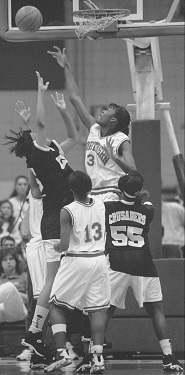
Tawana Towers: 1994 Class A Girls Basketball Final at Kellogg Arena, Battle Creek – Flint Northern, coached by Leteia Hughley and led by 6-4 freshman Tawana McDonald, defeated 1993 runner-up Detroit Martin Luther King, 46-32, for the Class A championship. McDonald batted down an MHSAA-record 10 shots, pulled down 13 rebounds and added five points and seven assists in a stellar performance.
Never Quit: 2008 Division 2 Football Semifinal, Spartan Stadium, East Lansing – Unbeaten, No. 1-ranked and heavily favored Muskegon trailed Davison by 22 late in the third quarter and 16 with less than five minutes to play. In perhaps the greatest comeback in playoff history, Muskegon recovered two onside kicks and scored 19 points in the final 4:31 to escape with a 38-35 victory and its third trip in five years to an MHSAA Final.
MHSAA Legends: 1998-2008 – For 10 years, the MHSAA showcased great teams from the past with their Legends of the Game series. From a historian’s perspective it was a chance to meet and learn more about folks I had often known only from the pages of microfilm. It was quite the treat to see years fall away as coaches, team managers and players reunited, in many cases for the first time after decades apart.
The MHSAA Record Books: Online, 1994 – One of my first efforts as state historian was to expand the record books beyond their primary focus on football, basketball, track & field and swimming & diving. With the arrival of the internet, an enhanced version of the record books was brought online. Coaches and fans were quick to respond with letters and e-mails, happily listing entries that had been “missed.” Soon, five category headings in a sport grew to 20, then to 50 and beyond.
Kids: 2004 Football Finals, Pontiac Silverdome – (OK, this is No. 11 ... consider it an extra point). For the first time, my sons joined me for my annual excursion to Metro Detroit for a Thanksgiving Day football weekend. They got to see the Silverdome before the move of the MHSAA Football Finals to beautiful Ford Field. Future Big Reds, they also got to see their future alma mater win another title.
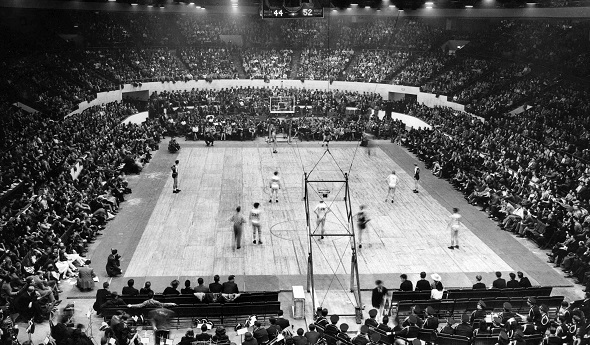
PHOTOS: (Top) An MHSAA boys basketball tournament game is played at Olympia Stadium in Detroit. (Middle) Flint Northern's Tawana McDonald blocks a shot during the 1994 Class A Final.
Grand Haven Playmakers Rising to Challenge After Loss of Senior Standout
By
Tom Kendra
Special for MHSAA.com
September 9, 2026
Grand Haven was expected to have one of the state’s best backfield duos this season in seniors Andrew Willemsen and KV Korenstra.
 That duo became singular in July, when Willemsen tore his ACL for the second-consecutive year, a gut-punch both for him and the Buccaneers’ coaching staff – which was planning on handing the ball to Willemsen 20-plus times per game.
Despite that emotional setback, Haven is off to its first 2-0 start since 2018, as the team’s many other offensive standouts – notably Korenstra and senior quarterback Easton Hintz – have stepped up their games.
“We all feel so bad for Andrew, and it just makes us appreciate things so much more,” said Korenstra, a Ferris State commit who rushed for 519 yards and caught 26 passes for 291 yards last fall.
“It’s good for our morale to be 2-0, but we all know that we can play so much better and that we have to play so much better, especially on offense.”
Grand Haven (2-0) heads into the gauntlet of its schedule the next three weeks, starting with Friday night’s Ottawa-Kent Conference Red opener at defending league champion Hudsonville, followed by East Kentwood at home and at Rockford.
The Bucs have found a way to win two tight games, a 35-34, triple-overtime thriller over visiting Spring Lake in the opener and then a hard-fought, 17-14 road win at Muskegon Reeths-Puffer last week.
“It hasn’t always been pretty, but we have been able to finish games out, which hasn’t been the case in the past,” said fourth-year Grand Haven coach Andrew Biedenbender, a Mount Pleasant native who played offensive line at Grand Valley State. “We can’t puff our chests out. We understand what’s ahead of us, but going into it with the confidence we now have is big.”
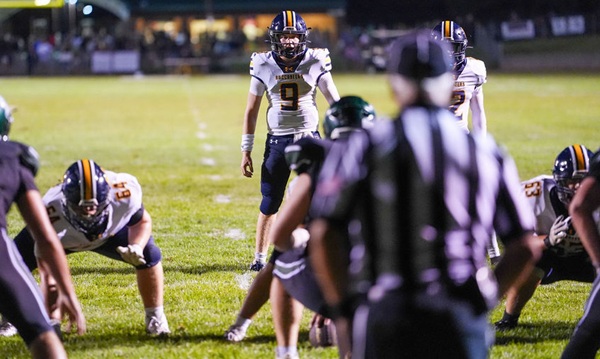
 Senior quarterback Easton Hintz has been the catalyst, completing 28-of-42 passes (67 percent) for 359 yards and four touchdowns, with no interceptions. The dual-threat playmaker also has rushed for 168 yards and a score.
Hintz employs a variety of receiving options, starting with 6-foot-2 wideout Amani Frierson, another Ferris State commit, who has 11 catches for 151 yards and a touchdown.
An emerging weapon for the Bucs is junior tight end Grayam Beyer (6-6, 225), who had a breakout game against Spring Lake with four catches for 43 yards, including two TDs. Beyer already has five Division I college offers and visited Ohio State last Saturday.
If those weapons draw excessive attention, Hintz often hooks up with shifty junior slot receivers Lennon Jorgensen and Drew Hammerle.
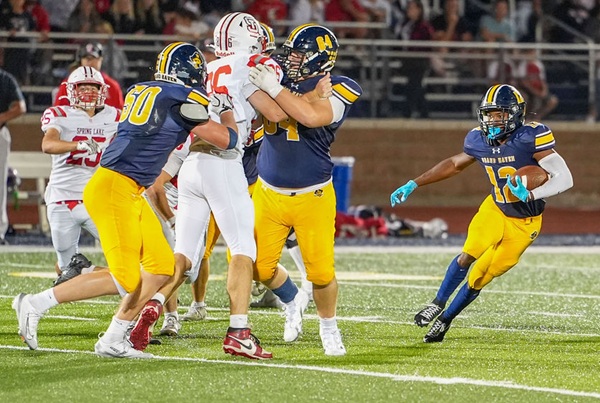
Korenstra has been solid, if not spectacular, with 157 rushing yards and two TDs through two games. Korenstra, who finished third at the Lower Peninsula Division 1 Finals in the 100-meter dash last spring (10.79), has been slowed by a sprained ankle which he suffered early in the opening game.
“If you saw him early last week, you would have never thought he could play a football game,” said Biedenbender of the senior speedster, who was clocked at 4.28 seconds in the 40-yard dash this summer.
“So he has been fighting that ankle but still has hit a couple of 15- or 20-yard runs, but we’re waiting for him to break off a couple of 40- or 50-yarders.”
While he waits for Korenstra to get back up to full speed, Biedenbender occasionally allows himself to imagine what might have been this fall if Willemsen had stayed healthy.
The three-sport standout and athletic freak burst onto the scene as a sophomore with 1,321 yards and 11 TDs. He missed his entire junior year after tearing his ACL during summer workouts but came all the way back and was part of two school-record sprint relay teams in track this spring.
 His recovery was so impressive (running a 4.3 40-yard dash and squatting almost 500 pounds early this summer) that he was offered a scholarship at Grand Valley. Willemsen was working out at GVSU in July when the unthinkable happened – a full tear of his other ACL.
“It’s like having a sports car in your garage that you never had a chance to drive,” said Biedenbender, whose main assistants are Matt Naber (offensive coordinator) and Eric Rozema (defensive coordinator). “He’s one of the best athletes ever at Grand Haven that no one’s going to know about. He has some great football ahead of him but, unfortunately, it won’t be for us.”
The Buccaneers still possess a variety of weapons that other teams would love to have, with an experienced senior quarterback in Hintz directing the show. Hintz (6-0, 185) threw for 975 yards last fall despite missing about one-third of the season with an injury, but is now on pace to easily eclipse the 1,000-yard passing plateau.
Haven’s 2-0 start also has put the team in position to make some noise in the conference race and compete for five wins and the school’s first playoff berth since 2019.
The quick start is a continuation of success at Grand Haven, which won the Division 1 boys volleyball title in the spring, to go along with a Finals appearance in softball and a fifth-place team finish in boys track.
“So much of it comes down to belief,” said Hintz, a crafty left-hander who is just as comfortable throwing on the run as he is in the pocket. “Our aiming point is making it to the playoffs and then winning a playoff game, which is something that hasn’t been done at this school in a long time. I believe we have the team to do it.”
 Tom Kendra worked 23 years at The Muskegon Chronicle, including five as assistant sports editor and the final six as sports editor through 2011. E-mail him at [email protected] with story ideas for Muskegon, Oceana, Mason, Lake, Oceola, Mecosta and Newaygo counties.
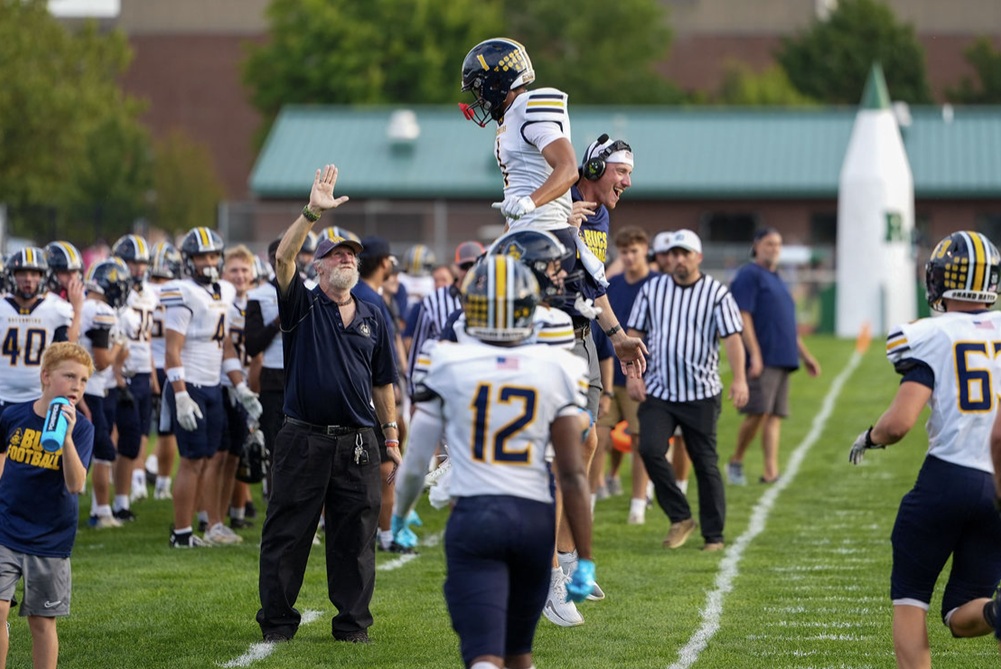
PHOTOS (Top) Fourth-year Grand Haven coach Andrew Biedenbender celebrates with wideout Amani Frierson (1) during last week’s victory over Muskegon Reeths-Puffer. (Middle) KV Korenstra (12) follows his blockers against Spring Lake. (Below) Senior quarterback Easton Hintz (9) prepares to take a snap against Reeths-Puffer. (Photos by Josh Walters/JWaltVisuals.)