

105 Schools Recognized As HEARTSafe
October 19, 2016
The Michigan Departments of Health and Human Services (MDHHS), and Education (MDE); American Heart Association (AHA); Michigan High School Athletic Association (MHSAA); and Michigan Alliance for Prevention of Sudden Cardiac Death of the Young (MAP-SCDY) have awarded 105 schools in Michigan with the MI HEARTSafe School designation which recognizes schools that are prepared to respond to cardiac emergencies.
“Many sudden cardiac deaths that claim the lives of children and young adults could be prevented through screening, detection, and treatment,” said Dr. Eden Wells, chief medical executive of MDHHS. “Appropriate medical response within three to five minutes is crucial for increasing the chance of survival, which is why I’m pleased to see so many of our schools taking vital measures to prepare and address this health issue.”
In order for a school to receive a MI HEARTSafe School designation, it must perform at least one cardiac emergency response drill per year, have a written medical emergency response plan and team, have current CPR/AED certification of at least 10 percent of staff, 100 percent of head varsity coaches, and 50 percent of P.E. staff; have accessible, properly maintained and inspected AEDs with signs identifying their location; and ensure pre-participation sports screening of all student athletes using the current physical and history form endorsed by the Michigan High School Athletic Association.
“We are so proud to support Michigan’s HEARTSafe schools,” said State Superintendent Brian Whiston. “Ensuring schools are prepared for sudden cardiac emergencies through planning, training, and life-saving AEDs is an important part of having safer learning environments for students, staff, and the community.”
Between 2003 and 2012 in Michigan, there were 2,590 young individuals between 1 and 39 years of age who died of sudden cardiac death. Of those, 214 were between 5 and 19 years of age. This is the third year of the MI HEARTSafe Schools program in Michigan. In the first two years of the initiative, 162 schools were previously designated as MI HEARTSafe Schools and prepared to help reduce the number of sudden cardiac deaths in our youth.
Public Act 12 of 2014 requires all schools (grades kindergarten to 12) to have a cardiac emergency response plan in place. This MI HEARTSafe School designation recognizes the 267 school buildings that have taken steps above and beyond to prepare to respond in the event of a cardiac emergency, and is awarded for a period of three years. Click for the list of designated schools.
Schools that meet all of the requirements will be able to apply for the MI HEARTSafe School designation each year. Click for information about the MI HEARTSafe Schools program.
Parade of Champions 2015-16
By
Geoff Kimmerly
MHSAA.com senior editor
June 23, 2016
By Geoff Kimmerly
Second Half editor
Seven schools hoisted Michigan High School Athletic Association team championship trophies for the first time this school year, as 99 schools total won one or more of the 130 Finals championships awarded during 2015-16.
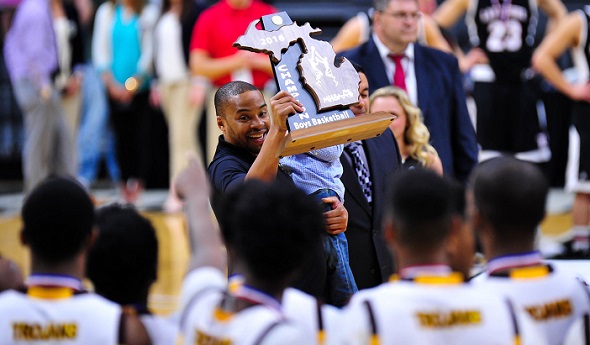
Teams earning the first MHSAA championship in any sport for their schools were Sterling Heights Parkway Christian in baseball, Detroit Henry Ford in boys basketball, Ypsilanti Arbor Prep in girls basketball, Tawas and Clarkston Everest Collegiate in boys golf, Burton Genesee Christian in boys soccer and Bloomfield Hills in boys tennis.
A total of 37 teams won their first MHSAA titles in their respective sports. A total of 50 champions were repeat winners from 2014-15 – and 25 of those won for at least the third straight season, up from 16 that accomplished the same feat a year ago. Still, championships were more spread out this school year; the 99 schools winning at least one title were nine more than in 2014-15.
The Birmingham Brother Rice boys lacrosse team has the longest title streak of 12 seasons, while the Ann Arbor Greenhills boys tennis team has won eight straight titles for the second-longest streak overall. The Gibraltar Carlson competitive cheer and Marquette girls track & field teams share the longest girls winning streaks with six straight championships apiece.
Marquette again claimed the most MHSAA team titles, six, winning in Division 1 boys skiing and Division 1 girls skiing, Upper Peninsula Division 1 girls cross country, Upper Peninsula boys swimming & diving, and Upper Peninsula Division 1 boys track & field and girls track & field. Ishpeming won five titles, and four more schools won at least three titles – Grand Rapids Forest Hills Central, Ithaca, Negaunee and Rockford (including the championship won by the combined Rockford/Sparta girls gymnastics team.)
Sixteen of the MHSAA's 28 championship tournaments are unified, involving teams from the Upper and Lower Peninsulas, while separate competition to determine titlists in both Peninsulas is conducted in remaining sports.
For a sport-by-sport listing of MHSAA champions for 2015-16 - Click Here (PDF)
PHOTO: Detroit Henry Ford boys basketball coach Kenneth Flowers hoists his team's Class B championship trophy this winter.