


2019-20 Classifications Announced
April 8, 2019
By Geoff Kimmerly
Second Half editor
Classifications for Michigan High School Athletic Association elections and postseason tournaments for the 2019-20 school year have been announced, with enrollment breaks for postseason tournaments posted to each sport’s page on the MHSAA Website.
Classifications for the upcoming school year are based on a second semester count date, which for MHSAA purposes was Feb. 13. The enrollment figure submitted for athletic classification purposes may be different from the count submitted for school aid purposes, as it does not include students ineligible for athletic competition because they reached their 19th birthday prior to September 1 of the current school year and will not include alternative education students if none are allowed athletic eligibility by the local school district.
Traditional classes (A, B, C, D) are used only for MHSAA elections and football playoff purposes – in 11-player to determine opponents’ point values, and in 8-player to determine if schools are eligible to compete in the MHSAA Playoffs (only Class D teams may participate in the postseason). All other sports’ tournaments will be conducted with schools in equal or nearly equal divisions.
To determine traditional classifications, after all counts are submitted, tournament-qualified member schools are ranked according to enrollment and then split as closely into quarters as possible. For 2019-20, there are 748 tournament-qualified member schools with 187 schools in each class.
Effective with the 2019-20 school year, schools with 863 or more students are in Class A. The enrollment limits for Class B are 395-862, Class C is 189-394, and schools with enrollments of 188 and fewer are Class D. The break between Classes A and B decreased 22 students from 2018-19, the break between Classes B and C decreased three students, and the break between Classes C and D is five students fewer than the current school year.
Schools recently were notified of their classification. MHSAA Executive Director Mark Uyl said schools may not subsequently lower their enrollment figure. However, if revised enrollment figures are higher and indicate that a school should be playing in a higher division, that school would be moved up.
Schools have the option to play at any higher division for a minimum of two years, but must exercise the option by May 1 for fall sports, August 15 for winter sports and October 15 for spring sports.
The divisions and qualifiers for the MHSAA Football Playoffs will be announced on Selection Sunday, Oct. 27, 2019. Visit the respective sport pages on the MHSAA Website to review the divisional alignments for all other MHSAA-sponsored tournament sports.
Among teams that will be playing in new divisions in 2019-20 are two reigning MHSAA champions. The Rochester Adams girls swimming & diving team will be moving into Lower Peninsula Division 1 this fall after winning Division 2 in 2018. The Saugatuck boys cross country team will move into Lower Peninsula Division 3 after winning Division 4 last fall. Additionally, two-time reigning Division 3 girls soccer champion Flint Powers Catholic is playing in Division 2 this spring, but will move back into Division 3 for the 2020 season. There will be a guaranteed new champion in Division 1 boys bowling in 2020 as this winter’s winner Farmington Hills Harrison will be closing after this school year.
A complete list of school enrollments used to determine classifications for the 2019-20 school year can be found on the Enrollment & Classification page of the MHSAA Website.
The new classification breaks will see 17 schools move up in class for 2019-20 while 12 schools will move down. (Note: This list does not include schools opting up in class/division for tournaments, which can be found on the Administrators page of the MHSAA Website, under Enrollment, Classification, Co-Ops):
Moving Up from Class B to Class A
Battle Creek Harper Creek
Dearborn Divine Child
Marysville
Parma Western
Pontiac
Stevensville Lakeshore
Moving Down from Class A to Class B
Clio
Grand Rapids Christian
Ortonville Brandon
Owosso
Redford Union
Moving Up from Class C to Class B
Adrian Madison
Dearborn Advanced Technology Academy
Flint Hamady
Moving Down from Class B to Class C
Detroit West Side Academy
Leslie
Moving Up from Class D to Class C
Adrian Lenawee Christian
Benton Harbor Countryside Academy
Deckerville
Kingston
Lutheran Westland
Mayville
Merrill
Saginaw Michigan Lutheran Seminary
Moving Down from Class C to Class D
Big Rapids Crossroads Academy
Britton Deerfield
Dryden
Eau Claire
Newberry
New Postseason Eligible Tournament Schools in 2019-20
Southfield Manoogian
Flint New Standard
Midland Calvary Baptist Academy
Starr Albion Prep
Whitmore Lake Livingston Classical
Enrollment Breaks by Classes – 2019-20
(Number of schools in parentheses)
Class A: 863 and above (187 schools)
Class B: 395 – 862 (187)
Class C: 189 – 394 (187)
Class D: 188 and below (187)
The MHSAA is a private, not-for-profit corporation of voluntary membership by more than 1,500 public and private senior high schools and junior high/middle schools which exists to develop common rules for athletic eligibility and competition. No government funds or tax dollars support the MHSAA, which was the first such association nationally to not accept membership dues or tournament entry fees from schools. Member schools which enforce these rules are permitted to participate in MHSAA tournaments, which attract more than 1.4 million spectators each year.
Rep Council Wrap-up: Fall 2012
December 7, 2012
A change in format for the Boys Basketball Finals highlighted actions taken by the Representative Council of the Michigan High School Athletic Association during its annual Fall Meeting, Nov. 30 in East Lansing.
Mirroring closely the format of the MHSAA Girls Basketball Finals, the Boys Finals will move this season from three to two sessions. The first session will tip off with the Class D Final at 10 a.m., followed by the Class A championship game. The second session will begin tentatively at 4:30 p.m. with the Class C Final and conclude with the Class B title game.
Previously, the Class A and B Finals were separate sessions, with the Class A Final tipping at 4 p.m. and Class B at 8 p.m. The change will make for a shorter day for spectators wishing to attend all four games, and also allow them to do so by purchasing tickets for two sessions instead of three.
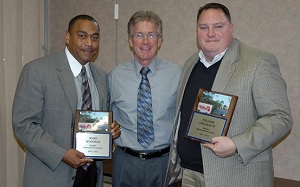 The Fall Meeting also saw the addition of two members to the 19-person council. Reese Public Schools athletic director Dave Derocher began a two-year term after being elected earlier this fall to represent Class C and D schools in the northern Lower Peninsula. Orlando Medina, who serves as athletic coordinator for Harrison Township L’Anse Creuse Public Schools, was appointed for a two-year term. He also previously served as athletic director at Detroit Cesar Chavez Academy. They fill positions formerly held by Beal City superintendent William Chilman IV and Romulus High School athletic director Mark Woodson, whose terms ended.
Also, Carmen Kennedy, principal at St. Clair Shores South Lake High School, was reappointed for a second two-year term. The Representative Council is the legislative body of the MHSAA. All but five members are elected by member schools. Four members are appointed by the Council to facilitate representation of females and minorities, and the 19th position is occupied by the Superintendent of Public Instruction or designee.
The most prominent points discussed at the Fall Meeting were risk minimization for athletes and possible strategies for making school sports safer. Among topics discussed were raising expectations for coaches’ participation in online safety courses and schools’ management of heat illness; the possible restructuring of practice policies in regards to hot weather; and game rules revisions to enhance safety especially in football, soccer and ice hockey.
The Council reviewed its previous actions on those topics, including discussions in December 2011 that led to the inclusion of health and safety content in online rules meetings. Council members considered a model policy for managing heat and humidity, and also a number of ideas collected during Fall Update meetings with administrators throughout the state.
No action was requested on those items at the Fall Meeting. Complete and vetted proposals are likely to be considered when the Council next meets in March and then May.
PHOTO: Outgoing Representative Council members Mark Woodson of Romulus (left) and William Chilman IV (right) are presented plaques for their service by MHSAA Executive Director Jack Roberts (middle) during the Fall Meeting.