


2020 Bush Awards Honor Dedicated ADs
By
Geoff Kimmerly
MHSAA.com senior editor
October 21, 2020
East Grand Rapids’ Tim Johnston, Maple City Glen Lake’s Mark Mattson, Vicksburg’s Michael Roy and Gaylord’s Christian Wilson all lead programs that frequently earn headlines for success in competition.
But these four athletic directors also are known in their local and statewide sports communities for the positive experiences they help provide students, their own as well as those who take part in the same leagues or tournament events they frequently host.
To honor their often unsung work in creating these experiences for athletes, all four have been named recipients of the Michigan High School Athletic Association’s Allen W. Bush Award for 2020.
Al Bush served as executive director of the MHSAA for 10 years. The award honors individuals for past and continuing service to prep athletics as a coach, administrator, official, trainer, doctor or member of the media. The award was developed to bring recognition to men and women who are giving and serving without a lot of attention. This is the 29th year of the award, with selections made by the MHSAA's Representative Council.
“Leaders among peers, ceaseless dedication, never saying ‘no’ when needed – these are how this year’s Bush Award honorees are described by their colleagues, and how we’ve come to know them as well,” MHSAA Executive Director Mark Uyl said. “What they give willingly for school sports goes far beyond awards they’ve received, and at the same time often receives little attention. We’re delighted to recognize all of their continuing contributions.”
Johnston has begun his 39th year in education, with the last eight for East Grand Rapids Public Schools, where he has led one of the state’s most successful athletic programs – EGR, which offers 34 varsity sports, was named a Michigan Exemplary Athletic Program in 2018 by the Michigan Interscholastic Athletic Administrators Association (MIAAA). Johnson was chosen as his region’s Athletic Director of the Year by the MIAAA in 2017. He previously served as a teacher and coach at Grand Rapids Catholic Central, and then as an athletic director and principal at Hastings.
 He has made significant contributions to Michigan’s largest high school league, having served as president, vice president, secretary and realignment chairperson for the Ottawa-Kent Conference, and hosted various MHSAA Tournament competitions for the District, Regional and Finals rounds. Johnston also has served on multiple MHSAA sport committees and its board of canvassers, and as part of the Scholar-Athlete Award selection committee. Additionally, he has served as an instructor for the MHSAA’s Coaches Advancement Program (CAP) and as a program presenter at conferences for both the MIAAA and National Interscholastic Athletic Administrators Association (NIAAA) – and served as Michigan’s delegate to the latter.
After graduating from Grand Rapids Catholic Central, Johnston earned an associate degree from Grand Rapids Junior College and a bachelor’s from Grand Valley State University, and then a master’s in education leadership from Michigan State University. He earned his certified athletic administrator (CAA) designation from the NIAAA.
“Tim has always been incredibly positive in advocating for kids,” MHSAA Executive Director Mark Uyl said. “I’ve known Tim for years as a principal and as an athletic director, and there’s absolutely no one who better sees the big picture of how academics and athletics fit together.”
Mattson is into his 22nd year coaching, teaching or serving as an administrator in Michigan high schools, and in his second tenure as athletic director at Maple City Glen Lake. He previously served in the same role and others at Marquette High School for 11 years and then as athletic director at Traverse City Central before returning to Glen Lake as athletic director and assistant principal. He also coached and taught in Rhinelander, Wis., to begin his career, and served as an undergrad men’s basketball assistant coach at Northern Michigan University.
 Mattson also is a frequent MHSAA Tournament host and participated on sport committees for skiing, football, basketball, cross country and track & field, and has served as an MIAAA regional representative and as secretary for the Big North Conference. He received MIAAA regional Athletic Director of the Year awards in both 2008 and 2018, and was selected as the Upper Peninsula Athletic Director of the Year in 2006.
A current member of the MHSAA Representative Council – representing Class C and D schools in the northern Lower Peninsula – Mattson is a graduate of L’Anse High School and earned his bachelor’s degree and then his master’s in educational administration both from NMU. While at NMU and into his tenure at Marquette, Mattson also was a registered MHSAA official in football and basketball for a decade and briefly for softball and volleyball.
“Mark, having served his career in northern Michigan and the Upper Peninsula, always brings a unique perspective on how the largest schools survive in northern Michigan,” Uyl said. “Schools like Marquette and Traverse City Central face a unique challenge. He’s always been an advocate for schools with those unique circumstances – but also for all schools up north, and especially now as part of the Representative Council.”
Roy is a graduate of Paw Paw High School who returned to Michigan after earning bachelor’s and master’s degrees – the latter in curriculum and instruction – at the University of Nevada-Las Vegas, where he also was a member of the football team for two years. He is into his 22nd year as an athletic administrator, serving three years at Lawton before joining the Vicksburg administration at the start of the 2001-02 school year. He has hosted more than 100 MHSAA postseason events and numerous CAP sessions while also serving as a CAP instructor, and his Vicksburg program received the Exemplary Athletic Program award in 2020.
 Roy served as president of the MIAAA during the 2019-20 school year and has made vast contributions as part of the athletic directors’ professional organization with more than 15 years as a regional representative and 10 times serving as the state’s NIAAA delegate at the National Federation of State High School Associations (NFHS) national conference. He has served more than a decade as a Leadership Training Institute instructor for the MIAAA and as part of the NIAAA national teaching faculty.
He has received three certifications from the NIAAA including the certified master athletic administrator designation in 2005. Roy was named his region’s Athletic Director of the Year by the MIAAA in 2009 and state Athletic Director of the Year in 2012 – when he was also a finalist for national Athletic Director of the Year from the National High School Coaches Association.
“Mike has been incredibly giving with his time, especially with his leadership with the MIAAA,” Uyl said. “He has a can-do attitude, whether it be in hosting events or with other problem-solving he’s provided our entire MHSAA staff over many years.”
Wilson is into his 19th year in education, serving as athletic director and assistant principal for Gaylord Community schools; he also briefly served as athletic director at Novi High School and as high school athletic director in Mount Gilead, Ohio, and taught in Auburndale, Wis.
 Wilson also is a frequent host of MHSAA Tournament events – he hosted more than 10 during the 2019-20 school year alone – and also has served on various MHSAA committees. He has served as president of the Big North Conference and provided his expertise to the local Little League and youth football boards. He was named his region’s Athletic Director of the Year by the MIAAA in 2016.
A graduate of Chassell High School, Wilson then earned his bachelor’s degree from Northern Michigan University and a master’s in athletic administration from Western Michigan University. Prior to beginning his career in education, Wilson served as an assistant men’s basketball coach at both Michigan Technological University and Western Michigan. He played at Michigan Tech before finishing his career at NMU.
“Christian has been a successful administrator for many years because of his outstanding temperament and the way he connects with people,” Uyl said. “He’s someone who takes the work seriously, but never takes himself too seriously. He has served as a mentor to so many, and he’s very gifted at building relationships. At the end of the day, that’s what our business is about – those relationships.”
The MHSAA is a private, not-for-profit corporation of voluntary membership by more than 1,500 public and private senior high schools and junior high/middle schools which exists to develop common rules for athletic eligibility and competition. No government funds or tax dollars support the MHSAA, which was the first such association nationally to not accept membership dues or tournament entry fees from schools. Member schools which enforce these rules are permitted to participate in MHSAA tournaments, which attract more than 1.4 million spectators each year.
Former Siena Heights Coach Kohn Excited for Next Phase as Lenawee Christian AD
By
Doug Donnelly
Special for MHSAA.com
June 3, 2026
When Matt Kohn found out that Siena Heights University was closing its doors at the end of the 2025-26 school year, he was on vacation at a southern Indiana campground with his family.
 He got out of the water, answered a call from one of the Siena Heights assistant coaches and was given the shocking news. Within minutes, he dried off and was packed and in his car, making the four-hour drive back to Adrian to meet with his coaching staff and players.
“I did it for my coaches,” Kohn said. “It was important for us to be on the same page and get together a game plan.”
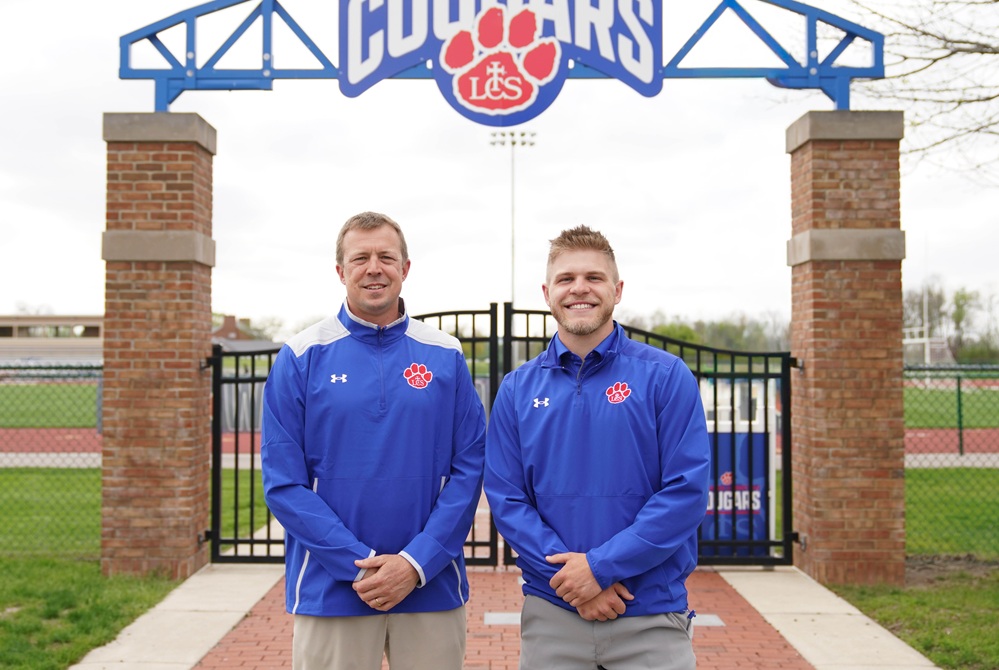
Kohn, 44, is putting together a new game plan these days. The Adrian native began his new job this week as the athletic director at Adrian Lenawee Christian schools.
It’s a significant change from being head coach of the NAIA Saints, a position he held for the past decade. At Siena Heights, his football team typically had 120-130 players. Lenawee Christian, a Class D-size school, will have an enrollment of 114 this fall.
“It’s all relative,” Kohn said.
Instead of overseeing a team with 14 assistant coaches, he will lead an athletic program that has had incredible success over the years. Over the past decade, the Cougars have won two Division 4 girls basketball championships and three 8-Player football title. LCS won two Girls Volleyball Finals in the early 2000s, and the boys basketball program has 11 Regional titles and a Finals appearance since 1998.
The school takes tremendous pride in its athletic program and Kohn, who lives just minutes from campus, is excited to be a part of the LCS family.
“This is a great opportunity for myself and my family, and truly is done by God,” Kohn said. “Being able to stay home and continue into the next phase of my professional career is really all I could have asked for.”
Kohn finished out the school year at Siena Heights, helping find new schools for his remaining football players and new homes for his coaching staff.
“They made a commitment to me by coming to Siena Heights,” he said. “I felt it was important that I remained committed to them.”
As the end of the school year became closer and closer, however, he started searching for his next career move. He didn’t want to move out of the Adrian area but also knew he needed to find a job. When previous LCS athletic director Craig Anderson was promoted to principal, Kohn applied for the administrator position.
 “I have so many connections to LCS,” he said. “I couldn’t be more excited.”
While growing up in Adrian, his dad, Bill Kohn, was a head football coach at multiple schools in Lenawee County, including Morenci, Adrian – and Lenawee Christian.
On its campus on the west side of Adrian off US-223, LCS has what it calls The Centre, which offers fitness and training facilities, youth and adult sports leagues, an indoor pool and outdoor water recreation area. The Centre opened in 1988. Kohn said his parents would drop him off at The Centre when he was a kid to play sports. It’s where he developed his love for athletes.
Eventually he became a record-setting quarterback at Adrian High School and played in the Michigan High School Coaches Association East-West All-Star game. He went on to play quarterback at the University of Indianapolis and spent time with the Ohio Valley Greyhounds of the United Indoor Football Association and two seasons in the Arena Football League with the Nashville Kats and Kansas City Brigade.
He returned to the University of Indianapolis to coach for three seasons before returning to Adrian to join the fledgling Siena Heights football program. In 2016 he was named the interim head coach and took over the job full-time in 2017. Over 10 seasons overall, the Saints won 50 games and had just one sub-.500 finish. They were often ranked nationally and nearly made the NAIA playoffs a couple of times.
“I can honestly say I showed up to work every single day for 15 years, and I gave it everything I had,” Kohn said of being a college head football coach. “There's not a drop of me left that I did not spend in investing in my coaches and investing in my players and getting our guys ready for games and training them and recruiting. That program got every last drop of Matt Kohn. So, I don't have any regrets in that regard.”
Kohn is part of a bit of a transition at Lenawee Christian. The Cougars named a new varsity football coach this week, and with Anderson becoming principal, the school has also hired Noah Beaudrie, an Erie Mason graduate and former quarterback at Adrian College, as the assistant athletic director. Beaudrie comes from a family of athletes. His father is the football head coach at Monroe Jefferson, which had its best season in years last fall, and his sister won a Finals championship in track & field last weekend.
“I’m blessed to have someone like Noah by my side,” Kohn said.
Kohn said in his new role, he will bring his passion for developing student-athletes to the high school level.
“I'm coming into an incredible situation with incredibly strong team members,” he said. “That definitely motivates me every morning, to come to work and just get a little better every day because of the team I have around me.”
 Doug Donnelly has served as a news and sports reporter at the Adrian Daily Telegram and the Monroe News for 30 years, including 10 years as city editor in Monroe. He's written a book on high school basketball in Monroe County and compiles record books for various schools in southeast Michigan. He is now publisher and editor of The Blissfield Advance, a weekly newspaper. E-mail him at [email protected] with story ideas for Jackson, Washtenaw, Hillsdale, Lenawee and Monroe counties.
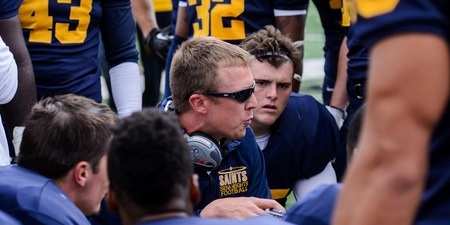
PHOTOS (Top) New Adrian Lenawee Christian athletic director Matt Kohn, left, and assistant Noah Beaudrie post for a photo in front of the school’s stadium gate. (Middle) Kohn huddles with his Siena Heights football team. (Top photo courtesy of Lenawee Christian Schools. Middle photo courtesy of the Siena Heights athletic program.)