


23rd WISL Conference Set for Feb. 4-5
January 11, 2018
By Geoff Kimmerly
Second Half editor
The first, largest and longest-running program of its type in the country, the Michigan High School Athletic Association’s Women In Sports Leadership Conference will take place Feb. 4-5 at the Crowne Plaza Lansing West.
The 23rd edition of the conference again will feature three keynote speakers and a variety of workshops. The program annually attracts upwards of 500 participants, most of them high school female student-athletes. High school students, coaches and administrators are invited to find registration information on the MHSAA Website.
Cost is $50 for students and $60 for adults, not including lodging for those intending to stay overnight in Lansing. A registration form for lodging also is available on the MHSAA Website.
The theme for this WISL Conference is “LEAD: Embrace the Challenge” – and the opening address will be delivered by U.S. national team volleyball setter Alisha Glass, who starred at Leland High School and led the Comets to the Class D championship as a senior in 2006. She continues to hold four MHSAA records including for career kills (3,584) and aces (937) and went on to start all four seasons as a setter at Penn State, leading the Nittany Lions to three straight NCAA Division I championships. Glass then led the U.S. national team to the 2014 world championship and the 2016 Olympic bronze medal. She will speak on 21st century leadership responsibilities and daily leadership opportunities student athletes may encounter.
The winningest coach in NCAA softball history, University of Michigan’s Carol Hutchins, will speak on the importance of leadership and continually sharpening those skills at the WISL Banquet during the evening of Feb. 4. Hutchins, a graduate of Lansing Everett High School and Michigan State University, has built a 1,527-491-5 record over 33 seasons and also is the winningest coach in Michigan athletic department history. Hutchins joined the Wolverines staff as an assistant in 1983 and took over the program as head coach in 1985. She led Michigan to the College World Series championship in 2005 and a runner-up finish in 2015. Hutchins played both softball and basketball at Michigan State and helped the Spartans to the 1976 Association of Intercollegiate Athletics for Women national softball championship. She also holds a master’s degree from Indiana University.
Michigan State University women’s volleyball coach Cathy George will challenge participants to “find the leader in you” throughout life during the morning of Feb. 5. George recently completed her 13th season at MSU and 31st overall as a college head coach by guiding the Spartans to the NCAA Elite Eight. Her 256 wins at MSU are the most in program history, and she has a career record of 621-398 – counting also 11 seasons leading Western Michigan University, five at University of Texas-Arlington and two at North Dakota State. Her MSU teams have made the NCAA Tournament seven straight seasons. As an athlete, George was a team captain and three-time all-league selection at Illinois State, helping the Redbirds to three NCAA Tournament appearances.
Workshops offered during the WISL conference include topics on coaching, teaching and learning leadership, sports nutrition and performance, injury prevention, promoting team chemistry and roles and responsibilities of captains. A complete itinerary is available on the MHSAA Website.
The WISL Banquet will include the presentation of this year’s Women In Sports Leadership Award. The winner will be announced later this month.
Follow the #WISL hashtag on Twitter to learn more about the conference’s activities.
MHSAA Suspends Winter Tournaments
March 12, 2020
By Geoff Kimmerly
Second Half editor
Postseason events sponsored by the Michigan High School Athletic Association have been suspended immediately and indefinitely due to concerns related to COVID-19.
The Ice Hockey, Girls Gymnastics and Lower Peninsula Boys Swimming & Diving Finals had been scheduled for this weekend, while the Girls & Boys Basketball Tournaments are midway through earlier rounds of their playoff progressions.
On Wednesday, Gov. Gretchen Whitmer recommended a stoppage of large gatherings in order to assist in preventing the spread of COVID-19.
“Based on the events of the last 48 hours and with things changing by the minute, we believe we have no choice but to suspend our winter tournaments immediately,” MHSAA Executive Director Mark Uyl said. “This is a suspension until we have a better handle on the situation. The health and welfare of everyone involved is our number one priority.”
Uyl added that more information and updates will be forthcoming over the next few days. No timetable has been determined for possible rescheduling for tournaments.
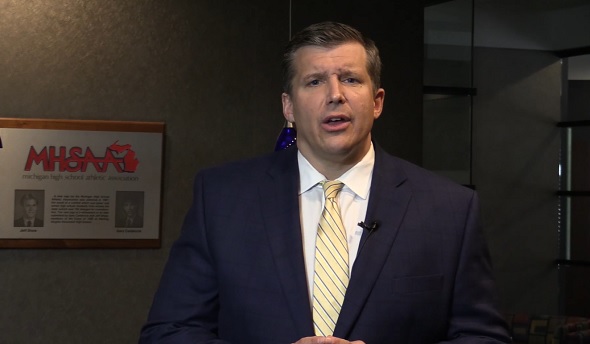
Click for a video statement from Mark Uyl.
The MHSAA is a private, not-for-profit corporation of voluntary membership by more than 1,500 public and private senior high schools and junior high/middle schools which exists to develop common rules for athletic eligibility and competition. No government funds or tax dollars support the MHSAA, which was the first such association nationally to not accept membership dues or tournament entry fees from schools. Member schools which enforce these rules are permitted to participate in MHSAA tournaments, which attract more than 1.4 million spectators each year.