


23rd WISL Conference Set for Feb. 4-5
January 11, 2018
By Geoff Kimmerly
Second Half editor
The first, largest and longest-running program of its type in the country, the Michigan High School Athletic Association’s Women In Sports Leadership Conference will take place Feb. 4-5 at the Crowne Plaza Lansing West.
The 23rd edition of the conference again will feature three keynote speakers and a variety of workshops. The program annually attracts upwards of 500 participants, most of them high school female student-athletes. High school students, coaches and administrators are invited to find registration information on the MHSAA Website.
Cost is $50 for students and $60 for adults, not including lodging for those intending to stay overnight in Lansing. A registration form for lodging also is available on the MHSAA Website.
The theme for this WISL Conference is “LEAD: Embrace the Challenge” – and the opening address will be delivered by U.S. national team volleyball setter Alisha Glass, who starred at Leland High School and led the Comets to the Class D championship as a senior in 2006. She continues to hold four MHSAA records including for career kills (3,584) and aces (937) and went on to start all four seasons as a setter at Penn State, leading the Nittany Lions to three straight NCAA Division I championships. Glass then led the U.S. national team to the 2014 world championship and the 2016 Olympic bronze medal. She will speak on 21st century leadership responsibilities and daily leadership opportunities student athletes may encounter.
The winningest coach in NCAA softball history, University of Michigan’s Carol Hutchins, will speak on the importance of leadership and continually sharpening those skills at the WISL Banquet during the evening of Feb. 4. Hutchins, a graduate of Lansing Everett High School and Michigan State University, has built a 1,527-491-5 record over 33 seasons and also is the winningest coach in Michigan athletic department history. Hutchins joined the Wolverines staff as an assistant in 1983 and took over the program as head coach in 1985. She led Michigan to the College World Series championship in 2005 and a runner-up finish in 2015. Hutchins played both softball and basketball at Michigan State and helped the Spartans to the 1976 Association of Intercollegiate Athletics for Women national softball championship. She also holds a master’s degree from Indiana University.
Michigan State University women’s volleyball coach Cathy George will challenge participants to “find the leader in you” throughout life during the morning of Feb. 5. George recently completed her 13th season at MSU and 31st overall as a college head coach by guiding the Spartans to the NCAA Elite Eight. Her 256 wins at MSU are the most in program history, and she has a career record of 621-398 – counting also 11 seasons leading Western Michigan University, five at University of Texas-Arlington and two at North Dakota State. Her MSU teams have made the NCAA Tournament seven straight seasons. As an athlete, George was a team captain and three-time all-league selection at Illinois State, helping the Redbirds to three NCAA Tournament appearances.
Workshops offered during the WISL conference include topics on coaching, teaching and learning leadership, sports nutrition and performance, injury prevention, promoting team chemistry and roles and responsibilities of captains. A complete itinerary is available on the MHSAA Website.
The WISL Banquet will include the presentation of this year’s Women In Sports Leadership Award. The winner will be announced later this month.
Follow the #WISL hashtag on Twitter to learn more about the conference’s activities.
Bedford's Gandee Honored for 'Spirit'
March 13, 2017
By John Gillis
Special from NFHS
Hunter Gandee, a student-athlete at Temperance Bedford High School, has been selected as the 2017 Section 4 recipient of the “National High School Spirit of Sport Award” by the National Federation of State High School Associations (NFHS).
The National High School Spirit of Sport Award was created by the NFHS to recognize those individuals who exemplify the ideals of the spirit of sport that represent the core mission of education-based athletics.
The mark of a “good big brother” is often to what lengths he might go to assist his younger siblings.
That sense of familial assistance has perhaps never been taken to the extremes that Hunter Gandee has repeatedly done for his younger brother Braden.
A standout student, Hunter is a junior with a 3.92 grade-point average and a member of the National Honor Society.
On the sports side, Hunter is in his third season on the varsity wrestling team, and participates in Greco-Roman and freestyle wrestling during the offseason. He's also a member of the MHSAA Student Advisory Council.
While those accomplishments are unquestionably outstanding, they might pale in comparison to what he has done for Braden.
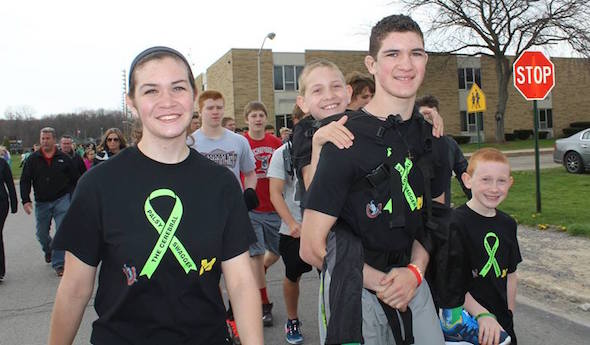
Born with cerebral palsy, Braden has limited use of his legs. Nonetheless, Hunter has taken it upon himself to help Braden know what it feels like to walk long distances – and he’s done it three times. Organized for the purpose of raising awareness of cerebral palsy, Hunter literally carries Braden on his back for long walks known as “CP Swaggers.”
In 2014, Hunter carried Braden 40 miles from the Bedford Junior High School wrestling room to the University of Michigan’s Bahna Wrestling Center. The following year, they upped the trek’s mileage to 57 miles.
However, that couldn’t foreshadow what was to follow in April 2016 when Hunter carried Braden on his back an amazing 111 miles – some 14 miles more than the first two walks combined.
About the Award: The NFHS divides the nation into eight geographical sections. The states in Section 4 are Michigan, Illinois, Indiana, Iowa and Wisconsin.
Nominations for this award were generated through NFHS member state associations and reviewed by the NFHS Spirit of Sport Award Selection Committee composed of state association staff members.
While the national winner will be recognized June 29 at the NFHS Summer Meeting in Providence, Rhode Island, the section winners will be recognized within their respective states and will receive awards before the end of the current school year.
PHOTO: Hunter Gandee, second from right, carries his brother Braden as part of their effort to bring awareness to cerebral palsy. (Photo courtesy of The Cerebral Palsy Swagger.)