

Brush Up on the New Transfer Rule
July 18, 2019
By Rob Kaminski
MHSAA benchmarks editor
Eligibility under the new “sport-specific” transfer rule begins this coming fall after circulating extensively for nearly one school year.
Unless one of the stated 15 exceptions is met, participation during the 2018-19 school year determines eligibility for 2019-20.
The new rule adopted by the Representative Council at its May 2018 meeting has found support among most audiences. A transfer student’s eligibility in 2019-20 is based upon that student’s participation from this past school year (2018-19). It will be paramount for administrators and coaches to have awareness of the sports a transfer student participated in during the previous school year.
The long-standing 15 Exceptions to immediate eligibility, such as a full and complete residential change or a student moving between divorced parents by completing of an Educational Transfer Form, did not change.
One might call the rule on the way out “The Fourth-Friday Transfer Rule.” Under this old rule, when a student enrolled at the new school determined his or her eligibility. Under the new Sport Specific Transfer rule, what a student played in the previous season determines eligibility.
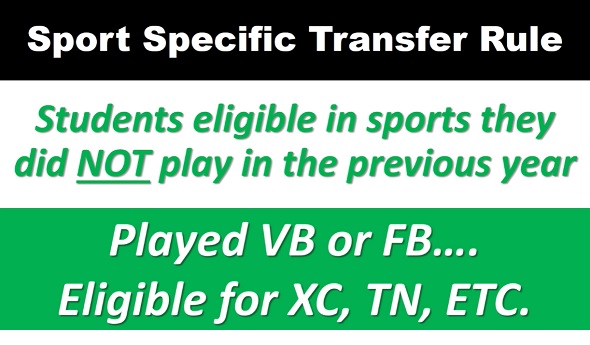
The Council passed a more lenient rule on the one hand and more restrictive on the other. The more lenient aspect is a change that finds a transfer student ELIGIBLE in any sport in which he or she did not participate in a game or a scrimmage in the previous school year.
The more restrictive portion tends to discourage students who change schools for sports reasons. A transfer student who did play a sport in the previous season – and who does not meet one of the 15 Exceptions – is NOT ELIGIBLE in that sport for the next season. If a student changes schools in mid-season, the student would be ineligible for the rest of that season in that sport and the next season for that sport.
Participation under this and other rules means playing in an interscholastic game or scrimmage after starting the 9th grade at any high school. It does not mean practice, but entering an interscholastic game, meet or scrimmage in any way. It also may involve more than one sport, so a three-sport athlete who does not have a residential change and transfers would be ineligible in those sports during the next school year – but eligible for any other sport. It also means a student cut from a team – one who never entered a scrimmage or game – may transfer and play without delay for that new school’s team. It may also mean that a student who meets one of the stated exceptions such as a residential change but enrolls in a school other than her or his school of residence, would have eligibility in sports not played in the previous year.
The new rule will tend to discourage students from changing schools for sports because they would be ineligible in any sport they have played in school the previous season for that sport. It will increase participation for some students who were otherwise not eligible under the current rule.
It is always best to contact school athletic directors who can connect with the MHSAA to verify eligibility prior to enrollment.
If the student’s new school requests in writing, the MHSAA Executive Committee may approve a waiver that reduces the period of ineligibility to 90 scheduled school days at the new school if the change of schools was for compelling reasons demonstrated with outside documentation having nothing to do with sports, curriculum, finances, and school demographics. The Executives Committee also has authority to approve immediate eligibility.

2020 Bush Awards Honor Dedicated ADs
By
Geoff Kimmerly
MHSAA.com senior editor
October 21, 2020
East Grand Rapids’ Tim Johnston, Maple City Glen Lake’s Mark Mattson, Vicksburg’s Michael Roy and Gaylord’s Christian Wilson all lead programs that frequently earn headlines for success in competition.
But these four athletic directors also are known in their local and statewide sports communities for the positive experiences they help provide students, their own as well as those who take part in the same leagues or tournament events they frequently host.
To honor their often unsung work in creating these experiences for athletes, all four have been named recipients of the Michigan High School Athletic Association’s Allen W. Bush Award for 2020.
Al Bush served as executive director of the MHSAA for 10 years. The award honors individuals for past and continuing service to prep athletics as a coach, administrator, official, trainer, doctor or member of the media. The award was developed to bring recognition to men and women who are giving and serving without a lot of attention. This is the 29th year of the award, with selections made by the MHSAA's Representative Council.
“Leaders among peers, ceaseless dedication, never saying ‘no’ when needed – these are how this year’s Bush Award honorees are described by their colleagues, and how we’ve come to know them as well,” MHSAA Executive Director Mark Uyl said. “What they give willingly for school sports goes far beyond awards they’ve received, and at the same time often receives little attention. We’re delighted to recognize all of their continuing contributions.”
Johnston has begun his 39th year in education, with the last eight for East Grand Rapids Public Schools, where he has led one of the state’s most successful athletic programs – EGR, which offers 34 varsity sports, was named a Michigan Exemplary Athletic Program in 2018 by the Michigan Interscholastic Athletic Administrators Association (MIAAA). Johnson was chosen as his region’s Athletic Director of the Year by the MIAAA in 2017. He previously served as a teacher and coach at Grand Rapids Catholic Central, and then as an athletic director and principal at Hastings.
 He has made significant contributions to Michigan’s largest high school league, having served as president, vice president, secretary and realignment chairperson for the Ottawa-Kent Conference, and hosted various MHSAA Tournament competitions for the District, Regional and Finals rounds. Johnston also has served on multiple MHSAA sport committees and its board of canvassers, and as part of the Scholar-Athlete Award selection committee. Additionally, he has served as an instructor for the MHSAA’s Coaches Advancement Program (CAP) and as a program presenter at conferences for both the MIAAA and National Interscholastic Athletic Administrators Association (NIAAA) – and served as Michigan’s delegate to the latter.
After graduating from Grand Rapids Catholic Central, Johnston earned an associate degree from Grand Rapids Junior College and a bachelor’s from Grand Valley State University, and then a master’s in education leadership from Michigan State University. He earned his certified athletic administrator (CAA) designation from the NIAAA.
“Tim has always been incredibly positive in advocating for kids,” MHSAA Executive Director Mark Uyl said. “I’ve known Tim for years as a principal and as an athletic director, and there’s absolutely no one who better sees the big picture of how academics and athletics fit together.”
Mattson is into his 22nd year coaching, teaching or serving as an administrator in Michigan high schools, and in his second tenure as athletic director at Maple City Glen Lake. He previously served in the same role and others at Marquette High School for 11 years and then as athletic director at Traverse City Central before returning to Glen Lake as athletic director and assistant principal. He also coached and taught in Rhinelander, Wis., to begin his career, and served as an undergrad men’s basketball assistant coach at Northern Michigan University.
 Mattson also is a frequent MHSAA Tournament host and participated on sport committees for skiing, football, basketball, cross country and track & field, and has served as an MIAAA regional representative and as secretary for the Big North Conference. He received MIAAA regional Athletic Director of the Year awards in both 2008 and 2018, and was selected as the Upper Peninsula Athletic Director of the Year in 2006.
A current member of the MHSAA Representative Council – representing Class C and D schools in the northern Lower Peninsula – Mattson is a graduate of L’Anse High School and earned his bachelor’s degree and then his master’s in educational administration both from NMU. While at NMU and into his tenure at Marquette, Mattson also was a registered MHSAA official in football and basketball for a decade and briefly for softball and volleyball.
“Mark, having served his career in northern Michigan and the Upper Peninsula, always brings a unique perspective on how the largest schools survive in northern Michigan,” Uyl said. “Schools like Marquette and Traverse City Central face a unique challenge. He’s always been an advocate for schools with those unique circumstances – but also for all schools up north, and especially now as part of the Representative Council.”
Roy is a graduate of Paw Paw High School who returned to Michigan after earning bachelor’s and master’s degrees – the latter in curriculum and instruction – at the University of Nevada-Las Vegas, where he also was a member of the football team for two years. He is into his 22nd year as an athletic administrator, serving three years at Lawton before joining the Vicksburg administration at the start of the 2001-02 school year. He has hosted more than 100 MHSAA postseason events and numerous CAP sessions while also serving as a CAP instructor, and his Vicksburg program received the Exemplary Athletic Program award in 2020.
 Roy served as president of the MIAAA during the 2019-20 school year and has made vast contributions as part of the athletic directors’ professional organization with more than 15 years as a regional representative and 10 times serving as the state’s NIAAA delegate at the National Federation of State High School Associations (NFHS) national conference. He has served more than a decade as a Leadership Training Institute instructor for the MIAAA and as part of the NIAAA national teaching faculty.
He has received three certifications from the NIAAA including the certified master athletic administrator designation in 2005. Roy was named his region’s Athletic Director of the Year by the MIAAA in 2009 and state Athletic Director of the Year in 2012 – when he was also a finalist for national Athletic Director of the Year from the National High School Coaches Association.
“Mike has been incredibly giving with his time, especially with his leadership with the MIAAA,” Uyl said. “He has a can-do attitude, whether it be in hosting events or with other problem-solving he’s provided our entire MHSAA staff over many years.”
Wilson is into his 19th year in education, serving as athletic director and assistant principal for Gaylord Community schools; he also briefly served as athletic director at Novi High School and as high school athletic director in Mount Gilead, Ohio, and taught in Auburndale, Wis.
 Wilson also is a frequent host of MHSAA Tournament events – he hosted more than 10 during the 2019-20 school year alone – and also has served on various MHSAA committees. He has served as president of the Big North Conference and provided his expertise to the local Little League and youth football boards. He was named his region’s Athletic Director of the Year by the MIAAA in 2016.
A graduate of Chassell High School, Wilson then earned his bachelor’s degree from Northern Michigan University and a master’s in athletic administration from Western Michigan University. Prior to beginning his career in education, Wilson served as an assistant men’s basketball coach at both Michigan Technological University and Western Michigan. He played at Michigan Tech before finishing his career at NMU.
“Christian has been a successful administrator for many years because of his outstanding temperament and the way he connects with people,” Uyl said. “He’s someone who takes the work seriously, but never takes himself too seriously. He has served as a mentor to so many, and he’s very gifted at building relationships. At the end of the day, that’s what our business is about – those relationships.”
The MHSAA is a private, not-for-profit corporation of voluntary membership by more than 1,500 public and private senior high schools and junior high/middle schools which exists to develop common rules for athletic eligibility and competition. No government funds or tax dollars support the MHSAA, which was the first such association nationally to not accept membership dues or tournament entry fees from schools. Member schools which enforce these rules are permitted to participate in MHSAA tournaments, which attract more than 1.4 million spectators each year.