

Brush Up on the New Transfer Rule
July 18, 2019
By Rob Kaminski
MHSAA benchmarks editor
Eligibility under the new “sport-specific” transfer rule begins this coming fall after circulating extensively for nearly one school year.
Unless one of the stated 15 exceptions is met, participation during the 2018-19 school year determines eligibility for 2019-20.
The new rule adopted by the Representative Council at its May 2018 meeting has found support among most audiences. A transfer student’s eligibility in 2019-20 is based upon that student’s participation from this past school year (2018-19). It will be paramount for administrators and coaches to have awareness of the sports a transfer student participated in during the previous school year.
The long-standing 15 Exceptions to immediate eligibility, such as a full and complete residential change or a student moving between divorced parents by completing of an Educational Transfer Form, did not change.
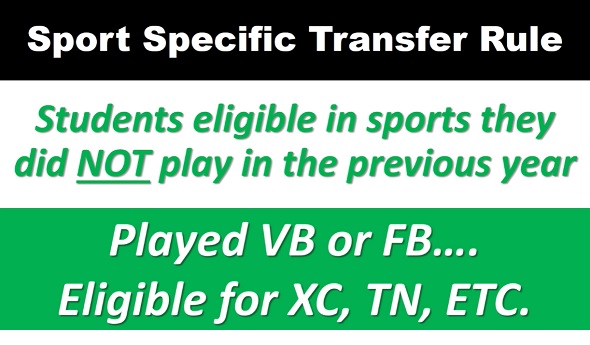
One might call the rule on the way out “The Fourth-Friday Transfer Rule.” Under this old rule, when a student enrolled at the new school determined his or her eligibility. Under the new Sport Specific Transfer rule, what a student played in the previous season determines eligibility.
The Council passed a more lenient rule on the one hand and more restrictive on the other. The more lenient aspect is a change that finds a transfer student ELIGIBLE in any sport in which he or she did not participate in a game or a scrimmage in the previous school year.
The more restrictive portion tends to discourage students who change schools for sports reasons. A transfer student who did play a sport in the previous season – and who does not meet one of the 15 Exceptions – is NOT ELIGIBLE in that sport for the next season. If a student changes schools in mid-season, the student would be ineligible for the rest of that season in that sport and the next season for that sport.
Participation under this and other rules means playing in an interscholastic game or scrimmage after starting the 9th grade at any high school. It does not mean practice, but entering an interscholastic game, meet or scrimmage in any way. It also may involve more than one sport, so a three-sport athlete who does not have a residential change and transfers would be ineligible in those sports during the next school year – but eligible for any other sport. It also means a student cut from a team – one who never entered a scrimmage or game – may transfer and play without delay for that new school’s team. It may also mean that a student who meets one of the stated exceptions such as a residential change but enrolls in a school other than her or his school of residence, would have eligibility in sports not played in the previous year.
The new rule will tend to discourage students from changing schools for sports because they would be ineligible in any sport they have played in school the previous season for that sport. It will increase participation for some students who were otherwise not eligible under the current rule.
It is always best to contact school athletic directors who can connect with the MHSAA to verify eligibility prior to enrollment.
If the student’s new school requests in writing, the MHSAA Executive Committee may approve a waiver that reduces the period of ineligibility to 90 scheduled school days at the new school if the change of schools was for compelling reasons demonstrated with outside documentation having nothing to do with sports, curriculum, finances, and school demographics. The Executives Committee also has authority to approve immediate eligibility.
Advisory Council Seeking Class Of '22
By
Geoff Kimmerly
MHSAA.com senior editor
April 9, 2020
The MHSAA is seeking student-athletes to become members of its Student Advisory Council beginning with the 2020-21 school year.
Four boys and four girls from the Class of 2022 will be selected to two-year terms, and will meet on matters related to maintaining and promoting a proper perspective and sensible scope for high school sports in Michigan. Eight members from the Class of 2021 already are serving on the Council, while eight members of the Class of 2020 are leaving the Council this spring.
To be eligible for the committee, candidates must be a member of the Class of 2022, complete the official application including answering the three short-answer questions, submit a letter of recommendation from a school administrator, have a cumulative GPA of at least 3.0 (on a 4.0 scale) and be available for all scheduled meetings.
In addition, candidates should show a history of leadership on athletic teams as well as with other extracurricular activities, community service projects, or in the workplace; and show an understanding of the role of school sports and have ideas for promoting a proper perspective for educational athletics.
Applications are due to the MHSAA by 4:30 p.m. on April 29. Applications can be downloaded from the Student Advisory Council page of the MHSAA Website and must be returned via e-mail.
The Student Advisory Council meets seven times each school year, and once more for a 24-hour leadership camp. In addition to assisting in the promotion of the educational value of interscholastic athletics, the Council discusses issues dealing with the 4 S’s of educational athletics: scholarship, sportsmanship, safety (including health and nutrition) and the sensible scope of athletic programs. A fifth S – student leadership – is also a common topic. Members contribute in planning Sportsmanship Summits, Captains Clinics and other student leadership events, and assist with medal ceremonies at MHSAA championship events. The Council also judges the “Battle of the Fans,” which it created during the 2011-12 school year as a way to promote positive sportsmanship.
Newly-chosen members will join the following from the Class of 2021: Pierre Brooks II, Detroit Douglass; Macy Brown, Cadillac; Lydia Davenport, Ithaca; Freddy Kopplow, Traverse City St. Francis; Colin McAuliffe, Salem; Avery Peters, Mason; Abigail Pheiffer, Novi; and Landen Thompson, Stevensville Lakeshore.
The eight new members of the Student Advisory Council will be notified by May 8. The 2020-21 meetings are tentatively scheduled for Aug. 23, Oct. 4, Dec. 6, Feb. 14, April 18 and May 16. Meetings will take place at the MHSAA Office in East Lansing. Conference call meetings will be held Jan. 10 and Jan. 24. For more information, contact Andy Frushour at the MHSAA – 517-332-5046 or [email protected].
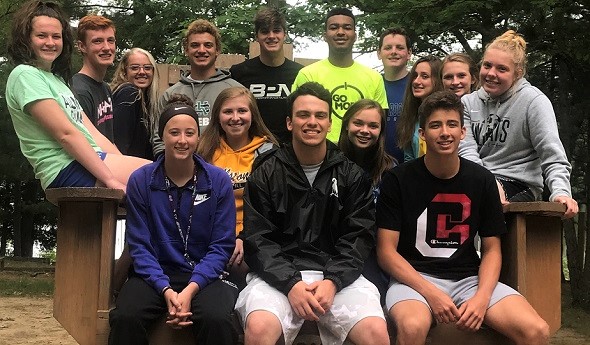
PHOTO: The MHSAA Student Advisory Council takes a minute out of a busy 24 hours during its annual overnight trip in 2019.