
Brush Up on the New Transfer Rule
July 18, 2019
By Rob Kaminski
MHSAA benchmarks editor
Eligibility under the new “sport-specific” transfer rule begins this coming fall after circulating extensively for nearly one school year.
Unless one of the stated 15 exceptions is met, participation during the 2018-19 school year determines eligibility for 2019-20.
The new rule adopted by the Representative Council at its May 2018 meeting has found support among most audiences. A transfer student’s eligibility in 2019-20 is based upon that student’s participation from this past school year (2018-19). It will be paramount for administrators and coaches to have awareness of the sports a transfer student participated in during the previous school year.
The long-standing 15 Exceptions to immediate eligibility, such as a full and complete residential change or a student moving between divorced parents by completing of an Educational Transfer Form, did not change.
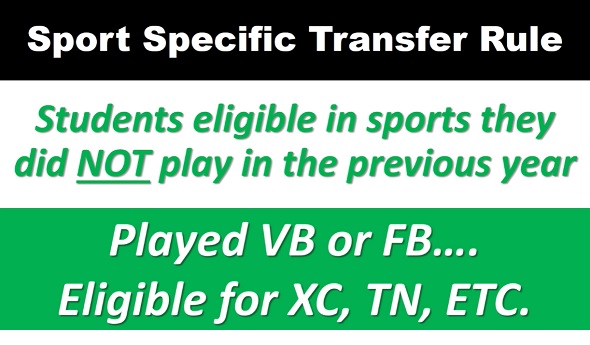
One might call the rule on the way out “The Fourth-Friday Transfer Rule.” Under this old rule, when a student enrolled at the new school determined his or her eligibility. Under the new Sport Specific Transfer rule, what a student played in the previous season determines eligibility.
The Council passed a more lenient rule on the one hand and more restrictive on the other. The more lenient aspect is a change that finds a transfer student ELIGIBLE in any sport in which he or she did not participate in a game or a scrimmage in the previous school year.
The more restrictive portion tends to discourage students who change schools for sports reasons. A transfer student who did play a sport in the previous season – and who does not meet one of the 15 Exceptions – is NOT ELIGIBLE in that sport for the next season. If a student changes schools in mid-season, the student would be ineligible for the rest of that season in that sport and the next season for that sport.
Participation under this and other rules means playing in an interscholastic game or scrimmage after starting the 9th grade at any high school. It does not mean practice, but entering an interscholastic game, meet or scrimmage in any way. It also may involve more than one sport, so a three-sport athlete who does not have a residential change and transfers would be ineligible in those sports during the next school year – but eligible for any other sport. It also means a student cut from a team – one who never entered a scrimmage or game – may transfer and play without delay for that new school’s team. It may also mean that a student who meets one of the stated exceptions such as a residential change but enrolls in a school other than her or his school of residence, would have eligibility in sports not played in the previous year.
The new rule will tend to discourage students from changing schools for sports because they would be ineligible in any sport they have played in school the previous season for that sport. It will increase participation for some students who were otherwise not eligible under the current rule.
It is always best to contact school athletic directors who can connect with the MHSAA to verify eligibility prior to enrollment.
If the student’s new school requests in writing, the MHSAA Executive Committee may approve a waiver that reduces the period of ineligibility to 90 scheduled school days at the new school if the change of schools was for compelling reasons demonstrated with outside documentation having nothing to do with sports, curriculum, finances, and school demographics. The Executives Committee also has authority to approve immediate eligibility.
43 Percent of Athletes are Multi-Sport
August 19, 2019
By Geoff Kimmerly
Second Half editor
Nearly 43 percent of athletes at MHSAA member high schools continued to participate in two or more sports in 2018-19, according to the Multi-Sport Participation Survey, reinforcing similar data collected for the first time two years ago and providing a foundation for work by the MHSAA’s Multi-Sport Task Force as it prepares to continue efforts this fall to promote the multi-sport high school experience.
Early and intense sport specialization has become one of the most serious issues related to health and safety at all levels of youth sports, as overuse injuries and burnout among athletes have been tied to chronic injuries and health-related problems later in life. In early 2016, the MHSAA appointed the Task Force on Multi-Sport Participation as part of a continued effort to promote and protect participant health and address the issues leading to early sport specialization.
The multi-sport participation survey was created in 2018 to provide data on the prevalence of sport specialization at MHSAA member high schools. This year’s survey received responses from 82.9 percent of member high schools and measured how multi-sport participation exists at schools. The collection of survey results annually is expected to show how schools are succeeding in promoting a multi-sport high school experience, providing another tool as schools work to guide students toward a well-rounded interscholastic sports career.
From schools that responded to this year’s survey, 42.9 percent of students participated in athletics in 2018-19 – 46.3 percent of boys and 39.5 percent of girls. The overall participation number was up nearly half a percent from 2017-18 (42.5), with the boys percentage holding steady and the girls increasing nearly a full percent from a year ago. Class D schools – those with the smallest enrollments – again enjoyed the highest percentage of athletes among the entire student body, at 57.1 percent, followed by Class C (50.7), Class B (45.8) and Class A (39.4).
Of those athletes counted by responding schools, 43 percent participated in more than one sport – including 45.1 percent of boys and 40.4 percent of girls – with all three of those percentages nearly identical to those derived from the first survey a year ago. Class D again enjoyed the highest percentage of multi-sport athletes, 61.8 percent, followed by Class C (56.7), Class B (48.7) and Class A (35.4).
Similar results for overall sport participation and multi-sport participation relative to enrollment size were seen by further breaking down Class A into schools of fewer than 1,000 students, 1,000-1,500 students, 1,501-2,000 students and more than 2,000 students. Similarly to 2017-18 for both sport participation as a whole and multi-sport participation specifically, the smallest Class A schools continued to enjoy the highest percentages, while percentages then decreased for every larger size group of schools.
Also of note, the percentage of two-sport athletes at every school measure around one-third of athletes – from 29.2 percent at Class A schools to 35.7 at Class B, 37.2 at Class C and 35.6 at Class D. However the number of athletes participating in three sports decreased substantially relative to the increase in school enrollment, with 22.5 percent of Class D athletes playing three sports, 18.2 in Class C, 12.4 in Class B and 6.0 percent in Class A.
The MHSAA Task Force on Multi-Sport Participation will be meeting this fall to discuss creating a program to measure multi-sport participation at MHSAA member schools and to recognize “achievers” – that is, schools that surpass the norm given their enrollment and other factors that affect school sports participation.
For 2018-19, in Class A, Marquette posted the highest percentage of multi-sport athletes with 85.9 percent, up 3.3 percent from its top-ranking Class A percentage from 2017-18. Grand Rapids Northview also topped 80 percent multi-sport participation, with 83.1 percent of its athletes playing two or more sports. Orchard Lake St. Mary’s, Detroit East English and Gibraltar Carlson all saw multi-sport participation from at least 70 percent of their athletes.
In Class B, four schools again achieved at least 80 percent multi-sport participation – Coloma (87.2 percent), Gladstone (86.7), Flat Rock (83.2) and Dundee (80.2), while 10 schools had 70 percent or more athletes playing at least two sports.
Six Class C schools reported more than 80 percent of its athletes taking part in more than one sport – Schoolcraft (87.1), Mayville (86.2), Manton (85.3), Houghton Lake (84.9), Cass City (84.7) and Decatur (83.5) – and 12 schools total with 75 percent or more athletes participating in multiple sports. There were 14 Class D schools with multi-sport participation at 80.9 percent or higher, with Gaylord St. Mary (93.2), Waterford Our Lady of the Lakes (91.5) and Watersmeet (90.3) topping the survey not just for Class D but among all schools that responded.
The full summary report on the Multi-Sport Participation Survey is available on the “Health & Safety” page of the MHSAA Website.