

Brush Up on the New Transfer Rule
July 18, 2019
By Rob Kaminski
MHSAA benchmarks editor
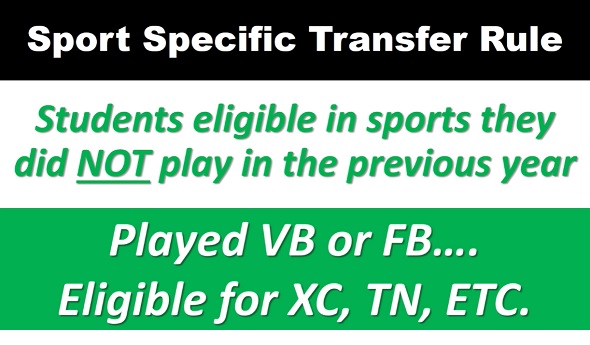
Eligibility under the new “sport-specific” transfer rule begins this coming fall after circulating extensively for nearly one school year.
Unless one of the stated 15 exceptions is met, participation during the 2018-19 school year determines eligibility for 2019-20.
The new rule adopted by the Representative Council at its May 2018 meeting has found support among most audiences. A transfer student’s eligibility in 2019-20 is based upon that student’s participation from this past school year (2018-19). It will be paramount for administrators and coaches to have awareness of the sports a transfer student participated in during the previous school year.
The long-standing 15 Exceptions to immediate eligibility, such as a full and complete residential change or a student moving between divorced parents by completing of an Educational Transfer Form, did not change.
One might call the rule on the way out “The Fourth-Friday Transfer Rule.” Under this old rule, when a student enrolled at the new school determined his or her eligibility. Under the new Sport Specific Transfer rule, what a student played in the previous season determines eligibility.
The Council passed a more lenient rule on the one hand and more restrictive on the other. The more lenient aspect is a change that finds a transfer student ELIGIBLE in any sport in which he or she did not participate in a game or a scrimmage in the previous school year.
The more restrictive portion tends to discourage students who change schools for sports reasons. A transfer student who did play a sport in the previous season – and who does not meet one of the 15 Exceptions – is NOT ELIGIBLE in that sport for the next season. If a student changes schools in mid-season, the student would be ineligible for the rest of that season in that sport and the next season for that sport.
Participation under this and other rules means playing in an interscholastic game or scrimmage after starting the 9th grade at any high school. It does not mean practice, but entering an interscholastic game, meet or scrimmage in any way. It also may involve more than one sport, so a three-sport athlete who does not have a residential change and transfers would be ineligible in those sports during the next school year – but eligible for any other sport. It also means a student cut from a team – one who never entered a scrimmage or game – may transfer and play without delay for that new school’s team. It may also mean that a student who meets one of the stated exceptions such as a residential change but enrolls in a school other than her or his school of residence, would have eligibility in sports not played in the previous year.
The new rule will tend to discourage students from changing schools for sports because they would be ineligible in any sport they have played in school the previous season for that sport. It will increase participation for some students who were otherwise not eligible under the current rule.
It is always best to contact school athletic directors who can connect with the MHSAA to verify eligibility prior to enrollment.
If the student’s new school requests in writing, the MHSAA Executive Committee may approve a waiver that reduces the period of ineligibility to 90 scheduled school days at the new school if the change of schools was for compelling reasons demonstrated with outside documentation having nothing to do with sports, curriculum, finances, and school demographics. The Executives Committee also has authority to approve immediate eligibility.

Bush Honorees' Impacts Can't Be Missed
By
Geoff Kimmerly
MHSAA.com senior editor
June 24, 2019
Detroit’s Vic Michaels, Novi’s Brian Gordon, Bronson’s Jean LaClair and Portland’s Kevin Veale all have impacted high school students as teachers, coaches and administrators over decades in their respectively communities. To honor their often unsung work in creating athletic opportunities, all four have been named recipients of the MHSAA’s Allen W. Bush Award for 2019.
Al Bush served as executive director of the MHSAA for 10 years. The award honors individuals for past and continuing service to prep athletics as a coach, administrator, official, trainer, doctor or member of the media. The award was developed to bring recognition to men and women who are giving and serving without a lot of attention. This is the 28th year of the award, with selections made by the MHSAA's Representative Council.
“The Bush Award was created to recognize the frequent behind-the-scenes efforts that go into creating worthwhile experiences for Michigan high school athletes. But it’s impossible to not see the impacts this year’s honorees have made in their communities,” MHSAA Executive Director Mark Uyl said. “We are pleased to honor them and celebrate their work in promoting educational athletics and all of its benefits.”
Michaels, who has served as director of the Detroit Catholic High School League since 2003, is the longest-serving director in Catholic League history and one of only seven directors since its formation in 1926. He came to the Archdiocese of Detroit league office as associate director in 1995 after serving as athletic director, assistant principal, teacher and coach at Center Line St. Clement since 1978. He coached St. Clement’s boys basketball varsity from 1978-95 and the girls varsity from 1980-85 and earned Coach of the Year recognition leading both programs.
 As director of the Catholic League, Michaels oversees all aspects of competition for 27 schools across 30 sports, in addition to the Catholic Schools Office of Health, Athletics, Physical Education and Safety. While his local imprint is large, he provides expertise at the statewide level as well. Michaels has represented non-public schools on the MHSAA Representative Council since 2003 and serves as the Council’s secretary-treasurer and as part of its Executive Committee. He served as president of the Michigan Interscholastic Athletic Administrators Association (MIAAA) in 2008 and also has held roles of vice president, secretary and board member. He’s served as coordinator for the Southeast Michigan Leagues Advisory Council (SEMLAC) and on various MHSAA sport and officials selection committees.
Michaels was named statewide Athletic Director of the Year by the MIAAA and received a regional award from the National High School Athletic Coaches Association (NHSACA) in 2010 after previously being chosen for MIAAA regional recognition in 2001. While at St. Clement, Michaels was named Catholic League Athletic Director of the Year in 1988 and inducted into the league’s Hall of Fame in 1990. Michaels graduated from Detroit St. Ambrose High School, then attended Detroit Institute of Technology and finished his bachelor’s degree at University of Detroit Mercy. He earned his certified athletic administrator (CAA) designation from the National Interscholastic Athletic Administrators Association (NIAAA).
“Vic Michaels is as good a leader as we have in high school sports in our state,” Uyl said. “While he represents the private and parochial schools on the Representative Council, he works with everybody and sees the big picture – but also can get to a granular level with our rules, which he knows inside and out. He is one of the most insightful voices in Michigan educational athletics.”
Gordon is completing his third decade in education, have begun as a physical education and health teacher for Royal Oak Schools in 1990. He moved into the athletic director/assistant principal role in 2010 and then became director of athletic and physical education at Novi High School in 2012. He’s taught at the elementary and middle school levels, and supervised physical education and served as a health advisory chairperson at the district level. Including a season while still a college student, he also has coached baseball, football, basketball and track & field from the junior high to varsity levels, including a stint as Royal Oak Kimball and Royal Oak High varsity baseball coach from 1995-2010. He was inducted into the Michigan High School Baseball Coaches Association Hall of Fame in 2011.
 At Novi, Gordon oversees the athletic program for more than 1,700 students in grades 7-12, plus more than 140 coaches. He has made Novi a home for playoff events, hosting more than 150 league and MHSAA tournament competitions at all levels including Boys Tennis and Girls Lacrosse Finals this spring and the 115-team Oakland County Track Meet multiple times. Under his leadership, Novi has hosted multiple levels of the MHSAA Coaches Advancement Program (CAP), and he has served on a variety of sport, officials and site selection committees for the Association in addition to local committee work. He also is a major promoter of Special Olympics Unified Sports in his community and league, hosting his conference’s first basketball tournament this past winter.
Gordon was named Oakland County Athletic Director of the Year for this school year by the Oakland County Athletic Directors Association, and he served as the OCADA president in 2014-15 and on its board from 2010-16. He’s served as vice president of the Kensington Lakes Activities Association and president of the Kensington Conference since 2012. Gordon has been a member of the MIAAA since 2008 and NIAAA since 2010, and was named a Regional Athletic Director of the Year by the MIAAA in 2018. He graduated from Clawson High School and earned his bachelor’s degree at Central Michigan University and master’s in sports administration and school leadership from Wayne State University. He also has achieved CAA status.
“Brian Gordon is one of the most positive people I’ve met in athletics,” Uyl said. “From his days coaching in Royal Oak to his move into an athletic director role, he’s always championed kids and school sports. He always sees what we do as a glass half full – and his willingness to host absolutely anything shows his continuing commitment to this work.”
LaClair is one of the most successful volleyball coaches in Michigan high school history, ranking fifth all-time for wins with a record of 1,180-361-96 at Midland Dow, Pinconning and most recently Bronson. She took over the Vikings’ program in the fall of 2000 and has led Bronson to five MHSAA championships, with its Division 3 title this past fall the varsity team’s fourth straight. She also led Pinconning to a Class B runner-up finish in 1997-98. LaClair has received various coaching honors and in 2017 was a finalist for the NHSACA’s national volleyball Coach of the Year award.
 While best-known for her achievements on court, LaClair has served 24 years as a highly-respected athletic administrator and assistant principal at Bronson High School. She received the MHSAA Women In Sports Leadership Award in 2015 and previously had spoken at WISL conferences in 2006 and 2008. She has hosted a variety of MHSAA tournament events in addition to sitting on a number of MHSAA and MIAAA committees. She also has instructed at MHSAA CAP sessions and been a registered game official for 18 years. LaClair received the George Lovich State Award of Merit this year for her leadership and standing within the MIAAA and NIAAA. She also was named a Regional Athletic Director of the Year by the MIAAA in 2009.
In addition to the national coaching recognition mentioned above, LaClair was inducted into the Michigan Interscholastic Volleyball Coaches Association Hall of Fame in 2006 and has served as MIVCA’s president, vice president and on its board. She also was inducted into the Michigan High School Coaches Association Hall of Fame in 2017. LaClair is a graduate of Midland Dow High School and Saginaw Valley State University, and earned a master’s degree in sports administration from Central Michigan University. She has earned the Certified Master Athletic Administrator (CMAA) designation.
“As an athletic director, Jean is incredibly consistent,” Uyl said. “Her leadership as an athletic director is so effective because she knows what matters in school sports and she treats all programs the same, including the volleyball program. That isn’t always easy when an athletic director also is a coach, and that consistency is really impressive.”
Veale is completing his 19th year as Portland Public Schools athletic director after previously teaching and serving as the girls track & field coach and as a football assistant at the high school. He has initiated a variety of efforts during his two decades in the district, founding the high school’s coaches association, captains’ club and athletic Hall of Fame among sports-related endeavors. He also has served as a volunteer coach for local recreation teams and given his time to assist in various community events. But his influence has stretched as well to league, regional and statewide levels.
 Veale has served in leadership roles in multiple leagues over his tenure, as executive secretary for the Ingham County League in 2001-02 and then president of the Capital Area Activities Conference in 2008-09. He’s hosted at Portland more than 100 MHSAA postseason events from the District-Quarterfinal levels, while also serving on multiple MHSAA committees including assisting in selection of MHSAA/Farm Bureau Insurance Scholar-Athlete Award winners. He served as membership committee chairperson for the MIAAA in 2005-06 and has been part of its scholarship committee since 2008.
Veale graduated from Iron Mountain High School and earned bachelor and master’s degrees from Central Michigan University, the latter in athletic administration. He also has achieved CAA designation and was named an MIAAA Regional Athletic Director of the Year in 2010.
“Kevin has really become the face of Portland Raiders athletics after 19 years in that community,” Uyl said. “He brings a great deal of positivity and high energy to the job every day. His teams have had great success, and he’s another administrator who sees all programs being equally important.”
The MHSAA is a private, not-for-profit corporation of voluntary membership by more than 1,500 public and private senior high schools and junior high/middle schools which exists to develop common rules for athletic eligibility and competition. No government funds or tax dollars support the MHSAA, which was the first such association nationally to not accept membership dues or tournament entry fees from schools. Member schools which enforce these rules are permitted to participate in MHSAA tournaments, which attract more than 1.4 million spectators each year.