

Brush Up on the New Transfer Rule
July 18, 2019
By Rob Kaminski
MHSAA benchmarks editor
Eligibility under the new “sport-specific” transfer rule begins this coming fall after circulating extensively for nearly one school year.
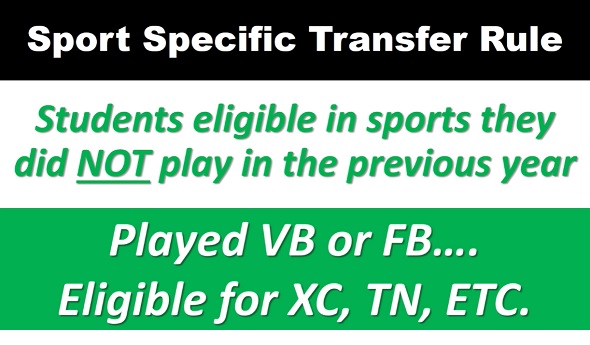
Unless one of the stated 15 exceptions is met, participation during the 2018-19 school year determines eligibility for 2019-20.
The new rule adopted by the Representative Council at its May 2018 meeting has found support among most audiences. A transfer student’s eligibility in 2019-20 is based upon that student’s participation from this past school year (2018-19). It will be paramount for administrators and coaches to have awareness of the sports a transfer student participated in during the previous school year.
The long-standing 15 Exceptions to immediate eligibility, such as a full and complete residential change or a student moving between divorced parents by completing of an Educational Transfer Form, did not change.
One might call the rule on the way out “The Fourth-Friday Transfer Rule.” Under this old rule, when a student enrolled at the new school determined his or her eligibility. Under the new Sport Specific Transfer rule, what a student played in the previous season determines eligibility.
The Council passed a more lenient rule on the one hand and more restrictive on the other. The more lenient aspect is a change that finds a transfer student ELIGIBLE in any sport in which he or she did not participate in a game or a scrimmage in the previous school year.
The more restrictive portion tends to discourage students who change schools for sports reasons. A transfer student who did play a sport in the previous season – and who does not meet one of the 15 Exceptions – is NOT ELIGIBLE in that sport for the next season. If a student changes schools in mid-season, the student would be ineligible for the rest of that season in that sport and the next season for that sport.
Participation under this and other rules means playing in an interscholastic game or scrimmage after starting the 9th grade at any high school. It does not mean practice, but entering an interscholastic game, meet or scrimmage in any way. It also may involve more than one sport, so a three-sport athlete who does not have a residential change and transfers would be ineligible in those sports during the next school year – but eligible for any other sport. It also means a student cut from a team – one who never entered a scrimmage or game – may transfer and play without delay for that new school’s team. It may also mean that a student who meets one of the stated exceptions such as a residential change but enrolls in a school other than her or his school of residence, would have eligibility in sports not played in the previous year.
The new rule will tend to discourage students from changing schools for sports because they would be ineligible in any sport they have played in school the previous season for that sport. It will increase participation for some students who were otherwise not eligible under the current rule.
It is always best to contact school athletic directors who can connect with the MHSAA to verify eligibility prior to enrollment.
If the student’s new school requests in writing, the MHSAA Executive Committee may approve a waiver that reduces the period of ineligibility to 90 scheduled school days at the new school if the change of schools was for compelling reasons demonstrated with outside documentation having nothing to do with sports, curriculum, finances, and school demographics. The Executives Committee also has authority to approve immediate eligibility.

Fall Athletes: Prepare for Hot Weather
July 26, 2018
By Geoff Kimmerly
Second Half editor
As summer activities wind down with an eye toward the beginning of fall sports next month, the MHSAA advises that student-athletes need to prepare for training in the hot weather that traditionally accompanies the beginning of August and the first practices of the school year.
Each year, the MHSAA provides information to its member schools to help them prepare for hot weather practice and game conditions during the late summer and early fall. Football practice can begin at MHSAA schools August 6, followed by first practices for all other fall sports August 8.
The topic of heat-related injuries receives a lot of attention at this time of year, especially when deaths at the professional, collegiate and interscholastic levels of sport occur, and especially since they are preventable in most cases with the proper precautions.
“This month’s high temperatures across much of Michigan served as a reminder that we all must take a role in making sure our student-athletes are ready for hot weather as practices get underway,” said John E. “Jack” Roberts, executive director of the MHSAA. “At the start of every fall, we point out that with proper precautions and planning, heat illness is almost always preventable. It is imperative that we continue to emphasize this message and teach the best practices for staying safe both to our returning student-athletes and those taking part for the first time.”
Heat, hydration and acclimatization continue to be focuses of the MHSAA’s required preseason rules meetings for coaches and officials. The online presentations discuss the need for good hydration in sports, regardless of the activity or time of year, and informs both how to recognize the early signs of heat illness and the immediate steps to take to respond to those symptoms. The MHSAA requires all head varsity, varsity assistant and subvarsity coaches at the high school level to complete the rules and risk minimization meeting requirement.
The first days of formal practices in hot weather should be more for heat acclimatization than the conditioning of athletes, and practices in such conditions need planning to become longer and more strenuous over a gradual progression of time. Schools also must consider moving practices to different locations or different times of day, or change practice plans to include different activities depending on the conditions. Furthermore, football practice rules allow for only helmets to be worn during the first two days, only shoulder pads to be added on the third and fourth days, and full pads to not be worn until the fifth day of team practice.
Roberts also emphasized that student-athletes should make sure to hydrate all day long – beginning before practice, continuing during and also after practice is done. Water and properly-formulated sports drinks are the best choices for hydration, while energy drinks, high-carbohydrate fruit juices (greater than eight percent carb content), carbonated and caffeinated beverages are among those that should be avoided. The “Health & Safety” page of the MHSAA Website has a number of links to various publications and information including recommendations on proper hydration from the National Federation of State High School Associations (NFHS).
A number of member schools follow the MHSAA’s Model Policy for Managing Heat & Humidity, which while not mandated for member schools was adopted as a rule for MHSAA postseason competition in 2013. The plan directs schools to begin monitoring the heat index at the activity site once the air temperature reaches 80 degrees, and provides recommendations when the heat index reaches certain points, including ceasing activities when it rises above 104 degrees. (When the temperature is below 80 degrees, there is no combination of heat and humidity that will result in a need to curtail activity.)
The model heat & humidity policy is outlined in a number of places on the MHSAA Website, including as part of the publication Heat Ways, also available for download from the “Health & Safety” page.