

Brush Up on the New Transfer Rule
July 18, 2019
By Rob Kaminski
MHSAA benchmarks editor
Eligibility under the new “sport-specific” transfer rule begins this coming fall after circulating extensively for nearly one school year.
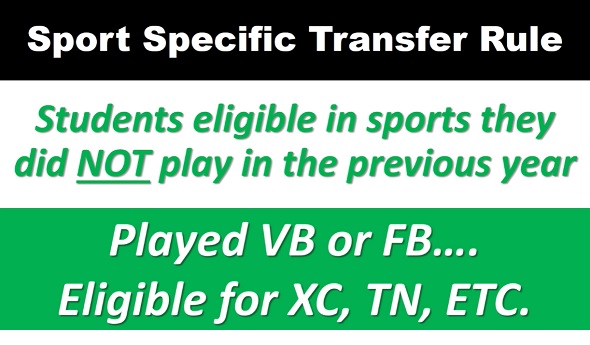
Unless one of the stated 15 exceptions is met, participation during the 2018-19 school year determines eligibility for 2019-20.
The new rule adopted by the Representative Council at its May 2018 meeting has found support among most audiences. A transfer student’s eligibility in 2019-20 is based upon that student’s participation from this past school year (2018-19). It will be paramount for administrators and coaches to have awareness of the sports a transfer student participated in during the previous school year.
The long-standing 15 Exceptions to immediate eligibility, such as a full and complete residential change or a student moving between divorced parents by completing of an Educational Transfer Form, did not change.
One might call the rule on the way out “The Fourth-Friday Transfer Rule.” Under this old rule, when a student enrolled at the new school determined his or her eligibility. Under the new Sport Specific Transfer rule, what a student played in the previous season determines eligibility.
The Council passed a more lenient rule on the one hand and more restrictive on the other. The more lenient aspect is a change that finds a transfer student ELIGIBLE in any sport in which he or she did not participate in a game or a scrimmage in the previous school year.
The more restrictive portion tends to discourage students who change schools for sports reasons. A transfer student who did play a sport in the previous season – and who does not meet one of the 15 Exceptions – is NOT ELIGIBLE in that sport for the next season. If a student changes schools in mid-season, the student would be ineligible for the rest of that season in that sport and the next season for that sport.
Participation under this and other rules means playing in an interscholastic game or scrimmage after starting the 9th grade at any high school. It does not mean practice, but entering an interscholastic game, meet or scrimmage in any way. It also may involve more than one sport, so a three-sport athlete who does not have a residential change and transfers would be ineligible in those sports during the next school year – but eligible for any other sport. It also means a student cut from a team – one who never entered a scrimmage or game – may transfer and play without delay for that new school’s team. It may also mean that a student who meets one of the stated exceptions such as a residential change but enrolls in a school other than her or his school of residence, would have eligibility in sports not played in the previous year.
The new rule will tend to discourage students from changing schools for sports because they would be ineligible in any sport they have played in school the previous season for that sport. It will increase participation for some students who were otherwise not eligible under the current rule.
It is always best to contact school athletic directors who can connect with the MHSAA to verify eligibility prior to enrollment.
If the student’s new school requests in writing, the MHSAA Executive Committee may approve a waiver that reduces the period of ineligibility to 90 scheduled school days at the new school if the change of schools was for compelling reasons demonstrated with outside documentation having nothing to do with sports, curriculum, finances, and school demographics. The Executives Committee also has authority to approve immediate eligibility.
Connecticut's Niehoff to Head NFHS
April 25, 2018
Special from NFHS
Karissa Niehoff, executive director of the Connecticut Association of Schools-Connecticut Interscholastic Athletic Conference (CAS-CIAC) the past seven years, has been selected as the next executive director of the National Federation of State High School Associations (NFHS), effective Aug. 1.
Niehoff was chosen from among four finalists by the NFHS Board of Directors at meetings last week in Indianapolis. She will succeed Bob Gardner, who is retiring this summer after eight years as NFHS executive director and 48 years in secondary education, including the final 18 years on the NFHS staff in Indianapolis.
“Faced with an overwhelming response from outstanding candidates from across the nation, we are pleased to welcome the next NFHS Executive Director, Karissa Niehoff,” said Jerome Singleton, president of the NFHS Board of Directors and commissioner of the South Carolina High School League. “She displays all the qualities we were seeking and beyond. It goes without saying, Bob Gardner is a hard act to follow as he will be regaled as a world-class director, peer and true fan of high school activities and athletics.
“I speak for myself and the Board of Directors when I share that the final four candidates were more than qualified with unique leadership styles and expertise in various fields of athletics and activities. Ms. Niehoff brings a stellar background in athletic administration, team participation and large-scale leadership. She displays the characteristics of a natural leader who will forge forward only to enhance the tradition of excellence in all NFHS programs.
“I am anticipating some exciting advancements in every aspect of the NFHS which, in turn, will broaden offerings at the state and local levels for NFHS members. We thank each applicant as it was a tedious process and difficult task for all involved. Congratulations to Karissa Niehoff on her new role as Executive Director as well as the extensive accomplishments and experience she earned over her impressive career,” Singleton concluded.
Niehoff, who has directed the NFHS-member CIAC since January 2011, will be the first female to head the national leadership organization for high school athletics and performing arts activities and the sixth full-time executive director of the NFHS, which will celebrate its 100th year of service during the 2018-19 school year.
Previous full-time executive directors of the NFHS are the late H.V. Porter (1940-58) and Cliff Fagan (1958-77), along with Brice Durbin (1977-93), Bob Kanaby (1993-2010) and Gardner (2010-18).
“I am truly humbled with this opportunity – what a privilege to serve as the next executive director of the NFHS,” Niehoff said. “I am excited to work with the staff and to be able to serve the 51 member state associations – picking up on what has already been accomplished to serve as the national leader in the world of education-based athletics and activities. I believe the NFHS is on the cusp of some exciting new opportunities for students in high school athletics and activities, and I consider it an honor to have been selected to lead this organization.”
Niehoff was named deputy executive director of CAS-CIAC in July 2010 and assumed the executive director’s position the following January. She began her career in Connecticut public education in 1989 as a physical education instructor at Greenwich High School. In the succeeding years, she was a teacher, coach, athletic director, assistant principal and principal at the middle school and high school levels.
Niehoff was a highly successful field hockey coach at Litchfield High School and Joel Barlow High School with four conference titles and one state championship. Niehoff also coached high school volleyball, softball, basketball and track. In 2000, Niehoff was appointed assistant principal of Har-Bur Middle School in Burlington. Four years later, she assumed the position of principal of Lewis Mills High School, a post she held until joining the Connecticut association.
At the national level, Niehoff has served on the NFHS Board of Directors the past three years, including a term this year as president-elect. She is currently chair of the NFHS Field Hockey Rules Committee and recently completed a term on the NFHS Student Services Committee. Niehoff also served 10 years on the United States Field Hockey Association Board of Ethics and was the field hockey program leader in 1996 at the International Youth Camp during the Olympic Games in Atlanta.
Niehoff served on the Education Committee of the United States Olympic Committee, authoring the “OlympiKids School Celebration Guide,” acting as U.S. delegate to International Olympic Academies in Greece and Canada, and representing the USOC at numerous national conventions, conferences and educational programs. She was co-founder and dean of the “Passing The Torch” Academy For Youth Sport Leadership, a USOC initiative to promote leadership and the spirit of Olympism within the realm of youth sport. In 1997, she coached a girls basketball team at the World Scholar Athlete Games, which involved more than 2,000 coaches and athletes from 150 countries.
Prior to joining the Connecticut association, Niehoff served on numerous CAS and CIAC boards and committees, including the Field Hockey Committee, CIAC Board of Control and as chair of the Sportsmanship Committee.
Niehoff earned a bachelor’s degree from the University of Massachusetts, a master’s from Southern Connecticut State University, a sixth-year degree in educational leadership from Central Connecticut State University and a doctorate in educational leadership from the University of Connecticut.
Niehoff, who was the sixth woman in 2010 to lead a state high school association on a full-time basis, has been inducted into multiple women’s sports halls of fame. She also has conducted numerous professional development workshops and presentations at the local, regional and national levels in the fields of education, athletics and leadership.