

Brush Up on the New Transfer Rule
July 18, 2019
By Rob Kaminski
MHSAA benchmarks editor
Eligibility under the new “sport-specific” transfer rule begins this coming fall after circulating extensively for nearly one school year.
Unless one of the stated 15 exceptions is met, participation during the 2018-19 school year determines eligibility for 2019-20.
The new rule adopted by the Representative Council at its May 2018 meeting has found support among most audiences. A transfer student’s eligibility in 2019-20 is based upon that student’s participation from this past school year (2018-19). It will be paramount for administrators and coaches to have awareness of the sports a transfer student participated in during the previous school year.
The long-standing 15 Exceptions to immediate eligibility, such as a full and complete residential change or a student moving between divorced parents by completing of an Educational Transfer Form, did not change.
One might call the rule on the way out “The Fourth-Friday Transfer Rule.” Under this old rule, when a student enrolled at the new school determined his or her eligibility. Under the new Sport Specific Transfer rule, what a student played in the previous season determines eligibility.
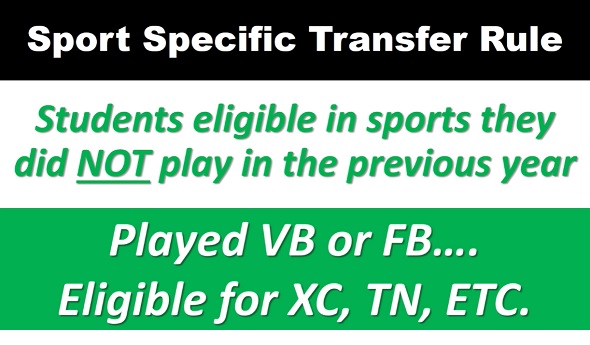
The Council passed a more lenient rule on the one hand and more restrictive on the other. The more lenient aspect is a change that finds a transfer student ELIGIBLE in any sport in which he or she did not participate in a game or a scrimmage in the previous school year.
The more restrictive portion tends to discourage students who change schools for sports reasons. A transfer student who did play a sport in the previous season – and who does not meet one of the 15 Exceptions – is NOT ELIGIBLE in that sport for the next season. If a student changes schools in mid-season, the student would be ineligible for the rest of that season in that sport and the next season for that sport.
Participation under this and other rules means playing in an interscholastic game or scrimmage after starting the 9th grade at any high school. It does not mean practice, but entering an interscholastic game, meet or scrimmage in any way. It also may involve more than one sport, so a three-sport athlete who does not have a residential change and transfers would be ineligible in those sports during the next school year – but eligible for any other sport. It also means a student cut from a team – one who never entered a scrimmage or game – may transfer and play without delay for that new school’s team. It may also mean that a student who meets one of the stated exceptions such as a residential change but enrolls in a school other than her or his school of residence, would have eligibility in sports not played in the previous year.
The new rule will tend to discourage students from changing schools for sports because they would be ineligible in any sport they have played in school the previous season for that sport. It will increase participation for some students who were otherwise not eligible under the current rule.
It is always best to contact school athletic directors who can connect with the MHSAA to verify eligibility prior to enrollment.
If the student’s new school requests in writing, the MHSAA Executive Committee may approve a waiver that reduces the period of ineligibility to 90 scheduled school days at the new school if the change of schools was for compelling reasons demonstrated with outside documentation having nothing to do with sports, curriculum, finances, and school demographics. The Executives Committee also has authority to approve immediate eligibility.

2018-19 Classifications Announced
March 27, 2018
By Geoff Kimmerly
Second Half editor
Classifications for Michigan High School Athletic Association elections and postseason tournaments for the 2018-19 school year have been announced, with enrollment breaks for postseason tournaments posted to each sport’s page on the MHSAA Website.
Classifications for the upcoming school year are based on a second semester count date, which for MHSAA purposes was Feb. 14. The enrollment figure submitted for athletic classification purposes may be different from the count submitted for school aid purposes, as it does not include students ineligible for athletic competition because they reached their 19th birthday prior to September 1 of the current school year and will not include alternative education students if none are allowed athletic eligibility by the local school district.
Beginning with 2018-19, traditional classes (A, B, C, D) will be used only for MHSAA elections and football playoff purposes – in 11-player to determine opponents’ point values, and in 8-player to determine if schools are eligible to compete in the MHSAA Playoffs (only Class D teams may participate in the postseason). All other sports’ tournaments will be conducted with schools in equal or nearly equal divisions, including volleyball and girls and boys basketball postseasons for the first time.
To determine traditional classifications, after all counts are submitted, tournament-qualified member schools are ranked according to enrollment and then split as closely into quarters as possible. For 2018-19, there are 747 tournament-qualified member schools with 186 schools in Class A, 188 schools in Class B, 186 schools in Class C and 187 schools in Class D.
Effective with the 2018-19 school year, schools with 885 or more students are in Class A. The enrollment limits for Class B are 398-884, Class C is 194-397, and schools with enrollments of 193 and fewer are Class D. The break between Classes A and B increased four students from 2017-18, the break between Classes B and C decreased eight students, and the break between Classes C and D is nine students fewer than the current school year.
Schools recently were notified of their classification. MHSAA Executive Director John E. "Jack" Roberts said schools may not subsequently lower their enrollment figure. However, if revised enrollment figures should be higher and indicate that a school should be playing in a higher division, that school would be moved up.
Schools have the option to play at any higher division for a minimum of two years, but must exercise the option by April 15 for fall sports, August 15 for winter sports and October 15 for spring sports.
The divisions and qualifiers for the MHSAA Football Playoffs will be announced on Selection Sunday, Oct. 21, 2018. Visit the respective sport pages on the MHSAA Website to review the divisional alignments for all other MHSAA-sponsored tournament sports.
Among teams that will be playing in new divisions in 2018-19 are four reigning MHSAA champions. The Macomb Lutheran North girls golf team will move to Division 4 after winning Division 3 this past fall. The East Grand Rapids girls swimming & diving team will move into Division 3 after winning Division 2 in the fall, while the Flint Powers Catholic boys soccer team will play in Division 2 after winning Division 3 this past season. Flint Powers Catholic’s girls soccer team, the reigning Division 3 champion playing in that division again this spring, will also move into Division 2 for the 2019 season.
A complete list of school enrollments used to determine classifications for the 2018-19 school year can be found on the Enrollment & Classification page of the MHSAA Website.
The new classification breaks will see 22 schools move up in class for 2018-19, while 15 schools will move down. (Note: This list does not include schools opting up in class/division for tournaments, which can be found on the Administrators page of the MHSAA Website, under Enrollment and Classification):
Moving Up From Class B to Class A
Detroit Mumford
Flint Southwestern
Haslett
Jackson Northwest
New Boston Huron
River Rouge
Moving Down From Class A to Class B
Battle Creek Harper Creek
Detroit Cody
Farmington Hills Harrison
Hazel Park
Stevensville Lakeshore
Moving Up From Class C to Class B
Constantine
Detroit Henry Ford
Detroit Jalen Rose Leadership Academy
Detroit School of Arts
Houghton
Negaunee
Pinconning
Wixom St. Catherine of Siena
Moving Down From Class B to Class C
Dearborn Advanced Technology Academy
Ecorse
Harrison
Millington
Moving Up From Class D to Class C
Bark River-Harris
Big Rapids Crossroads Academy
Hope of Detroit Academy
Mesick
Morenci
Munising
Rogers City
Wyoming Potter’s House Christian
Moving Down From Class C to Class D
Detroit Southeastern
Mendon
New Buffalo
Pittsford
Saginaw Michigan Lutheran Seminary
Saginaw Nouvel Catholic Central
New Postseason Eligible Tournament Schools in 2018-19
Dearborn Heights WISE Academy
Pontiac Arts & Technology Academy
Taylor (created from a merger of Taylor Truman and Taylor Kennedy)
Enrollment Breaks by Classes – 2018-19
(Number of schools in parentheses)
Class A: 885 and above (186 schools)
Class B: 398 – 884 (188)
Class C: 194 – 397 (186)
Class D: 193 and below (187)
The MHSAA is a private, not-for-profit corporation of voluntary membership by more than 1,500 public and private senior high schools and junior high/middle schools which exists to develop common rules for athletic eligibility and competition. No government funds or tax dollars support the MHSAA, which was the first such association nationally to not accept membership dues or tournament entry fees from schools. Member schools which enforce these rules are permitted to participate in MHSAA tournaments, which attract more than 1.4 million spectators each year.