

Brush Up on the New Transfer Rule
July 18, 2019
By Rob Kaminski
MHSAA benchmarks editor
Eligibility under the new “sport-specific” transfer rule begins this coming fall after circulating extensively for nearly one school year.
Unless one of the stated 15 exceptions is met, participation during the 2018-19 school year determines eligibility for 2019-20.
The new rule adopted by the Representative Council at its May 2018 meeting has found support among most audiences. A transfer student’s eligibility in 2019-20 is based upon that student’s participation from this past school year (2018-19). It will be paramount for administrators and coaches to have awareness of the sports a transfer student participated in during the previous school year.
The long-standing 15 Exceptions to immediate eligibility, such as a full and complete residential change or a student moving between divorced parents by completing of an Educational Transfer Form, did not change.
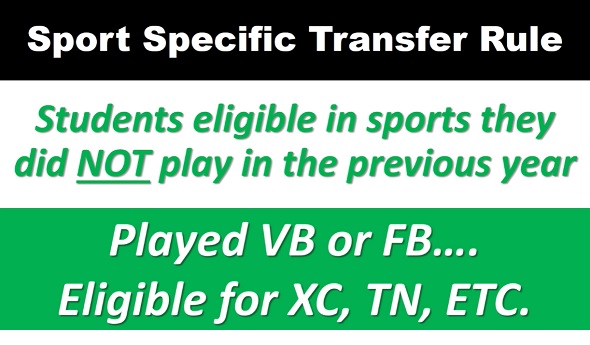
One might call the rule on the way out “The Fourth-Friday Transfer Rule.” Under this old rule, when a student enrolled at the new school determined his or her eligibility. Under the new Sport Specific Transfer rule, what a student played in the previous season determines eligibility.
The Council passed a more lenient rule on the one hand and more restrictive on the other. The more lenient aspect is a change that finds a transfer student ELIGIBLE in any sport in which he or she did not participate in a game or a scrimmage in the previous school year.
The more restrictive portion tends to discourage students who change schools for sports reasons. A transfer student who did play a sport in the previous season – and who does not meet one of the 15 Exceptions – is NOT ELIGIBLE in that sport for the next season. If a student changes schools in mid-season, the student would be ineligible for the rest of that season in that sport and the next season for that sport.
Participation under this and other rules means playing in an interscholastic game or scrimmage after starting the 9th grade at any high school. It does not mean practice, but entering an interscholastic game, meet or scrimmage in any way. It also may involve more than one sport, so a three-sport athlete who does not have a residential change and transfers would be ineligible in those sports during the next school year – but eligible for any other sport. It also means a student cut from a team – one who never entered a scrimmage or game – may transfer and play without delay for that new school’s team. It may also mean that a student who meets one of the stated exceptions such as a residential change but enrolls in a school other than her or his school of residence, would have eligibility in sports not played in the previous year.
The new rule will tend to discourage students from changing schools for sports because they would be ineligible in any sport they have played in school the previous season for that sport. It will increase participation for some students who were otherwise not eligible under the current rule.
It is always best to contact school athletic directors who can connect with the MHSAA to verify eligibility prior to enrollment.
If the student’s new school requests in writing, the MHSAA Executive Committee may approve a waiver that reduces the period of ineligibility to 90 scheduled school days at the new school if the change of schools was for compelling reasons demonstrated with outside documentation having nothing to do with sports, curriculum, finances, and school demographics. The Executives Committee also has authority to approve immediate eligibility.
Sorgi-Led Blanket Drive Spreads Support
May 26, 2017
By Geoff Kimmerly
Second Half editor
The design was the same, the pattern was one they’d used, and the little girl had received her blanket right around Christmas while undergoing cancer treatments.
 Nikki Sorgi has no way of knowing for sure if the blanket – described by an aunt who cares for the child during the school day – is one of more than 400 she, her older sister and Utica Ford classmates have donated to University of Michigan’s C.S. Mott Children’s Hospital over the last three years. But that doesn’t matter – the fact that a blanket, any blanket, is bringing a child comfort hits home as Sorgi considers what she’s helped to accomplish.
Sorgi is a recipient of an MHSAA/Lake Trust Credit Union “Community Service Award” for helping spearhead a campaign that stretched over the course of her high school career, with the co-leadership of her older sister Alex (a 2015 Ford graduate) and large contributions from her school’s National Honor Society chapter, student council and school store.
“It was really great to see, from the toy drive we started my freshman year, there are other kids out there who care,” Nikki Sorgi said. “A lot of people have this stereotypical view of teenagers, that they’re more concerned about themselves and what’s going on in their lives. It was cool to see other kids out there who care, who want to make a difference, even if they don’t have the ability to start their own project or event.”
Sorgi this fall will follow her sister Alex to Bowling Green State University, beginning studies toward an eventual career as a pediatrician. Providing care for children has been a major drive in her life since her freshman year, when she and Alex collected 250 toys to donate to hospitalized children.
 About that time, a medical issue struck closer to home – a friend and classmate was diagnosed with cancer. Realizing that a toy drive was great for younger kids but not as much of a help for older ones, the Sorgi sisters turned their focus to creating homemade tie-knot fleece blankets that could comfort patients of all ages.
Sadly, the friend who inspired the drive, Stefan Oncia, died after his battle in December 2014. A month later, the first donation of 60 blankets went to Kids Kicking Cancer in Southfield. The following Christmas season, more than 150 blankets were donated to patients at C.S. Mott. This past Christmas, the Sorgis delivered nearly 200 more blankets.
Along the way, Ford’s NHS helped raise funds for materials, and more than 60 students helped assemble them during an after-school blanket-making party. The Bemis Junior High life skills class also has contributed blankets the last two years, and Nikki worked with her travel softball coach to make their holiday gift exchange instead a donation of blankets.
The girls’ mother Roni has had a number of big assists along the way, and that likely will continue with Nikki finishing up high school (she’ll also join her sister playing softball at BGSU). Nikki, a four-year varsity softball and basketball player, said she’s talked to her coach Matt Joseph (who coaches both teams) about ways to continue the blanket drive in the future. Her brother Joey will be a sophomore next year and is expected to pick up the cause, with the sisters returning home at Thanksgiving to help orchestrate the drive with the help of Ford sports teams or NHS if it remains involved.
Nikki will use the award as a scholarship toward paying for her education. Her desire to become a doctor started before she started playing such a large role in bringing patients comfort – but seeing how the blankets have impacted children at the hospital has swayed her toward pediatrics while also teaching her a few lessons in persistence and communication.
“It shows the blanket drive might be one small thing, but it shows how much one small thing can do for people who are sick, or struggling, whatever the case may be,” Sorgi said. “Even though it’s just a small gesture.”
The Community Service Awards are sponsored by the Michigan High School Athletic Association and Lake Trust Credit Union to recognize student-athletes' efforts to improve the lives of others in their communities. In addition to the $1,000 award, the Lake Trust Foundation is awarding an additional $500 to each honoree, to be donated to a non-profit, 501 (c)(3) organization of the awardee’s choice.
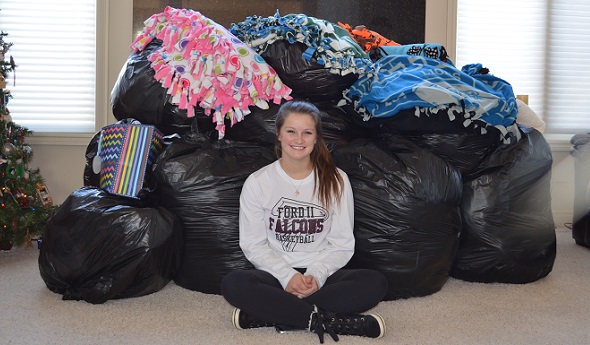
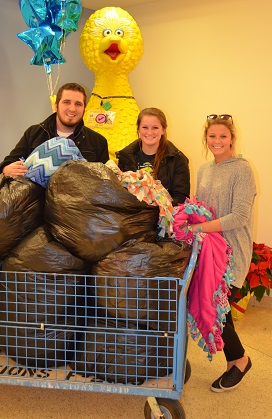
PHOTOS: (Top) Utica Ford senior Nikki Sorgi sits in front of a mountain of homemade blankets headed for C.S. Mott Children’s Hospital. (Middle) Sorgi, with older sister Alex (right) and Kevin Smith from Mott community relations, delivers the blankets to the hospital. (Photos courtesy of the Sorgi family.)
2017 Community Service Awards
Sunday: Colon "Yard Squad" - Read
Monday: Bailey Brown, Brighton - Read
Tuesday: Justice Ottinger, Newaygo - Read
Thursday: Katie Sesi, Ann Arbor Huron - Read