

Brush Up on the New Transfer Rule
July 18, 2019
By Rob Kaminski
MHSAA benchmarks editor
Eligibility under the new “sport-specific” transfer rule begins this coming fall after circulating extensively for nearly one school year.
Unless one of the stated 15 exceptions is met, participation during the 2018-19 school year determines eligibility for 2019-20.
The new rule adopted by the Representative Council at its May 2018 meeting has found support among most audiences. A transfer student’s eligibility in 2019-20 is based upon that student’s participation from this past school year (2018-19). It will be paramount for administrators and coaches to have awareness of the sports a transfer student participated in during the previous school year.
The long-standing 15 Exceptions to immediate eligibility, such as a full and complete residential change or a student moving between divorced parents by completing of an Educational Transfer Form, did not change.
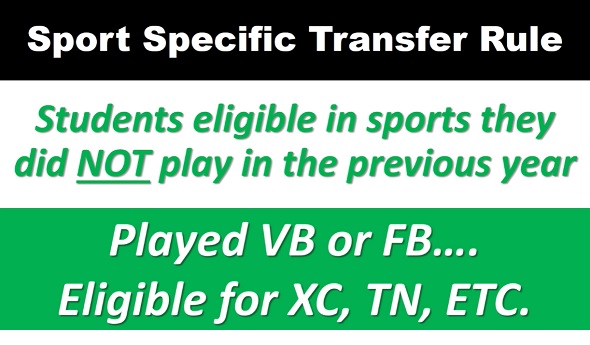
One might call the rule on the way out “The Fourth-Friday Transfer Rule.” Under this old rule, when a student enrolled at the new school determined his or her eligibility. Under the new Sport Specific Transfer rule, what a student played in the previous season determines eligibility.
The Council passed a more lenient rule on the one hand and more restrictive on the other. The more lenient aspect is a change that finds a transfer student ELIGIBLE in any sport in which he or she did not participate in a game or a scrimmage in the previous school year.
The more restrictive portion tends to discourage students who change schools for sports reasons. A transfer student who did play a sport in the previous season – and who does not meet one of the 15 Exceptions – is NOT ELIGIBLE in that sport for the next season. If a student changes schools in mid-season, the student would be ineligible for the rest of that season in that sport and the next season for that sport.
Participation under this and other rules means playing in an interscholastic game or scrimmage after starting the 9th grade at any high school. It does not mean practice, but entering an interscholastic game, meet or scrimmage in any way. It also may involve more than one sport, so a three-sport athlete who does not have a residential change and transfers would be ineligible in those sports during the next school year – but eligible for any other sport. It also means a student cut from a team – one who never entered a scrimmage or game – may transfer and play without delay for that new school’s team. It may also mean that a student who meets one of the stated exceptions such as a residential change but enrolls in a school other than her or his school of residence, would have eligibility in sports not played in the previous year.
The new rule will tend to discourage students from changing schools for sports because they would be ineligible in any sport they have played in school the previous season for that sport. It will increase participation for some students who were otherwise not eligible under the current rule.
It is always best to contact school athletic directors who can connect with the MHSAA to verify eligibility prior to enrollment.
If the student’s new school requests in writing, the MHSAA Executive Committee may approve a waiver that reduces the period of ineligibility to 90 scheduled school days at the new school if the change of schools was for compelling reasons demonstrated with outside documentation having nothing to do with sports, curriculum, finances, and school demographics. The Executives Committee also has authority to approve immediate eligibility.

Advisory Council Names Class Of 2019
By
Geoff Kimmerly
MHSAA.com senior editor
May 1, 2017
By Geoff Kimmerly
Second Half editor
Eight student-athletes who will be juniors at their schools during the 2017-18 academic year have been selected to serve two-year terms on the Michigan High School Athletic Association’s Student Advisory Council.
The Student Advisory Council is a 16-member group which provides feedback on issues impacting educational athletics from a student’s perspective, and also is involved in the operation of Association championship events and other programming. Members of the Student Advisory Council serve for two years, beginning as juniors. Eight new members are selected annually to serve on the SAC, with nominations made by MHSAA member schools. The incoming juniors will join the group of eight seniors-to-be appointed a year ago.
Selected to begin serving on the Student Advisory Council in 2017-18 are: Taylor Adams, Allendale; Neil Bazaj, Ann Arbor Greenhills; Megan Corbe, St. Joseph; Shane Dolan, Clarkston Everest Collegiate; Chloe Idoni, Fenton; William Jontz, Brighton; Pierce Morrissey, Big Rapids; and Abigail Nelson, Negaunee.
The first Student Advisory Council was formed for the 2006-07 school year. With the addition of this class beginning this summer, members will have represented 95 schools from 44 leagues plus independent schools that do not play in a league. Combined, the new appointees have participated in 13 MHSAA sports, and seven of the eight will be the first SAC members from their respective schools.
The Student Advisory Council meets seven times each school year, and once more for a 24-hour leadership camp. In addition to assisting in the promotion of the educational value of interscholastic athletics, the council discusses issues dealing with the 4 S’s of educational athletics: scholarship, sportsmanship, safety (including health and nutrition) and the sensible scope of athletic programs. There also is a fifth S discussed by the group – student leadership.
This school year, the Council judged the sixth “Battle of the Fans” after creating the contest during 2011-12 as a way to promote positive sportsmanship. The Council also completed updates to the “Captains 101” leadership guide first published in 2009, and in fall 2017 will be distributing a follow-up book titled “The Captains Playbook.” The 24-page book will be sent to schools throughout Michigan and also, by request, to other states and internationally.
The new additions to the SAC will join the Class of 2018 members who were selected a year ago: Sydney Hanson, Alma; Jordan Tirico, Ann Arbor Skyline; Danny deForest, Holland West Ottawa; Darby Dean, Lowell; Rachel Cummings, Mayville; Grace Reetz, Mount Pleasant Sacred Heart; Aaron Fahmer, Owendale-Gagetown; and Hunter Gandee, Temperance Bedford.
The MHSAA is a private, not-for-profit corporation of voluntary membership by more than 1,400 public and private senior high schools and junior high/middle schools which exists to develop common rules for athletic eligibility and competition. No government funds or tax dollars support the MHSAA, which was the first such association nationally to not accept membership dues or tournament entry fees from schools. Member schools which enforce these rules are permitted to participate in MHSAA tournaments, which attract more than 1.4 million spectators each year.