

Brush Up on the New Transfer Rule
July 18, 2019
By Rob Kaminski
MHSAA benchmarks editor
Eligibility under the new “sport-specific” transfer rule begins this coming fall after circulating extensively for nearly one school year.
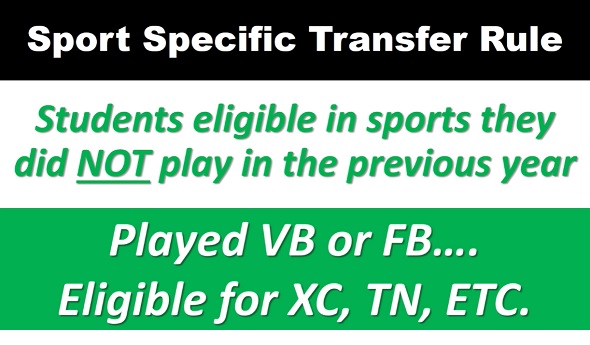
Unless one of the stated 15 exceptions is met, participation during the 2018-19 school year determines eligibility for 2019-20.
The new rule adopted by the Representative Council at its May 2018 meeting has found support among most audiences. A transfer student’s eligibility in 2019-20 is based upon that student’s participation from this past school year (2018-19). It will be paramount for administrators and coaches to have awareness of the sports a transfer student participated in during the previous school year.
The long-standing 15 Exceptions to immediate eligibility, such as a full and complete residential change or a student moving between divorced parents by completing of an Educational Transfer Form, did not change.
One might call the rule on the way out “The Fourth-Friday Transfer Rule.” Under this old rule, when a student enrolled at the new school determined his or her eligibility. Under the new Sport Specific Transfer rule, what a student played in the previous season determines eligibility.
The Council passed a more lenient rule on the one hand and more restrictive on the other. The more lenient aspect is a change that finds a transfer student ELIGIBLE in any sport in which he or she did not participate in a game or a scrimmage in the previous school year.
The more restrictive portion tends to discourage students who change schools for sports reasons. A transfer student who did play a sport in the previous season – and who does not meet one of the 15 Exceptions – is NOT ELIGIBLE in that sport for the next season. If a student changes schools in mid-season, the student would be ineligible for the rest of that season in that sport and the next season for that sport.
Participation under this and other rules means playing in an interscholastic game or scrimmage after starting the 9th grade at any high school. It does not mean practice, but entering an interscholastic game, meet or scrimmage in any way. It also may involve more than one sport, so a three-sport athlete who does not have a residential change and transfers would be ineligible in those sports during the next school year – but eligible for any other sport. It also means a student cut from a team – one who never entered a scrimmage or game – may transfer and play without delay for that new school’s team. It may also mean that a student who meets one of the stated exceptions such as a residential change but enrolls in a school other than her or his school of residence, would have eligibility in sports not played in the previous year.
The new rule will tend to discourage students from changing schools for sports because they would be ineligible in any sport they have played in school the previous season for that sport. It will increase participation for some students who were otherwise not eligible under the current rule.
It is always best to contact school athletic directors who can connect with the MHSAA to verify eligibility prior to enrollment.
If the student’s new school requests in writing, the MHSAA Executive Committee may approve a waiver that reduces the period of ineligibility to 90 scheduled school days at the new school if the change of schools was for compelling reasons demonstrated with outside documentation having nothing to do with sports, curriculum, finances, and school demographics. The Executives Committee also has authority to approve immediate eligibility.

Schools Approve 6th-Grade Membership
December 7, 2015
By Geoff Kimmerly
Second Half editor
By a vote of 561 in favor and 87 opposed, the membership of the Michigan High School Athletic Association has approved an amendment to the MHSAA Constitution that for the first time in 2016-17 will permit schools to join the MHSAA at the 6th-grade level.
Currently, MHSAA membership is open to schools at the 7th- and 8th-grade level as junior high/middle schools and at the 9th through 12th grades at the high school level. The MHSAA’s total membership of 1,458 schools consists at this time of 705 junior high/middle schools and 753 high schools.
The revision in the MHSAA Constitution does not require school districts to become member schools at the junior high/middle school level and does not require school districts to sponsor any interscholastic 6th-grade programs. If a school district’s MHSAA Membership Resolution lists a junior high/middle school as an MHSAA member school, and if the school sponsors a 6th-grade team in any sport or permits a 6th-grade student to participate with 7th- and/or 8th-grade students in any sport, then all MHSAA Regulations apply to all 6th-graders in all sports involving 6th-graders on teams sponsored by that school. If the school does not allow any 6th-graders to participate in a sport, MHSAA rules do not apply in that sport.
“There are a variety of reasons school districts so overwhelmingly supported this change,” MHSAA Executive Director John E. “Jack” Roberts said. “Some wanted the change so they could better market school sports to younger students. Some districts have their 6th-graders in the same buildings and even classrooms with 7th- and 8th-graders and see the natural fit. Some of our smaller junior high/middle schools need 6th-graders to fill out teams.”
MHSAA services, including catastrophic accident medical insurance and concussion care gap insurance, will be provided without charge for 6th-graders whose districts secure MHSAA membership, beginning with the 2016-17 school year.
The MHSAA is a private, not-for-profit corporation of voluntary membership by more than 1,400 public and private senior high schools and junior high/middle schools which exists to develop common rules for athletic eligibility and competition. No government funds or tax dollars support the MHSAA, which was the first such association nationally to not accept membership dues or tournament entry fees from schools. Member schools which enforce these rules are permitted to participate in MHSAA tournaments, which attract more than 1.4 million spectators each year.