

Brush Up on the New Transfer Rule
July 18, 2019
By Rob Kaminski
MHSAA benchmarks editor
Eligibility under the new “sport-specific” transfer rule begins this coming fall after circulating extensively for nearly one school year.
Unless one of the stated 15 exceptions is met, participation during the 2018-19 school year determines eligibility for 2019-20.
The new rule adopted by the Representative Council at its May 2018 meeting has found support among most audiences. A transfer student’s eligibility in 2019-20 is based upon that student’s participation from this past school year (2018-19). It will be paramount for administrators and coaches to have awareness of the sports a transfer student participated in during the previous school year.
The long-standing 15 Exceptions to immediate eligibility, such as a full and complete residential change or a student moving between divorced parents by completing of an Educational Transfer Form, did not change.
One might call the rule on the way out “The Fourth-Friday Transfer Rule.” Under this old rule, when a student enrolled at the new school determined his or her eligibility. Under the new Sport Specific Transfer rule, what a student played in the previous season determines eligibility.
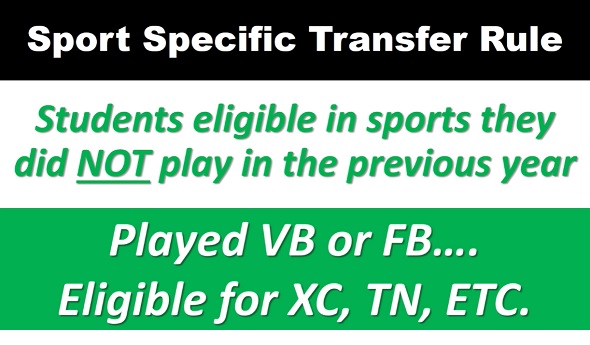
The Council passed a more lenient rule on the one hand and more restrictive on the other. The more lenient aspect is a change that finds a transfer student ELIGIBLE in any sport in which he or she did not participate in a game or a scrimmage in the previous school year.
The more restrictive portion tends to discourage students who change schools for sports reasons. A transfer student who did play a sport in the previous season – and who does not meet one of the 15 Exceptions – is NOT ELIGIBLE in that sport for the next season. If a student changes schools in mid-season, the student would be ineligible for the rest of that season in that sport and the next season for that sport.
Participation under this and other rules means playing in an interscholastic game or scrimmage after starting the 9th grade at any high school. It does not mean practice, but entering an interscholastic game, meet or scrimmage in any way. It also may involve more than one sport, so a three-sport athlete who does not have a residential change and transfers would be ineligible in those sports during the next school year – but eligible for any other sport. It also means a student cut from a team – one who never entered a scrimmage or game – may transfer and play without delay for that new school’s team. It may also mean that a student who meets one of the stated exceptions such as a residential change but enrolls in a school other than her or his school of residence, would have eligibility in sports not played in the previous year.
The new rule will tend to discourage students from changing schools for sports because they would be ineligible in any sport they have played in school the previous season for that sport. It will increase participation for some students who were otherwise not eligible under the current rule.
It is always best to contact school athletic directors who can connect with the MHSAA to verify eligibility prior to enrollment.
If the student’s new school requests in writing, the MHSAA Executive Committee may approve a waiver that reduces the period of ineligibility to 90 scheduled school days at the new school if the change of schools was for compelling reasons demonstrated with outside documentation having nothing to do with sports, curriculum, finances, and school demographics. The Executives Committee also has authority to approve immediate eligibility.

Ford Field Parking, Protocols Announced
November 24, 2014
By Geoff Kimmerly
Second Half editor
To provide for the convenience and safety of spectators attending the Michigan High School Athletic Association 11-Player Football Finals at Ford Field in Detroit, Nov. 28 and 29, attendees are being advised of a variety of items related to transportation and security – including policies regulating types of bags allowed into the stadium.
Parking will be available in Ford Field facilities and lots to the east and north of the stadium and cost $6. A map identifying the designated Ford Field lot (4) and parking deck can be found on the Football page of the MHSAA Website. (There also are a number of privately-operated parking facilities close to Ford Field, but their pricing may differ.)
Fans also are advised that tailgating, including the setting up and use of grilling equipment, and the consumption of alcohol, is prohibited in Ford Field parking facilities and lots.
Gates A, B and G will be available for public entrance during the event. Ticket sales will begin near Gates A and G at 8 a.m. each day, and the building will open its doors to spectators at 9 a.m.
Tickets are priced at $10 and allow a fan to see all four games in a single day. Spectators leaving the stadium will be required to purchase another ticket for re-entry. Children under the age of 2 will be admitted without charge for this event. There will not be a public Will Call window.
Upon arrival in the building, fans will find their designated seating areas on the South side of the field if their team is the designated home team for their contest and on the North side for the designated visiting team. Home teams this weekend are Clarkston, Muskegon Mona Shores, Muskegon, Grand Rapids South Christian, Grand Rapids West Catholic, Ithaca, Ishpeming and Munising. Brightly lit video boards above the seating areas will display the names of the participating teams each day, and fans should sit on the side of the stadium where they see their school’s name. For general fans, the entire lower bowl of Ford Field will be open for the event.
Security measures also will be in place to help assure spectator safety. Fans will be subject to a visual search, and Ford Field personnel reserve the right to request patrons open their coats, bags and other item-carrying vessels for visual inspection and deny entrance to individuals who do not cooperate. Items which fans will be prohibited from bringing into the building include, but are not limited to, the following:
- Purses larger than a clutch bag, coolers, briefcases, backpacks, cinch bags, grocery & paper bags, duffle bags, luggage of any kind, computer and camera bags and large camera cases.
- Aerosol cans (hairspray, mace, pepper spray, etc.)
- Animals (except service animals to aid guests with disabilities)
- Balloons (air or helium)
- Balls (beach balls, footballs, etc.)
- Banners or large flags
- Cameras with lenses longer than five inches
- Decals, stickers, confetti or glitter
- Electronic equipment including laptop computers, video recorders and video cameras, and tripods (hand-held video cameras are allowed)
- Fireworks
- Food, beverages or liquids (cans, bottles, boxes, flasks, etc.)
- Illegal substances
- Knives, pocket knives, box cutters, scissors, etc.
- Laser pointers
- Markers (permanent) and/or paint
- Noisemaking devices (bells, horns, kazoos, whistles, etc.)
- Objects that can be used as missiles or projectiles (sticks, bats, clubs, Frisbees, etc.)
- Seat cushions
- Strollers and infant car seats or carriers
- Umbrellas
Weapons
The following items will be permitted after inspection:
- Small bags, purses and fanny packs that do not exceed 8½ inches by 14 inches by 10 inches. An exception will be made for medically necessary items after proper inspection at a gate designated for this purpose.
- Diaper bags (only if accompanied by a child)
- Binoculars and binoculars cases
- Cameras and small camera cases (lenses may not measure longer than five inches)
- Small radios (no larger than the size of a football and used with an earpiece)
- Small hand-held video cameras (but no tripods or extension cords)
- Small, compact umbrellas (must be placed securely under seat)
- Posters and signs without poles or sticks, or larger than what one person can hold.
The complete list of prohibited items can be found on the Ford Field Web site under Policies & Info. Prohibited items that are discovered during security inspections at stadium entrances must either be returned to the owner's vehicle or discarded. Items will not be held for later pickup.
Fans are reminded that all image taking (still and video) may be only for personal, non-commercial use.