

Chance to Touch Lives 'Drives' Huron's Sesi
May 25, 2017
By Geoff Kimmerly
Second Half editor
Only a few times, collecting more than 300,000 cans and bottles was as gross as it might sound.
 Of course there was some mold, and a few bags had dead mice in them. Once, a bag was filled with ants, and Katie Sesi and her family would find them crawling around their car for the next month.
Another time, a duck bit her.
But those are just some of the funnier memories that were more than worth the opportunity for Sesi to meet and help an untold number of people, beginning when she was 6 years old – truly a life’s work so far for the Ann Arbor Huron junior.
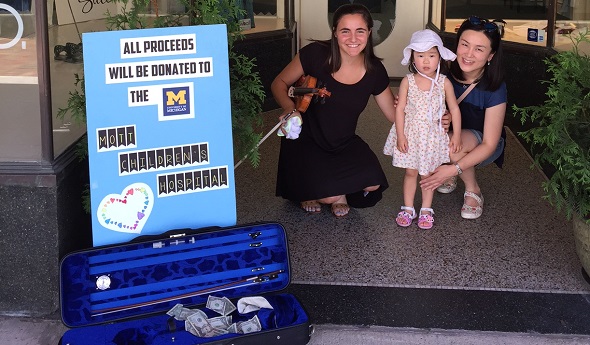
Sesi is a recipient of an MHSAA/Lake Trust Credit Union “Community Service Award” for her work raising $40,000 over the last decade for University of Michigan’s C.S. Mott Children’s Hospital. Playing her violin at the Ann Arbor Art Fair annually beginning in elementary school, and then taking on a can drive that’s seen her canvass neighborhoods all over her city and surrounding area, Sesi has managed to raise $10,000 every two years since 2010.
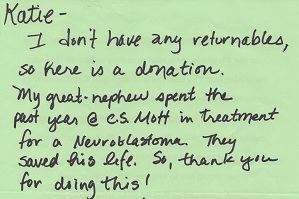
She’s also met at least 50 of her donors over that decade and received in the neighborhood of 300 letters from people encouraging her work and asking how else they might help.
“Meeting new people is just a good experience. It’s really interesting to learn about other people’s lives,” Sesi said. “My favorite part was the personal interaction. When I started doing the can drives, I didn’t think I’d talk to a bunch of people and learn their life stories. But people leave me notes that say, ‘Hey, you should come talk to me.’ For me, just talking to people is really fun. The unexpected chance to meet more people has been very memorable.”
It’s also an incredible story, considering Sesi’s decision to start lending a hand as barely an elementary schooler.
She’s played the violin since she was 3, and recalled reading a newspaper article about two girls playing their violins at a similar outside event. She thought to herself, I should do the same. Her mother, Yvonne Sesi, challenged her to make it happen.
Katie then realized that being 6, she didn’t really need the money people would give her while passing by. So she began saving toward what would eventually become that first $10,000 donation.
 At 9, with her mom at the wheel, Katie started her can drives. The first netted only $9. But she didn’t give up. At times she would work neighborhoods every weekend, leaving a flier at people’s houses explaining her mission and letting them know when she’d be back to collect.
Soon, the car was regularly full with the front seats moved up as far as possible to make room for the overflowing supply of returnables. She estimates she’s collected cans and bottles “several hundred” times.
Sesi’s first donation to C.S. Mott went toward building “The Treehouse” indoor playground, and subsequent donations have gone toward research of childhood cancers and the hospital’s Child and Family Life center, which provides support for patients and their families during treatment.
Yvonne is a doctor, and Katie is interested in becoming a pediatric oncologist (or going into business, or perhaps both). Helping children is especially close to her heart; one of her most memorable can drive interactions came with a family that had lost a son to lymphoma who had been treated at Mott; they invited her in to meet their newborn daughter they’d adopted after his death.
She’s choosing to donate half of her $1,000 award to U-M’s Chad Tough Fund, which directs funds to childhood cancer research in honor of Chad Carr, the grandson of retired Wolverines coach Lloyd Carr who died in November 2015 at age 5 after a fight with pediatric brain cancer. She’ll donate the other half of her award to the Ann Arbor Huron girls tennis team; she’s an all-state No. 1 singles player and team captain.
A regular in some neighborhoods, where people recognize her from past drives, Sesi said she’s learned a lot about perseverance and hard work – but again, is most inspired by the many people she’s met along the way.
“I knew early on that I wanted the money to go to children with cancer because it seemed to me completely unfair that kids should be denied a carefree and fun childhood,” Sesi wrote in her application for the award. “All together, I found that people have tremendous hearts and an unlimited capacity for supporting, helping and giving to others."
The Community Service Awards are sponsored by the Michigan High School Athletic Association and Lake Trust Credit Union to recognize student-athletes' efforts to improve the lives of others in their communities. In addition to the $1,000 award, the Lake Trust Foundation is awarding an additional $500 to each honoree, to be donated to a non-profit, 501 (c)(3) organization of the awardee’s choice.
PHOTOS: (Top) Katie Sesi, next to her violin case, has played to raise money every summer since she was 6 at the Ann Arbor Art Fair. (Middle) Sesi has received hundreds of notes like this one thanking her for her efforts. (Photos courtesy of Katie Sesi.)
2017 Community Service Awards
Sunday: Colon "Yard Squad" - Read
Monday: Bailey Brown, Brighton - Read
Tuesday: Justice Ottinger, Newaygo - Read

MHSAA Ups Awareness with 'Heat Ways'
August 6, 2013
With the beginning of a new year for high school sports just a week away, members of the Michigan High School Athletic Association have been preparing to follow a new model policy for hot weather activity, guided by a new publication and a rules meeting emphasis on heat and hydration.
The MHSAA Representative Council adopted a Model Policy for Managing Heat & Humidity earlier this year, a plan many schools have since adopted at the local level. The plan directs schools to begin monitoring the heat index at the activity site once the air temperature reaches 80 degrees, and provides recommendations when the heat index reaches certain points, including ceasing activities when it rises above 104 degrees.
The model policy is outlined in a number of places, including a new publication called Heat Ways, which is available for download from the MHSAA Website. Heat Ways not only provides the model policy, but addresses the need for proper acclimatization in hot weather.
The topic of heat-related injuries receives a lot of attention at this time of year, especially when deaths at the professional, collegiate and interscholastic levels of sport occur, and especially since they are preventable in most cases with the proper precautions. In football, data from the National Federation of State High School Associations shows that 41 high school players have died from heat stroke between 1995 and 2012.
Even before the days of the Internet, the MHSAA held a leadership role in providing resources each Spring to assist schools in their preparation for hot preseason practices. In addition to the information now contained in Heat Ways, the Association is making dealing with heat, hydration and acclimatization the topic for its required preseason rules meetings for coaches and officials. The 15-minute online presentation spends a fair amount of time talking about the need for good hydration in sports, regardless of the activity or time of year.
The Health & Safety Resources page of the MHSAA Website has a set a number of links to different publications and information, and a free online presentation from the National Federation of State High School Associations. Visit MHSAA.com, click on Schools, and then on Health & Safety Resources to find the information.
“We know now more than we ever have about when the risk is high and who is most at risk, and we’re fortunate to be able to communicate that information better than ever before to administrators, coaches, athletes and parents," said John E. “Jack” Roberts, executive director of the MHSAA. “Heat stroke is almost always preventable, and we encourage everyone to avail themselves of the information on our website.”
Roberts added that the first days of formal practices in hot weather should be more for heat acclimatization than the conditioning of athletes, and that practices in such conditions need planning to become longer and more strenuous over a gradual progression of time.
“Then, schools need to be vigilant about providing water during practices, making sure that youngsters are partaking of water and educating their teams about the need for good hydration practices away from the practice and competition fields,” Roberts said.