


Changes Accompany Start of Fall Practice
August 8, 2019
By Geoff Kimmerly
Second Half editor
An assortment of game rules, preseason policy and postseason tournament changes will greet more than 100,000 high school student-athletes as 2019-20 Fall practices begin next week for nine sports for which the MHSAA sponsors postseason tournaments.
The most immediately noticeable adjustment will allow boys soccer, girls and boys cross country, boys tennis and girls golf teams to begin practice Monday, Aug. 12, along with football teams across the state.
Football practice traditionally begins before the rest of fall sports, by rule on the 16th Monday before Thanksgiving. However, a change approved by the MHSAA Representative Council will allow sports with MHSAA Finals tied to a specific weekend every fall – for example, Lower Peninsula Cross Country Finals always are the first weekend in November – the opportunity to begin practice on that 16th Monday as well, which will keep those teams from losing about a week of practice and competition during “late” Thanksgiving years when the holiday is during the fourth full week of November. Volleyball and Lower Peninsula girls swimming & diving – which, like football, have Finals tied to Thanksgiving – are not affected by the lateness of the holiday and will begin practice Wednesday, Aug. 14, keeping with their traditional starts.
Football teams must have 12 days of preseason practice at all levels before their first game, over a period of 16 calendar days before the first kickoff, with the first games this falls scheduled for the weekend of Aug. 29-31. Competition this fall may begin Aug. 16 for cross country, golf, soccer and tennis and Aug. 23 for volleyball and swimming & diving.
The most publicized change in MHSAA policy this fall likely will be the addition of limited seeding for Lower Peninsula Boys Soccer District play, using a Michigan Power Ratings (MPR) formula that debuted to assist in Boys Lacrosse Regional seeding this past spring and will be utilized as well for Districts in girls and boys basketball this winter and girls soccer beginning in 2020. The MPR formula ranks teams based on success and strength of schedule, with the top two teams in each District then placed on opposite sides of the bracket on the draw date for that sport. For boys soccer this fall, all games reported to the MHSAA through Sept. 28 will be used for MPR, with brackets announced Sept. 29. For more information on MPR and the boys soccer selection process, go to the MHSAA Website’s Boys Soccer page and see the information under “Tracking the Tournament."
Football remains the most played sport among MHSAA member school student-athletes and will introduce this season a series of in-game and practice-related changes. To improve pace of play, all varsity games will be played with a 40-second play clock that begins after the conclusion of the previous play except when there is an exception (penalty, timeout, etc.). In those circumstances, a 25-second clock will start with the referee’s ready-to-play whistle. Also beginning this football season, at the MHSAA Finals level, instant replay will be used to review all scoring plays and turnovers or potential scoring plays and turnovers (that is, when an official’s decision may have prevented or awarded a score or turnover). Replay review will be automatic in these situations.
The other notable rules changes in football continue a focus on safety. Tripping a ball carrier – that is, intentionally using the lower leg or foot to obstruct a runner below the knees – now will result in a 15-yard penalty. The definition of a horse-collar tackle also has been expanded to include grabbing of the name plate area on the back of the jersey (along with the inside of the neck area of the jersey or shoulder pads) to bring a runner to the ground. Horse-collar tackling also is penalized with a 15-yard personal foul.
Also beginning this season, the amount of practice “collision” contact will be defined in minutes instead of allowed days. Teams will be allowed no more than six hours of full-pads collision contact per week during the preseason and no more than 30 minutes of collision contact during a week of in-season (after games begin) practice. “Collision” is defined as contact at game speed, with the execution of full tackles at a competitive pace, taking players to the ground. Although “collision” contact will be limited, “thud” contact will be unlimited. “Thud” is not considered collision contact and defined as full speed but above the waist only, with no player taken to the ground and no winner or loser.
All fall sports face at least minor rules changes this season, and a few of the other most noticeable in-game adjustments will come in girls golf, volleyball, girls swimming & diving and boys soccer.
• In golf, athletes will be allowed to use cell phones in four situations – to call a coach or tournament administrator for a health and safety issue, for use in inputting scores for live scoring or other scoring applications, to contact a rules official with questions, and for use as a distance-measuring device.
• Also in golf, a new rule sets the maximum allowable score per hole at 12 strokes.
• In volleyball, attempted serves that make contact with a backboard or other support device hanging from the ceiling over the serving area now will be illegal serves instead of faults (which previously allowed the server another attempt). Also, when a ball in play strikes the cables or diagonal poles used to retract baskets or similar apparatus to the ceiling, the game official will stop play and determine if the ball was playable -- if it is ruled playable before making contact with the apparatus, there will be a replay; if the ball is deemed to have not been playable, it will be ruled out of bounds.
• Also in volleyball, a change regarding uniforms will make the libero more recognizable. A libero’s uniform top must clearly contrast with those of the rest of her teammates by using another predominant color. The libero’s uniform may be trimmed with the predominant color of her non-libero teammates’ uniforms, and vice versa. Also regarding volleyball uniforms, “00” may no longer be used as a jersey number, only numbers 0-99 to eliminate confusion.
• In swimming, the definition of a legal finish has changed to include a competitor touching any part of the finish end of the lane, not just the touch pad. In diving, the degree of difficulty was adjusted for back and reverse somersaults to provide consistency with difficulty of other dives.
• The game clock will stop in boys soccer beginning this fall when the team leading the game makes a substitution during the final five minutes of the second period of regulation or second part of overtime. This stoppage aims to prevent the team in the lead from using substitutions as a way to run time off the clock.
The 2019 Fall campaign culminates with postseason tournaments beginning with the Upper Peninsula Girls Tennis Finals during the first week of October and wraps up with the 11-Player Football Finals on Nov. 29 and 30. Here is a complete list of fall tournament dates:
Cross Country
U.P. Finals – Oct. 19
L.P. Regionals – Oct. 25 or 26
L.P. Finals – Nov. 2
11-Player Football
Selection Sunday – Oct. 27
Pre-Districts – Nov. 1 or 2
District Finals – Nov. 8 or 9
Regional Finals – Nov. 15 or 16
Semifinals – Nov. 23
Finals – Nov. 29-30
8-Player Football
Selection Sunday – Oct. 27
Regional Semifinals – Nov. 1 or 2
Regional Finals – Nov. 8 or 9
Semifinals – Nov. 16
Finals – Nov. 23
L.P. Girls Golf
Regionals – Oct. 7, 8, 9, 10, 11 or 12
Finals – Oct. 18-19
Soccer
Boys L.P. Districts – Oct. 9-11 & 14-19
Boys L.P. Regionals – Oct. 22-26
Boys L.P. Semifinals – Oct. 30
Boys L.P. Finals – Nov. 2
L.P. Girls Swimming & Diving
Diving Regionals – Nov.14
Swimming/Diving Finals – Nov. 22-23
Tennis
U.P. Girls Finals – Oct. 2, 3, 4 or 5
L.P. Boys Regionals – Oct. 10, 11 or 12
L.P. Finals – Oct. 18-19
Girls Volleyball
Districts – Nov. 4-9
Regionals – Nov. 12 &14
Quarterfinals – Nov. 19
Semifinals – Nov. 21-22
Finals – Nov. 23
The MHSAA is a private, not-for-profit corporation of voluntary membership by more than 1,500 public and private senior high schools and junior high/middle schools which exists to develop common rules for athletic eligibility and competition. No government funds or tax dollars support the MHSAA, which was the first such association nationally to not accept membership dues or tournament entry fees from schools. Member schools which enforce these rules are permitted to participate in MHSAA tournaments, which attract more than 1.4 million spectators each year.
MHSAA Accepting Student Advisory Council Applications for Class of 2028
By
Geoff Kimmerly
MHSAA.com senior editor
April 8, 2026
The Michigan High School Athletic Association is seeking student-athletes to become members of its Student Advisory Council beginning with the 2026-27 school year.
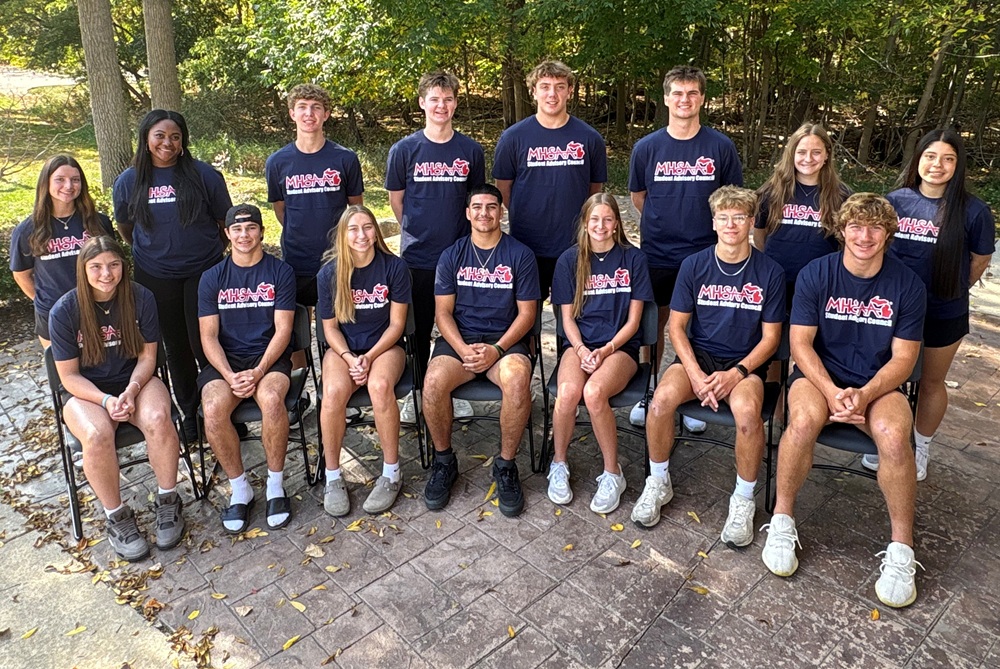
Four boys and four girls from the Class of 2028 will be selected to two-year terms and will meet on matters related to maintaining and promoting a proper perspective and sensible scope for high school sports in Michigan. Eight members from the Class of 2027 already are serving on the Council, while eight members from the Class of 2026 are leaving the Council this spring.
To be eligible for the committee, candidates must be a member of the Class of 2028, complete the official application including answering the three short-answer questions, submit a letter of recommendation from a school administrator, have a cumulative GPA of at least 3.0 (on a 4.0 scale) and be available for all scheduled meetings.
In addition, candidates should show a history of leadership on athletic teams as well as with other extracurricular activities, community service projects, or in the workplace; and show an understanding of the role of school sports and have ideas for promoting a proper perspective for educational athletics.
Applications are due to the MHSAA by 4:30 p.m. on April 20. Applications can be downloaded from the Student Advisory Council page and must be returned via e-mail, fax or any mail delivery service.
The Student Advisory Council meets in person five times each school year, three times via Zoom, and once more for a 24-hour leadership camp. In addition to assisting in the promotion of the educational value of interscholastic athletics, the Council discusses issues dealing with the 4 S’s of educational athletics: scholarship, sportsmanship, safety (including health and nutrition) and the sensible scope of athletic programs. A fifth S – student leadership – is also a common topic. Members contribute to the planning of Sportsmanship Summits and other student leadership events, and assist with medal ceremonies at MHSAA championship events.
Newly-chosen members will join the following from the Class of 2027: Nichole James, Detroit Edison; Mia McGregor, Mio; Camryn Siegers, Holland Christian; Lucy Weber, Fenton; Brody Hammer, Middleville Thornapple Kellogg; Sam Bentley, Ypsilanti Lincoln; Mason Mireles, Hartford; and Joey Smokevitch, Johannesburg-Lewiston.
The eight new members of the Student Advisory Council will be notified by May 1. The 2026-27 in-person meetings at the MHSAA Office in East Lansing are tentatively scheduled for Aug. 23, Oct. 4, Dec. 6, Feb. 7 and April 25, in addition to Zoom meetings Sept. 13, Jan. 10 and March 7. For additional information, contact Andy Frushour at the MHSAA at (517) 332-5046 or [email protected].
PHOTO The 2025-26 MHSAA Student Advisory Council.