

Clinic to Serve Voices of Our Communities
December 20, 2017
By Geoff Kimmerly
Second Half editor
Roger Smith was a senior at Lake Orion High School in 1993-94 when he got his first public address announcing opportunity, filling in for varsity boys basketball games after the longtime announcer decided to take a season off.
Tony Coggins was only a freshman when he grabbed the microphone for the first time – getting that chance when his dad, Flushing athletic director Dale Coggins, couldn’t find anyone else to announce middle school football games.
Steve Miller actually started as a game official during his senior year of high school at East Detroit, and is a college football official today – but with the PA bug keeping him in that part of the game as well.
All three have similar getting-started stories – they jumped in with little to no experience but with both feet, found mentors to emulate (including one in common, longtime MHSAA and Michigan State University voice Erik O. Furseth), and honed their craft over decades on their ways to becoming mainstays in their communities and regulars at MHSAA Finals in multiple sports.
Miller, Coggins and Smith will share those experiences and wisdom as instructors at the MHSAA’s Public Address Announcers Clinic on Jan. 6 at the MHSAA Office in East Lansing. The day will provide an opportunity not just for training, but for announcers statewide to come together and discuss the key contribution they make to high school sports all over our state.
“I don’t claim to be an expert, but I’ve done it enough years now too that I’ve had emergency situations and really odd requests,” Smith said. “I’m the only football announcer here (at Lake Orion), and I never get to get with my fellow colleagues. So it’s nice to have that network, to know there are other people out there who do it, and to learn from others and to see mistakes that I probably still am making and how to get better and situations I haven’t thought about.”
The clinic will use a curriculum developed by the National Association of Sports Public Address Announcers and focus on the role of the public address announcer, public address announcing expectations (school, state association and NASPAA), public address announcing philosophy, sportsmanship/NASPAA Code of Conduct, announcing Do's and Don'ts, scriptwriting and handling emergency situations.
Registration is limited to 75 attendees, but spots are available. Click for the registration form.
“The public address announcer helps set the tone for educational athletic events,” said John Johnson, MHSAA Director of Broadcast Properties. “At the high school level, we expect our announcers to inform everyone of what’s happening – not to entertain them – and to be a welcoming and reassuring presence. This clinic provides information they can’t get anywhere else.”
Miller initially hoped to work in sports television growing up, then switched lanes to education. He teaches mathematics and applied technology at Harrison Township L’Anse Creuse, where he started doing PA in 1999 for girls basketball games.
 Coggins’ middle school football debut came in 1985, and 33 years later he’s going strong. Now in his 18th year announcing where he teaches at Holly, Coggins lends his voice to football, basketball, baseball, softball, volleyball, competitive cheer and swimming & diving events. Smith is in his 17th year back at his alma mater, where he teaches broadcasting. He primarily announces football and basketball although he’s helped with baseball, softball and swimming as well, using the opportunity to practice what he preaches to his students in the classroom.
“I have zero athletic ability whatsoever, which is interesting because my father was an all-state running back. But I enjoy being involved, and I've always been the one for history and statistics and knowing what's going on,” Coggins said. “This is a way for me to be involved. It's a way for me to use a talent I've been given; public speaking has always come pretty naturally for me.
“So I worked at my craft to get better. I got better from watching the people around me, from studying the people I like, and the people – if I saw someone I didn’t care for – I'd make a note and say to myself, ‘Don't do that.’ I take feedback from people very personally, and I mean that in a good way. If somebody takes the time to come up and say ‘You did this well; I think you should change this,’ that means they care about the program also. We all have the same goal in mind, and that's to make the experience good for the high school student and the parents, the fans, that come there.”
Miller began learning his craft by attending MHSAA championship events and paying special attention to Furseth, the longtime and legendary voice of Football and Basketball Finals. Nearly two decades after getting his start, Miller also is the voice of University of Michigan men’s and women’s lacrosse and has announced MHSAA Finals in multiple sports since 2005.
In 2012, he officiated the Division 1 Football Final at Ford Field, then moved to the press deck to announce the Division 3 Final that night.
“There are a lot of great examples of how to do this at this level, and also not great examples,” Miller said. “The biggest issue is just doing it the right way and knowing what’s expected at our level – being the informational voice instead of the cheerleader. I was fortunate; I took the lead from guys like Eric who knew that was what was expected. And it just wasn’t my personality or my style to start yelling and screaming.”
The conference registration fee of $75 includes the NASPAA’s second edition of “The Voice Above The Crowd” – the official public address announcing manual for amateur sports – plus a one-year membership in the NASPAA and lunch.
All three instructors are members of the NASPAA and continue to announce MHSAA Finals in football, basketball, baseball and softball.
“I’m super honored to be involved in those kinds of events, to be able to provide a soundtrack to some of the biggest moments in people’s lives,” Miller said. “Knowing I’m providing a service is big for me, and it’s kinda neat being the invisible voice … the invisible soundtrack that helps make the experience special for them.”
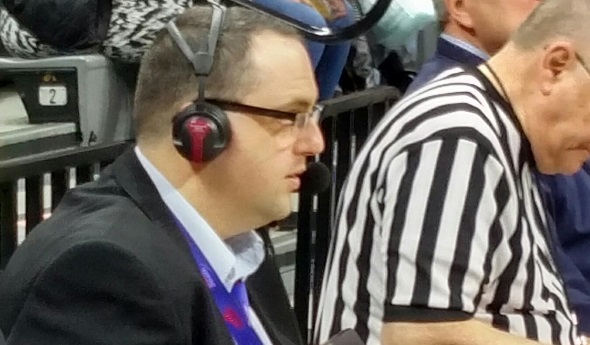
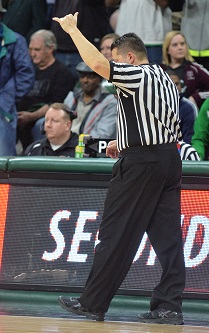
PHOTOS: (Top) Steve Miller calls a basketball game during an MHSAA Finals weekend at the Breslin Center at Michigan State University. (Middle) While officials regulate action on the court, announcers like Roger Smith (lower left) call the shots from the PA seat.
Leland's Glass Childress Selected as 11th Michigan Inductee Into NFHS Hall of Fame
By
Geoff Kimmerly
MHSAA.com senior editor
March 9, 2026
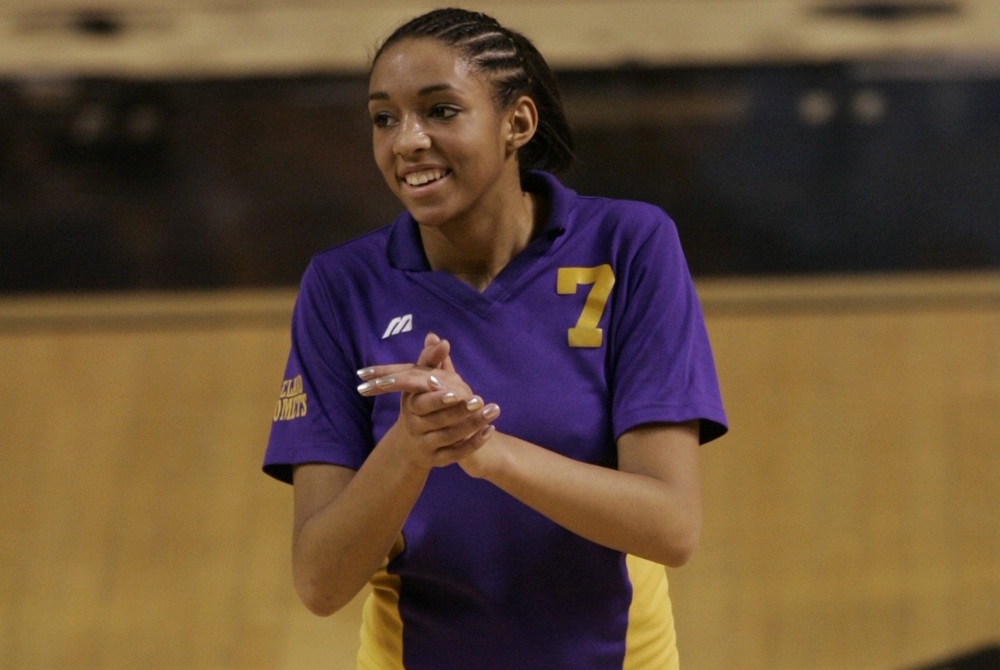
More than two decades have passed since Alisha Glass took her final swing at a volleyball in a Leland High School uniform, and yet her accomplishments for her small-town school in Northern Michigan remain among the most notable in that sport’s history not just statewide, but at the national level.
Glass, now Alisha Glass Childress – who went on to star on three Penn State national championship teams and help the U.S. national team to a bronze medal at the 2016 Olympics – will have her record-setting high school career enshrined this summer as one of 12 honorees announced today as this year’s inductees into the National High School Hall of Fame by the National Federation of State High School Associations (NFHS).
 Childress will be inducted as part of the 43rd Hall of Fame class at a ceremony during the NFHS summer meeting June 29 in Salt Lake City. The rest of the class is made up of four more athletes, three coaches, two game officials, one former state association administrator and one former fine arts educator. Childress was nominated by the Michigan High School Athletic Association.
She will become the Hall of Fame’s 11th inductee from Michigan, joining the MHSAA’s first full-time Executive Director Charles E. Forsythe (inducted 1983), River Rouge boys basketball coach Lofton Greene (1986), Warren Regina athletic director, softball and basketball coach Diane Laffey (2000), Fennville basketball and baseball standout Richie Jordan (2001), Grosse Pointe Woods University Liggett boys and girls tennis coach Bob Wood (2005), Bloomfield Hills Cranbrook hockey standout Jim Johnson (2007), Owosso football, basketball and baseball all-stater Brad Van Pelt (2011); Vermontville Maple Valley baseball national record holder Ken Beardslee (2016), retired MHSAA Executive Director John E. “Jack” Roberts (2022) and Dearborn Heights Robichaud football, basketball and track & field star Tyrone Wheatley (2024).
“My high school career at Leland, surrounded by such an amazing support system and community, was the essential first chapter of my story. It cultivated the grit and the fundamental love for the game that allowed me to reach the highest levels of athletics,” Childress said. “I’m proud of every medal and trophy, but I’m just as proud of the roots I planted back in high school that made them all possible.”
Childress graduated from Leland in 2006 with national high school career records of 3,584 kills, 680 blocks and 937 aces, and 296 aces for one season as a junior. Her aces records still stand, her career kills record stood until broken in 2024 by Shelby’s Navea Gauthier, and she remains third on the career blocks list. Glass continues to hold MHSAA records for single-season and career aces and also for her 48 kills in Leland’s 2005-06 Class D Final win over Battle Creek St. Philip. Childress also led Leland to a Class D runner-up finish in 2004-05 and the Semifinals in 2003-04. (All three tournament runs took place while girls volleyball was still played during the winter season before moving to the fall to begin the 2007-08 school year).
Childress earned the Miss Volleyball Award and Gatorade Player of the Year Award for Michigan as a senior, and her name is listed 19 times throughout the MHSAA girls volleyball record book. She also made Michigan's Class D all-state first team on the basketball court as both a junior and senior, averaging 18 points and 11 rebounds per game as a junior and 16 points, 10 rebounds and 3.7 blocked shots per game as a senior while leading her basketball team to Class D Quarterfinals both of those seasons.
“As our staff researched our first 50 years of female sports for our ‘Title IX at 50’ celebration during the 2021-22 school year, they told stories of several standouts who went on to collegiate, Olympic and professional stardom – and Alisha Glass stands out even among the greats,” MHSAA Executive Director Mark Uyl said. “Taking into account everything she accomplished individually and with her teams, and not just in volleyball but basketball as well, it’s a strong argument that Alisha Glass continues to set the bar as not only our state’s best female athlete all-time, but arguably the most accomplished volleyball player in national high school history. We are thrilled that she will be inducted into the National High School Hall of Fame.”
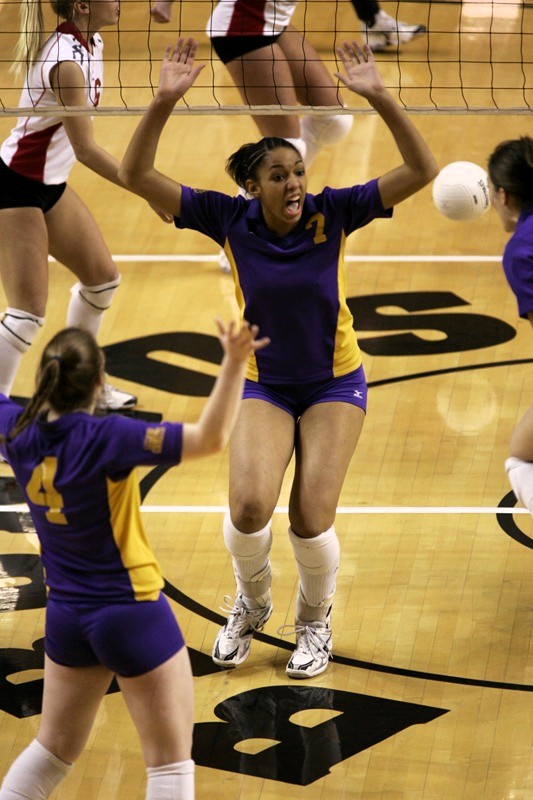 Also during high school, Childress played on the 2004 and 2005 USA youth national volleyball teams and helped the 2004 team to the North, Central America and Caribbean Volleyball Confederation (NORECA) championship, and was named Best Server at that event. After high school, she started all four seasons at national power Penn State and set the Nittany Lions to three straight NCAA championships, being named to the American Volleyball Coaches Association (AVCA) All-America first team twice and second team once.
Childress continued her career professionally and internationally, playing professionally in the United States and Puerto Rico, Italy, Turkey, Poland and Brazil and being named USA Volleyball Indoor Female Athlete of the Year for both 2013 and 2014. She led the U.S. national team to bronze at 2016 Olympics and was named Best Setter of the tournament, after being selected as an alternate for the 2012 Olympic team.
Most recently, Childress played for the Pro Volleyball Federation's Vegas Thrill in 2024 and 2025 and played in the league's first All-Star Match last season. She’s currently the head coach of the San Diego Mojo of Major League Volleyball and last summer also completed her first season as a coach with Athletes Unlimited. She previously served as an assistant coach with the Stanford University women’s volleyball program from 2019-21 – including during the team’s run to the Division I national title in 2019 – and also served as an assistant for the gold medal-winning U.S. national team during the 2018 Pan American Cup.
Childress is the daughter of Laurie Glass, who retired from coaching Leland after the 2023 season and ranks seventh in MHSAA girls volleyball coaching history for victories with a career record of 1,259-410-124. Glass led Leland to three Class D championships and five runner-up finishes. Childress’ grandfather Larry Glass ranks on the MHSAA girls basketball coaching victory list with a 388-110 record and led Leland to three straight Class D titles from 1980-82. He also coached the Northwestern University men’s basketball team for six seasons.
Additionally, Childress is married to past Stanford basketball star Josh Childress, who went on to play eight seasons in the NBA and several more overseas. They have three daughters, Maya, Mina and Amara.
The National High School Hall of Fame was started in 1982 by the NFHS. The 12 individuals were chosen after a two-level selection process involving a screening committee composed of active high school state association administrators, coaches and officials, and a final selection committee composed of coaches, former athletes, state association officials, media representatives and educational leaders. Nominations were made through NFHS member associations. Also chosen for this class were athletes Joe Carter (Oklahoma), Jordan Larson (Nebraska), Krissy Wendell-Pohl (Minnesota) and Patrick Willis (Tennessee); sport coaches Jan Barker (Texas), David Gentry (North Carolina) and Flo Valdez (New Mexico); game officials Burney Jenkins (Kentucky) and Mary Lou Thimas (Massachusetts), former state association administrator Steve Savarese (Alabama) and former fine arts educator Craig Ihnen (Iowa).
For more on this year’s Hall of Fame class, visit the NFHS Website.