

Clinic to Serve Voices of Our Communities
December 20, 2017
By Geoff Kimmerly
Second Half editor
Roger Smith was a senior at Lake Orion High School in 1993-94 when he got his first public address announcing opportunity, filling in for varsity boys basketball games after the longtime announcer decided to take a season off.
Tony Coggins was only a freshman when he grabbed the microphone for the first time – getting that chance when his dad, Flushing athletic director Dale Coggins, couldn’t find anyone else to announce middle school football games.
Steve Miller actually started as a game official during his senior year of high school at East Detroit, and is a college football official today – but with the PA bug keeping him in that part of the game as well.
All three have similar getting-started stories – they jumped in with little to no experience but with both feet, found mentors to emulate (including one in common, longtime MHSAA and Michigan State University voice Erik O. Furseth), and honed their craft over decades on their ways to becoming mainstays in their communities and regulars at MHSAA Finals in multiple sports.
Miller, Coggins and Smith will share those experiences and wisdom as instructors at the MHSAA’s Public Address Announcers Clinic on Jan. 6 at the MHSAA Office in East Lansing. The day will provide an opportunity not just for training, but for announcers statewide to come together and discuss the key contribution they make to high school sports all over our state.
“I don’t claim to be an expert, but I’ve done it enough years now too that I’ve had emergency situations and really odd requests,” Smith said. “I’m the only football announcer here (at Lake Orion), and I never get to get with my fellow colleagues. So it’s nice to have that network, to know there are other people out there who do it, and to learn from others and to see mistakes that I probably still am making and how to get better and situations I haven’t thought about.”
The clinic will use a curriculum developed by the National Association of Sports Public Address Announcers and focus on the role of the public address announcer, public address announcing expectations (school, state association and NASPAA), public address announcing philosophy, sportsmanship/NASPAA Code of Conduct, announcing Do's and Don'ts, scriptwriting and handling emergency situations.
Registration is limited to 75 attendees, but spots are available. Click for the registration form.
“The public address announcer helps set the tone for educational athletic events,” said John Johnson, MHSAA Director of Broadcast Properties. “At the high school level, we expect our announcers to inform everyone of what’s happening – not to entertain them – and to be a welcoming and reassuring presence. This clinic provides information they can’t get anywhere else.”
Miller initially hoped to work in sports television growing up, then switched lanes to education. He teaches mathematics and applied technology at Harrison Township L’Anse Creuse, where he started doing PA in 1999 for girls basketball games.
 Coggins’ middle school football debut came in 1985, and 33 years later he’s going strong. Now in his 18th year announcing where he teaches at Holly, Coggins lends his voice to football, basketball, baseball, softball, volleyball, competitive cheer and swimming & diving events. Smith is in his 17th year back at his alma mater, where he teaches broadcasting. He primarily announces football and basketball although he’s helped with baseball, softball and swimming as well, using the opportunity to practice what he preaches to his students in the classroom.
“I have zero athletic ability whatsoever, which is interesting because my father was an all-state running back. But I enjoy being involved, and I've always been the one for history and statistics and knowing what's going on,” Coggins said. “This is a way for me to be involved. It's a way for me to use a talent I've been given; public speaking has always come pretty naturally for me.
“So I worked at my craft to get better. I got better from watching the people around me, from studying the people I like, and the people – if I saw someone I didn’t care for – I'd make a note and say to myself, ‘Don't do that.’ I take feedback from people very personally, and I mean that in a good way. If somebody takes the time to come up and say ‘You did this well; I think you should change this,’ that means they care about the program also. We all have the same goal in mind, and that's to make the experience good for the high school student and the parents, the fans, that come there.”
Miller began learning his craft by attending MHSAA championship events and paying special attention to Furseth, the longtime and legendary voice of Football and Basketball Finals. Nearly two decades after getting his start, Miller also is the voice of University of Michigan men’s and women’s lacrosse and has announced MHSAA Finals in multiple sports since 2005.
In 2012, he officiated the Division 1 Football Final at Ford Field, then moved to the press deck to announce the Division 3 Final that night.
“There are a lot of great examples of how to do this at this level, and also not great examples,” Miller said. “The biggest issue is just doing it the right way and knowing what’s expected at our level – being the informational voice instead of the cheerleader. I was fortunate; I took the lead from guys like Eric who knew that was what was expected. And it just wasn’t my personality or my style to start yelling and screaming.”
The conference registration fee of $75 includes the NASPAA’s second edition of “The Voice Above The Crowd” – the official public address announcing manual for amateur sports – plus a one-year membership in the NASPAA and lunch.
All three instructors are members of the NASPAA and continue to announce MHSAA Finals in football, basketball, baseball and softball.
“I’m super honored to be involved in those kinds of events, to be able to provide a soundtrack to some of the biggest moments in people’s lives,” Miller said. “Knowing I’m providing a service is big for me, and it’s kinda neat being the invisible voice … the invisible soundtrack that helps make the experience special for them.”
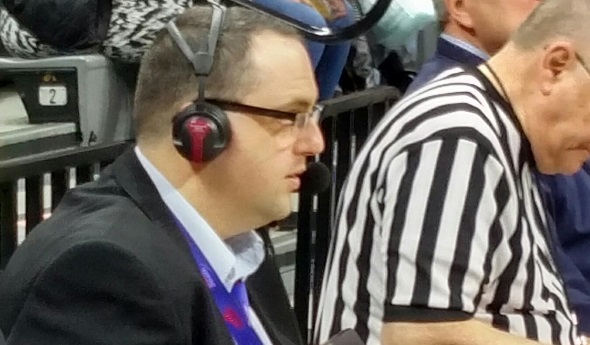
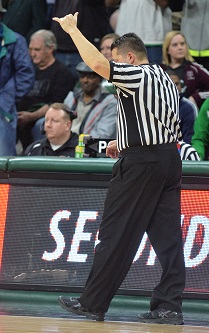
PHOTOS: (Top) Steve Miller calls a basketball game during an MHSAA Finals weekend at the Breslin Center at Michigan State University. (Middle) While officials regulate action on the court, announcers like Roger Smith (lower left) call the shots from the PA seat.

Scholar-Athlete Finalists Announced
By
Geoff Kimmerly
MHSAA.com senior editor
January 22, 2016
By Geoff Kimmerly
Second Half editor
The 120 finalists for the Michigan High School Athletic Association's Scholar-Athlete Awards for the 2015-16 school year have been announced.
 The program, celebrating its 27th anniversary, has recognized student-athletes since the 1989-90 school year and again this winter will honor 32 individuals from MHSAA member schools who participate in at least one sport in which the Association sponsors a postseason tournament.
Farm Bureau Insurance underwrites the Scholar-Athlete Awards and will present a $1,000 scholarship to each recipient. Since the beginning of the program, 672 scholarships have been awarded.
Scholarships will be presented proportionately by school classification, with 12 scholarships to be awarded to Class A student-athletes, six female and six male; eight scholarships will be awarded to Class B student-athletes, four female and four male; six scholarships will be awarded to Class C student-athletes, three female and three male; and four scholarships will be awarded to Class D student-athletes, two female and two male. In addition, the final two scholarships will be awarded at-large to minority recipients, regardless of school size.
Every MHSAA member high school could submit as many applications as there are scholarships available in its classification, and could have more than one finalist. East Grand Rapids has five finalists this year, Grosse Ile has four finalists and Birmingham Seaholm and Marquette each have three. Fourteen schools each have two finalists: Ann Arbor Pioneer, Bellaire, Bronson, Dearborn Edsel Ford, Farmington Hills Harrison, Grand Rapids Forest Hills Central, Grandville, Hudsonville, Laingsburg, Scottville Mason County Central, Onsted, Pontiac Notre Dame Prep, Portland and White Cloud.
Multiple-sport participation remains the norm among applicants. The average sport participation rate of the finalists is 2.51, while the average of the application pool was 2.14. There are 62 three-plus sport participants in the finalists field, and all but one of the 28 sports in which the MHSAA sponsors postseason tournaments are represented.
Of 374 schools which submitted applicants, 45 submitted the maximum allowed. This year, 1,425 applications were received. All applicants will be presented with certificates commemorating their achievement. Additional Scholar-Athlete information, including a complete list of scholarship nominees, can be found on the MHSAA Website.
The applications were judged by a 58-member committee of school coaches, counselors, faculty members, administrators and board members from MHSAA member schools. Selection of the 32 scholarship recipients will take place in early February. Class C and D scholarship recipients will be announced Feb. 2; Class B scholarship recipients will be announced Feb. 9, and Class A scholarship recipients will be announced Feb. 16. All announcements will be made on the MHSAA Website.
To honor the 32 Scholar-Athlete Award recipients, a ceremony will take place during halftime of the Class C Boys Basketball Final, March 26, at the Breslin Student Events Center in East Lansing.
To be eligible for the award, students must have a cumulative grade point average of 3.50 (on a 4.0 scale), and previously have won a varsity letter in at least one sport in which the MHSAA sponsors a postseason tournament. Students also were asked to respond to a series of short essay questions, submit two letters of recommendation and a 500-word essay on the importance of sportsmanship in educational athletics.
Farm Bureau Insurance of Michigan was founded in 1949 by Michigan farmers who wanted an insurance company that worked as hard as they did. Those values still guide the company today and are a big reason why it is known as Michigan’s Insurance Company, dedicated to protecting the farms, families, and businesses of this great state. Farm Bureau Insurance agents across Michigan provide a full range of insurance services—life, home, auto, farm, business, retirement, Lake Estate®, and more—protecting nearly 500,000 Michigan policyholders.
The MHSAA is a private, not-for-profit corporation of voluntary membership by more than 1,400 public and private senior high schools and junior high/middle schools which exists to develop common rules for athletic eligibility and competition. No government funds or tax dollars support the MHSAA, which was the first such association nationally to not accept membership dues or tournament entry fees from schools. Member schools which enforce these rules are permitted to participate in MHSAA tournaments, which attract more than 1.4 million spectators each year.
2015-16 Scholar-Athlete Award Finalists
BOYS CLASS A
Jack Eisentrout, Ann Arbor Pioneer
Nathan Lazor, Birmingham Groves
Zaven Dadian, Birmingham Seaholm
Jason Ren, Canton
Brendan Oosse, East Grand Rapids
Easton Schultz, East Grand Rapids
Jared Char, Farmington Hills Harrison
Charles R. Perkins Jr., Farmington Hills Harrison
Santino J. Guerra, Flint Kearsley
Garrett Farney, Grandville
Noah Andrew Weigle, Grandville
Jeremy Tervo, Hartland
Eric Mettetal, Howell
Riley Costen, Hudsonville
Daniel Karel, Hudsonville
Traver Parlato, Kalamazoo Loy Norrix
Kevin Hansen, Lake Orion
Alexander Oquist, Livonia Stevenson
Benjamin G. Cole, Marquette
Joseph Weber, Marquette
Kobe Burse, Muskegon Mona Shores
Drew Blakely, Richland Gull Lake
Kyle Jones, Swartz Creek
Lars Hornburg, Traverse City Central
GIRLS CLASS A
Clare Brush, Ann Arbor Pioneer
Catherine Markley, Birmingham Seaholm
Lauren McLeod, Birmingham Seaholm
Cameron Peek, Caledonia
Jaime Freas, Dearborn Edsel Ford
Sarah Hartshorn, Dearborn Edsel Ford
Mallak Taleb, Dearborn Heights Crestwood
Mackenzie Cole, East Grand Rapids
Marie Lachance, East Grand Rapids
Anna Laffrey, East Grand Rapids
Allia Marie McDowell, Farmington Hills Mercy
Brianna Costigan, Fenton
Ally Stapleton, Grand Rapids Forest Hills Central
Catherine Stapleton, Grand Rapids Forest Hills Central
Meredith Howe, Grand Rapids Forest Hills Northern
Erin Armbruster, Grosse Pointe North
Kelsey Emmanuel, Lowell
Kayla Dobies, Macomb Dakota
Lindsey Rudden, Marquette
Genevieve Soltesz, Mattawan
Olivia Arends, Mt. Pleasant
Mary Catherine McLaughlin, Northville
Ellen Wegener, Rochester
Jennifer Eaton, St. Johns
BOYS CLASS B
Geoffrey Richard Pisani, Big Rapids
Spencer Keoleian, Bloomfield Hills Cranbrook Kingswood
Nicolas Arons, Chelsea
Brendan Spangler, Coldwater
Evan Ciancio, Comstock Park
Ryan Mangulabnan, Dearborn Divine Child
Kyle Gavulic, Goodrich
Caleb E. Doane, Grant
Adam Kopp, Grosse Ile
Blake Willison, Grosse Ile
Justin Carlson, Hastings
Josef Philipp, Hillsdale
Austin Davis, Onsted
Austin Robert Thompson, Onsted
David Arnst, Ovid-Elsie
Trevor Trierweiler, Portland
GIRLS CLASS B
Erin Isola, Allegan
Greta Wilker, Belding
Lindsey Carlson, Charlotte
Keri Frahm, Frankenmuth
Kate Tobin, Grosse Ile
Katherine Williams, Grosse Ile
Alexis LaChappa, Harrison
Camryn A. Klein, Ionia
Fallon Gates, Manistee
Abigail Ufkes, Marshall
Paiton Plutchak, Menominee
Erica Lynn Schwegman, Pontiac Notre Dame Prep
Elizabeth Swartz, Pontiac Notre Dame Prep
Amanda Pohl, Portland
Claudia Raines, Saginaw Swan Valley
Brenna James, Sault Ste. Marie
BOYS CLASS C
Joseph Comstock, Addison
Quentin E. Millette, Ann Arbor Greenhills
Daniel R. McMichael, Bronson
Sawyer Cuthrell, Cass City
Anthony Hoholik, Manistique
Spencer Graham Knizacky, Mason County Central
Cameron Brayman, Montague
Broc Roberts, Petersburg-Summerfield
Trenden Peacock, Sand Creek
Dylan Marshall, St Ignace
Michael Klettner, Traverse City St. Francis
Bowman Seabrook, White Cloud
GIRLS CLASS C
Hannah Steffke, Beal City
Molly Lynch, Bloomfield Hills Academy of the Sacred Heart
Alexa Ratkowski, Bronson
Kelsey Engstrom, Charlevoix
Ellen Doyle, Gobles
Hanna Angst, Laingsburg
Julia Angst, Laingsburg
Bailee Kimbel, Manton
Jordyn Sanders, Mason County Central
Mallory Raven, Morley-Stanwood
Shelby Vincke, New Lothrop
Christiana M. Jones, White Cloud
BOYS CLASS D
Garrett Kraatz, Allen Park Inter-City Baptist
Joshua Robert Riggs, Brethren
Matthew Gratowski, DeTour
Gregory Scott Seppanen, Eben Junction Superior Central
Jayvin Wolfe, Fulton-Middleton
Nathaniel Jones, Muskegon Catholic Central
Daniel Good, Owendale-Gagetown
Benjamin Turner, Sterling Heights Parkway Christian
GIRLS CLASS D
Lindsay Lampman, Bellaire
Chloe Niepoth, Bellaire
Maria Stankewicz, Crystal Falls Forest Park
Abby Sutherland, Lake Linden-Hubbell
Elizabeth Munoz, Leland
Averi Rachelle Munro, Morrice
Natalie Frances Beaulieu, Newberry
Paige Blake, Ontonagon