Clinic to Serve Voices of Our Communities
December 20, 2017
By Geoff Kimmerly
Second Half editor
Roger Smith was a senior at Lake Orion High School in 1993-94 when he got his first public address announcing opportunity, filling in for varsity boys basketball games after the longtime announcer decided to take a season off.
Tony Coggins was only a freshman when he grabbed the microphone for the first time – getting that chance when his dad, Flushing athletic director Dale Coggins, couldn’t find anyone else to announce middle school football games.
Steve Miller actually started as a game official during his senior year of high school at East Detroit, and is a college football official today – but with the PA bug keeping him in that part of the game as well.
All three have similar getting-started stories – they jumped in with little to no experience but with both feet, found mentors to emulate (including one in common, longtime MHSAA and Michigan State University voice Erik O. Furseth), and honed their craft over decades on their ways to becoming mainstays in their communities and regulars at MHSAA Finals in multiple sports.
Miller, Coggins and Smith will share those experiences and wisdom as instructors at the MHSAA’s Public Address Announcers Clinic on Jan. 6 at the MHSAA Office in East Lansing. The day will provide an opportunity not just for training, but for announcers statewide to come together and discuss the key contribution they make to high school sports all over our state.
“I don’t claim to be an expert, but I’ve done it enough years now too that I’ve had emergency situations and really odd requests,” Smith said. “I’m the only football announcer here (at Lake Orion), and I never get to get with my fellow colleagues. So it’s nice to have that network, to know there are other people out there who do it, and to learn from others and to see mistakes that I probably still am making and how to get better and situations I haven’t thought about.”
The clinic will use a curriculum developed by the National Association of Sports Public Address Announcers and focus on the role of the public address announcer, public address announcing expectations (school, state association and NASPAA), public address announcing philosophy, sportsmanship/NASPAA Code of Conduct, announcing Do's and Don'ts, scriptwriting and handling emergency situations.
Registration is limited to 75 attendees, but spots are available. Click for the registration form.
“The public address announcer helps set the tone for educational athletic events,” said John Johnson, MHSAA Director of Broadcast Properties. “At the high school level, we expect our announcers to inform everyone of what’s happening – not to entertain them – and to be a welcoming and reassuring presence. This clinic provides information they can’t get anywhere else.”
Miller initially hoped to work in sports television growing up, then switched lanes to education. He teaches mathematics and applied technology at Harrison Township L’Anse Creuse, where he started doing PA in 1999 for girls basketball games.
 Coggins’ middle school football debut came in 1985, and 33 years later he’s going strong. Now in his 18th year announcing where he teaches at Holly, Coggins lends his voice to football, basketball, baseball, softball, volleyball, competitive cheer and swimming & diving events. Smith is in his 17th year back at his alma mater, where he teaches broadcasting. He primarily announces football and basketball although he’s helped with baseball, softball and swimming as well, using the opportunity to practice what he preaches to his students in the classroom.
“I have zero athletic ability whatsoever, which is interesting because my father was an all-state running back. But I enjoy being involved, and I've always been the one for history and statistics and knowing what's going on,” Coggins said. “This is a way for me to be involved. It's a way for me to use a talent I've been given; public speaking has always come pretty naturally for me.
“So I worked at my craft to get better. I got better from watching the people around me, from studying the people I like, and the people – if I saw someone I didn’t care for – I'd make a note and say to myself, ‘Don't do that.’ I take feedback from people very personally, and I mean that in a good way. If somebody takes the time to come up and say ‘You did this well; I think you should change this,’ that means they care about the program also. We all have the same goal in mind, and that's to make the experience good for the high school student and the parents, the fans, that come there.”
Miller began learning his craft by attending MHSAA championship events and paying special attention to Furseth, the longtime and legendary voice of Football and Basketball Finals. Nearly two decades after getting his start, Miller also is the voice of University of Michigan men’s and women’s lacrosse and has announced MHSAA Finals in multiple sports since 2005.
In 2012, he officiated the Division 1 Football Final at Ford Field, then moved to the press deck to announce the Division 3 Final that night.
“There are a lot of great examples of how to do this at this level, and also not great examples,” Miller said. “The biggest issue is just doing it the right way and knowing what’s expected at our level – being the informational voice instead of the cheerleader. I was fortunate; I took the lead from guys like Eric who knew that was what was expected. And it just wasn’t my personality or my style to start yelling and screaming.”
The conference registration fee of $75 includes the NASPAA’s second edition of “The Voice Above The Crowd” – the official public address announcing manual for amateur sports – plus a one-year membership in the NASPAA and lunch.
All three instructors are members of the NASPAA and continue to announce MHSAA Finals in football, basketball, baseball and softball.
“I’m super honored to be involved in those kinds of events, to be able to provide a soundtrack to some of the biggest moments in people’s lives,” Miller said. “Knowing I’m providing a service is big for me, and it’s kinda neat being the invisible voice … the invisible soundtrack that helps make the experience special for them.”
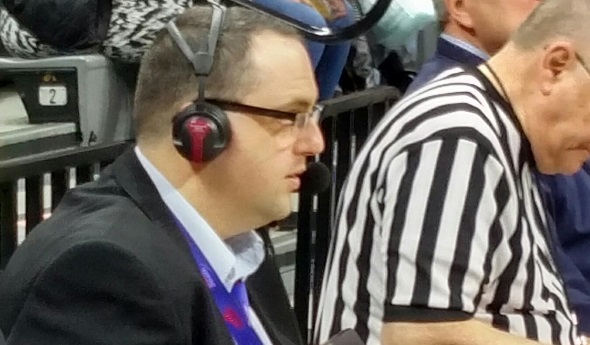
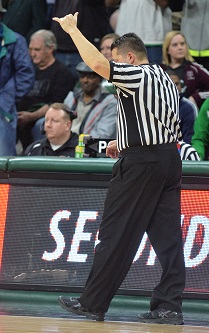
PHOTOS: (Top) Steve Miller calls a basketball game during an MHSAA Finals weekend at the Breslin Center at Michigan State University. (Middle) While officials regulate action on the court, announcers like Roger Smith (lower left) call the shots from the PA seat.
Rally Champs 'Survive' Fun-Filled Forest
August 19, 2013
By Geoff Kimmerly
Second Half editor
As one of Michigan’s top high school swimming sprinters, Fenton senior Gabbi Haaraoja no doubt was in strong shape to start this summer.
But she and her Tigers teammates made sure to prepare for this month’s preseason “survival trip” with plenty of miles running and yards swimming a local lake.
All that training paid off during three days and two nights at Pigeon River Country State Forest near Vanderbilt as the team prepared for last week’s first day of practice and a run at a 10th-consecutive league championship.
And the Tigers have kicked off the title effort by being named winners of the MHSAA’s inaugural Prep Rally, a contest that was part of the MHSAA’s PLAY (Preparation Lasts All Year) initiative to encourage athletes to remain active during the offseason so they are prepared physically and acclimated to warm weather when practice begins in the fall.
“Being out in nature, it’s really pretty there. You appreciate it more,” Haaraoja said, then adding some tongue-in-cheek. “It definitely was fun. But it was a lot more work than what we were used to. I think I’m actually glad I’m a senior.”
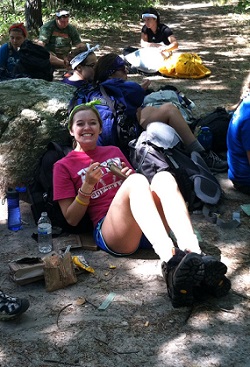 Athletes from Grosse Pointe Woods University Liggett and Beal City also were finalists. Participating athletes from Fenton’s girls swimming and diving team will receive tickets to an MHSAA Final of their choice, where they will be recognized for their achievement.
Fenton has taken similar training trips heading into all 14 seasons under coach Brad Jones. Others have included activities like canoeing and dune climbing, The last four years, the team journeyed to El Cortez Beach Resort in Oscoda for some time on Lake Huron together before practice began.
This season’s seniors asked to do something new. And it was a new experience for many in more ways than one.
The team left Aug. 11 and returned home two days later in time for the first day of practice. Jones took north 24 athletes, and some had never camped or slept outside. Six seniors made their fourth preseason trip with the team – but for 12 freshmen, this was their first experience as high schoolers.
That team demographic made this summer’s trip especially important for bonding. But it also had a desired effect physically – both heading into this fall and in setting preparation expectations for the future.
Pigeon River Country has 67 miles of trails, and the team hiked four or more miles between camp sites each day – making this the most physically taxing of the trips any of the Tigers had been on to start swimming and diving season.
“We were very up front that in August we’re taking this trip, and you need to be able to go 6-7 miles walking. We put that out there early on,” Jones said. “We have pretty good girls doing what they’re needing to do outside of (swimming) training. (But) we were pretty up front that you don’t put your backpack on and your hiking shoes on for the first time in August.”
Haaraoja said the hikes made it obvious quickly who had prepped during the summer and who needed to catch up. Seniors rotated throughout the line of teammates, so those who began a hike leading the group finished at the back with those working harder to keep in step.
Once in the woods, Jones split his athletes into four teams for a series of challenges that included building their own fires, cooking their own meals (they didn’t receive food until the fire was started) and breaking camp the next day. One trail ran past a small lake, and the athletes swam across it in a relay to earn more points. Another relay-type event involved filling buckets with water.
The challenge champions received ice cream.
“By the time we get home, everybody knows everybody else,” Jones said. “Once we get into training, the top girls are in one lane and the beginners are in another. So there’s not a lot of interaction. But this gives the whole team a chance to get to know each other.”
That’s the part Haaraoja said she’ll remember most fondly, while also appreciating the edge the added physical activity of the summer prep and trip should give the team this fall and in years to come.
“For the underclassmen, they realized where they should be at the beginning of the season next year so they don’t come into it completely out of shape,” Haaraoja said. “It helped our underclassmen learn what our goals were. They know what they’re working for.”
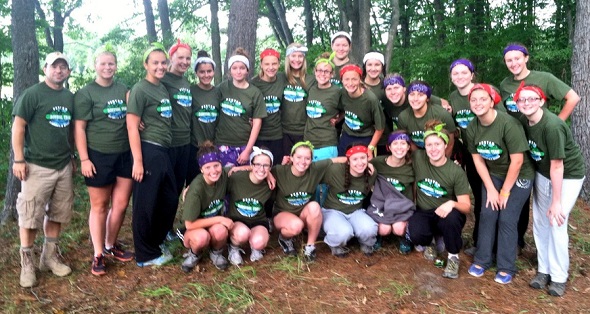
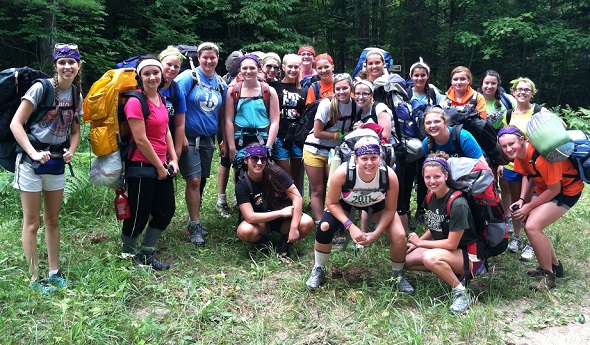
PHOTOS: (Top) Fenton's girls swimming and diving athletes take a moment for a photo during their three-day "survival trip." (Middle) The Tigers take a quick lunch break during a hike at Pigeon River Country State Forest. (Below) The Fenton athletes pose for one more photo wearing their "survivor" T-shirts. (Photos courtesy of Fenton coach Brad Jones.)