

Cohen Champions Treatment, Technology
By
Geoff Kimmerly
MHSAA.com senior editor
March 10, 2014
Abby Cohen was looking for a problem to solve.
Two years later, she’s potentially only one more year from helping relieve a medical dilemma faced by 25 million Americans.
And the most impressive part might be that she graduated from high school a mere five years ago and is 23 years old.
 Cohen, a 2009 MHSAA Scholar-Athlete Award winner as a senior at Bloomfield Hills Cranbrook-Kingswood, certainly could be called proactive, going back to her days as a volleyball, basketball and soccer standout for the Cranes. Less than a year after graduating from Washington University in St. Louis, Mo., she’s co-founder and co-CEO of Sparo Labs, which seeks to provide asthma sufferers with a proactive way of monitoring their symptoms and improving their treatments.
“Everyone has a different perspective on how to go about doing things,” Cohen said. “For me, growing up trying to improve in sports, I’d write down a list of things to do every day and actually do them, follow through. That aspect of always wanting to get better, and improve, is something that’s carried through to the rest of what we do at Sparo and in general how I approach things.”
 On March 22, the MHSAA and Farm Bureau Insurance will recognize a 25th class of Scholar-Athlete Award winners. In advance of the celebration, Second Half has caught up with some of the hundreds who have been recognized (see additional links at the bottom of this page).
Cohen, who also served on the MHSAA Student Advisory Council from 2007-09, chose Washington based on its strong engineering problem and successful women’s basketball program. She studied bio-medical engineering and was a freshman on the Bears team that defeated Hope College for the Division III national championship in 2010.
But that first season was followed by a series of ankle injuries that required reconstructive surgery – and, effectively, ended her collegiate sports career. She still can play pick-up games, but four-hour daily practices and the other commitments of a varsity program would've been too much.
She missed basketball. But the end of her competitive career on the court, as it turned out, allowed more time to dive into a new pursuit – and, in her words, “work with another kind of team.”
“I’m a big believer in everything happens for a reason,” Cohen said. “It was disappointing having to have surgery to make everything feel better, for the long term, not just basketball. For me at that time, I didn't appreciate that with the extra time I could have, I could take the time to try new things, make the world a better place.”
Cohen planned at first to eventually become a physician. She shadowed a number of doctors, but decided that in the long run she could have a greater impact as an engineer designing products physicians could use.
In addition to her classwork, she helped form an extracurricular entrepreneurial group – and set out for an issue in need of repair. She and her now-business partner Andrew Brimer didn't realize how many Americans are affected by asthma, “that respiratory diseases are the only ones getting worse over time rather than getting better. That although technology is improving, why it’s not making a dent.”
They set out find out and make that dent themselves.
Through a series of interviews with patients, doctors, respiratory therapists and others in the field, Cohen and Brimer got an idea what could help – an affordable, easy-to-use device to allow patients to monitor on their own their symptoms so they can better manage them and the treatments to help. Cohen and Brimer designed a device that plugs into a smart phone and allows patients to blow into it like a whistle and register lung function readings – while also collecting data on medications, pollen counts, and other variables that affect lung function. Their device also should dent the health care costs that go with current testing, which generally requires an office visit.
Sparo will work over the next six months to improve its app interface and user experience, and then submit for Food and Drug Administration approval at the end of this year or the beginning of 2015 – with the hope it will then become available to patients later next spring.
Cohen is based in St. Louis, where she and Brimer have been able to work with three large local hospitals and within a nurturing entrepreneurial community. Brimer's brother owns a tech education company in New York which has provided additional support as she and Brimer discussed what was possible. “We were talking to patients and physicians, and it just seemed like the right thing to do,” Cohen said. “If we weren’t going to do this, who was?”
Cohen and Brimer have won 9 of 11 entrepreneurship grant competitions they've entered, netting more than $300,000 to get their lab rolling and allow them to hire two more engineers. Long-term, today’s work could just be the start of what Cohen hopes eventually will reach into developing countries as well.
She remains in touch with a number of teachers at Cranbrook-Kingswood – also, her mother Sheila Cohen teaches sixth-grade math at the school – and she spoke there at the end of 2013 as part of a TEDx event.
As she continues to build her team, Cohen is reminded of additional lessons she learned on the courts and soccer field – including a major one that will continue to pay as Sparo expands.
“Learning how to work on a team, with really different personalities, different people who all play different roles,” Cohen said. “That really came from sports – the ability to work with people and reach one common goal.”
Click to read the series' first installments:
- 25 Years Later, Scholar Athletes Shine On
- On Call as Doctor, Director, Mom
- "Mailloux Management" Goes Global
- Goorhouse Gives Back at Home
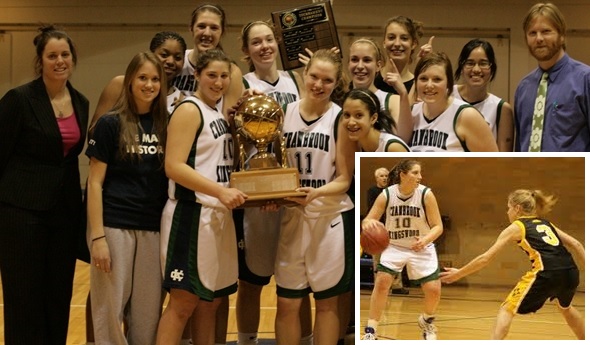
PHOTO: Abby Cohen (10) helps her teammates hoist a trophy while a player at Bloomfield Hills Cranbrook-Kingswood in 2009. (Photo courtesy of Cranbrook-Kingswood.)

SAC Sound-Off: Glad to be an AD's Son
October 30, 2012
By Coby Ryan
Manistique junior
 “Oh, you’re Rob Ryan’s son, right?”
As a student-athlete, I hear that all the time. The Upper Peninsula is a tightly-knit network in the sports world. Names, faces, and schools are heavily interconnected. And as the son of Manistique’s athletic director Rob Ryan, everything in that perspective is multiplied.
There are certainly perks to being my father’s son. At every away game I attend, I am greeted by some coach, athletic director, or other school official who already knows my name before the game even starts. Also, we have unlimited access to the gym. It is hard to stay connected to statewide sports living where I do, but having my dad as an AD helps. We always attend the MHSAA Boys Basketball Finals in East Lansing through him, and we love it. Finally, he introduced me to the MHSAA Student Advisory Council, and I am extremely thankful for that. He has more sports-related access than most people, and I benefit from that.
There also are some traits of being an AD’s son that people probably do not see if they do not have a similar relationship. I definitely am held to a higher standard, both academically and athletically, because of my father’s position in the school. This pushes me to be the best student-athlete I can be, and for that I am grateful.
But, there can also be a feeling of being overshadowed by what he does. I am my own person; I am not my father. Many times, I am identified by his achievements, not mine. If I play a good game, I’m “Rob Ryan’s son,” not “Coby Ryan.” Identity problems can be an issue as an athletic director’s child, but this motivates me more to want to be called by my own name because of who I am and what I’ve accomplished.
When I am attending or involved in an athletic competition, my peers and I do not have the same experience. They all see the players playing, a couple guys reffing, and some other people doing statistics or something; they don’t really care about the details. They are just there to watch the game.
When I go, I see things in an entirely different light. I see a team that arrived on the field or court without a hitch because my dad was there to greet them, show them where everything was, and make sure they were all settled in. I see an unbiased, professional officiating crew contracted by my father from a different community. I see scorekeepers, announcers, timers, and statisticians, all hired by him because of their knowledge of the game being played and their ability to perform the task given to them. When there are unruly fans, coaches, or players, I see people that my dad has to deal with by getting them out of the game so enjoyment is not taken away from the rest. In the student section, I am much more aware of sportsmanship and what is appropriate or inappropriate for a high school game than my peers because of him. Being his son puts a whole new perspective on how I view the game.
Through my dad, I can be much more involved in my community’s sports, even if I am not playing all of them. He taught me how to keep stats for basketball games. He had me announce JV football games. I have been a referee with him in local basketball tournaments. Also, we coached a girls basketball travel team together. These opportunities all arose from his being an athletic director.
Overall, I love being my dad’s kid. We both love high school sports and get to enjoy them in more ways than most fathers and sons ever will. I believe there are some negatives to it, but I find that in the end these actually just make me a better student-athlete and a better person. I guess I am pretty lucky to be “Rob Ryan’s son.”
Coby Ryan, Manistique junior
- Sports: Football, basketball, track and field
- Non-sports activities: Class President, Quiz Bowl, Drama Club, Glee Club, National Honor Society, Spanish Club, YETI, Academic Booster Club Class Representative
- Favorite class: Gym
- Up next: Ryan hopes to attend the University of Michigan.
- Shining moment: Scoring 22 points and beating our rival Big Bay de Noc in JV basketball.
- Pump-up jam: "Winner" by Jamie Foxx (with Justin Timberlake & T.I.)
- Must-see TV: "The Office"
- Favorite films: "Step Brothers" and "The Dark Knight"
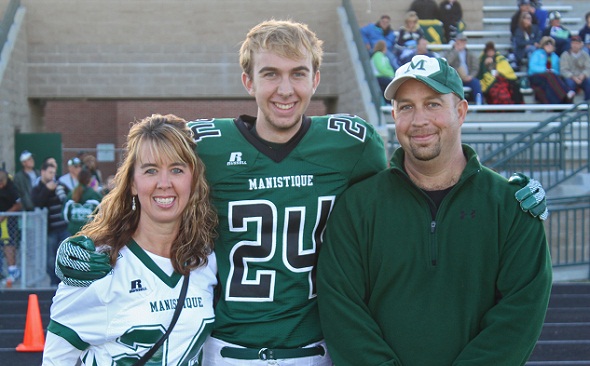
PHOTO: Manistique junior Coby Ryan stands with parents Christi and Rob during his football team's Parents Night this fall.