

Cohen Champions Treatment, Technology
By
Geoff Kimmerly
MHSAA.com senior editor
March 10, 2014
Abby Cohen was looking for a problem to solve.
Two years later, she’s potentially only one more year from helping relieve a medical dilemma faced by 25 million Americans.
And the most impressive part might be that she graduated from high school a mere five years ago and is 23 years old.
 Cohen, a 2009 MHSAA Scholar-Athlete Award winner as a senior at Bloomfield Hills Cranbrook-Kingswood, certainly could be called proactive, going back to her days as a volleyball, basketball and soccer standout for the Cranes. Less than a year after graduating from Washington University in St. Louis, Mo., she’s co-founder and co-CEO of Sparo Labs, which seeks to provide asthma sufferers with a proactive way of monitoring their symptoms and improving their treatments.
“Everyone has a different perspective on how to go about doing things,” Cohen said. “For me, growing up trying to improve in sports, I’d write down a list of things to do every day and actually do them, follow through. That aspect of always wanting to get better, and improve, is something that’s carried through to the rest of what we do at Sparo and in general how I approach things.”
 On March 22, the MHSAA and Farm Bureau Insurance will recognize a 25th class of Scholar-Athlete Award winners. In advance of the celebration, Second Half has caught up with some of the hundreds who have been recognized (see additional links at the bottom of this page).
Cohen, who also served on the MHSAA Student Advisory Council from 2007-09, chose Washington based on its strong engineering problem and successful women’s basketball program. She studied bio-medical engineering and was a freshman on the Bears team that defeated Hope College for the Division III national championship in 2010.
But that first season was followed by a series of ankle injuries that required reconstructive surgery – and, effectively, ended her collegiate sports career. She still can play pick-up games, but four-hour daily practices and the other commitments of a varsity program would've been too much.
She missed basketball. But the end of her competitive career on the court, as it turned out, allowed more time to dive into a new pursuit – and, in her words, “work with another kind of team.”
“I’m a big believer in everything happens for a reason,” Cohen said. “It was disappointing having to have surgery to make everything feel better, for the long term, not just basketball. For me at that time, I didn't appreciate that with the extra time I could have, I could take the time to try new things, make the world a better place.”
Cohen planned at first to eventually become a physician. She shadowed a number of doctors, but decided that in the long run she could have a greater impact as an engineer designing products physicians could use.
In addition to her classwork, she helped form an extracurricular entrepreneurial group – and set out for an issue in need of repair. She and her now-business partner Andrew Brimer didn't realize how many Americans are affected by asthma, “that respiratory diseases are the only ones getting worse over time rather than getting better. That although technology is improving, why it’s not making a dent.”
They set out find out and make that dent themselves.
Through a series of interviews with patients, doctors, respiratory therapists and others in the field, Cohen and Brimer got an idea what could help – an affordable, easy-to-use device to allow patients to monitor on their own their symptoms so they can better manage them and the treatments to help. Cohen and Brimer designed a device that plugs into a smart phone and allows patients to blow into it like a whistle and register lung function readings – while also collecting data on medications, pollen counts, and other variables that affect lung function. Their device also should dent the health care costs that go with current testing, which generally requires an office visit.
Sparo will work over the next six months to improve its app interface and user experience, and then submit for Food and Drug Administration approval at the end of this year or the beginning of 2015 – with the hope it will then become available to patients later next spring.
Cohen is based in St. Louis, where she and Brimer have been able to work with three large local hospitals and within a nurturing entrepreneurial community. Brimer's brother owns a tech education company in New York which has provided additional support as she and Brimer discussed what was possible. “We were talking to patients and physicians, and it just seemed like the right thing to do,” Cohen said. “If we weren’t going to do this, who was?”
Cohen and Brimer have won 9 of 11 entrepreneurship grant competitions they've entered, netting more than $300,000 to get their lab rolling and allow them to hire two more engineers. Long-term, today’s work could just be the start of what Cohen hopes eventually will reach into developing countries as well.
She remains in touch with a number of teachers at Cranbrook-Kingswood – also, her mother Sheila Cohen teaches sixth-grade math at the school – and she spoke there at the end of 2013 as part of a TEDx event.
As she continues to build her team, Cohen is reminded of additional lessons she learned on the courts and soccer field – including a major one that will continue to pay as Sparo expands.
“Learning how to work on a team, with really different personalities, different people who all play different roles,” Cohen said. “That really came from sports – the ability to work with people and reach one common goal.”
Click to read the series' first installments:
- 25 Years Later, Scholar Athletes Shine On
- On Call as Doctor, Director, Mom
- "Mailloux Management" Goes Global
- Goorhouse Gives Back at Home
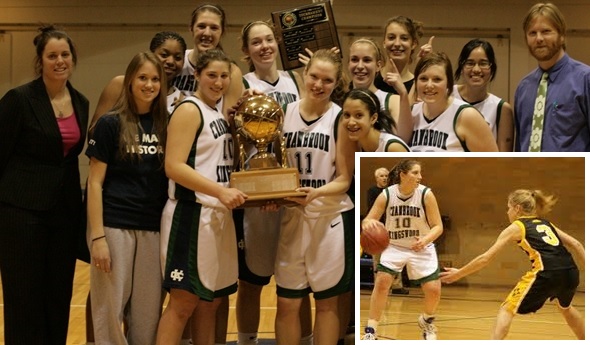
PHOTO: Abby Cohen (10) helps her teammates hoist a trophy while a player at Bloomfield Hills Cranbrook-Kingswood in 2009. (Photo courtesy of Cranbrook-Kingswood.)

SAC Sound-Off: Drawing the Line at Our First Summit
October 9, 2012
By Kiersten Mead
Saginaw Swan Valley junior
Every two years, the Michigan High School Athletic Association conducts Sportsmanship Summits aiming to instruct athletes on how to be the best examples of sportsmanship in their communities, both while competing and cheering on their teams. Participants experience a variety of sessions, including one directed by members of the MHSAA Student Advisory Council. The first summit of this fall was Monday in Lansing; summits also will be held in Warren, Gaylord and Kalamazoo.
 On the morning of the first Sportsmanship Summit of 2012, I was trying my hardest to not let my nerves and excitement get the best of me.
As a member of the MHSAA Student Advisory Council, my role is to listen to and understand the points of view of student athletes, and share them with the MHSAA. I had spent the day before the summit preparing with the rest of my team, but I knew the sessions would be a learning experience for all of us. I was fortunate enough to be in a group with three seniors: Elle Lehman, Thye Fischman, and Matt Freeman, which made me feel a little more confident.
Our portion of the summit was to discuss the “gray areas” of sportsmanship. Our group knew that if we just sat there and gave some sort of lecture or speech, people would be bored to tears.
So instead, we did it in an interactive way. We started by having everyone stand on the outside of a roped-off circle. We began asking questions – and if an answer applied to them, they were told to step over the line.
We started with random questions, like asking who preferred the University of Michigan over Michigan State. Slowly, we worked our way into sportsmanship-centered topics. We asked the more “black and white” questions that everyone generally saw eye-to-eye on first. These led into others like, “Is it okay, as a player, to flip off fans?” or even, “Is it considered bad to spit at a referee?” If people thought that either “crossed the line” into bad sportsmanship, they were asked to step over the line.
Eventually, we started asking our “gray area” questions. For example, we asked if yelling “air ball” or “you, you, you” after a player makes a mistake is crossing the line. After everyone made their decisions, we asked them to share their thoughts and even personal experiences or stories.
I absolutely loved this part of it! I really enjoyed hearing what people thought on certain topics, especially when I didn’t necessarily see things the same way. My favorite part of our session, though, was hearing all of the personal stories. There was always at least one person in each group that had his or her fair share of them. I would not have traded my job for anything! Although, I do think it would have been really cool to have taken part in the other sessions.
The idea of tweeting throughout the day with the hash tag “BOTF” (signifying Battle of the Fans) also was a lot of fun! It resulted in a lot of people following and connecting with others they would never have otherwise gotten to know. By the time the third group (of four) had entered our session, it was clear people were starting to get more comfortable with each other.
In our session especially, there were quite a few things that surprised me. In some of the more “black and white” situations, there would sometimes be one person who thought some things were okay, while the rest of the group disagreed. It also surprised me how we would have a group very split on an issue, while another group would all see it the same way. When it’s all said and done though, I think people understood the message we were trying to convey.
In the end, the idea of the entire summit was that all of us should always be displaying positive sportsmanship. Many people told us there were things that their student sections do, that they know are wrong, yet they do them anyway. The point of this summit was to understand the importance of stepping up, being a leader, and leading by example. Nothing will change unless someone decides to take charge and change things for the better.
My hope is the people who attended the summit at the Lexington Hotel in Lansing walked away understanding their views of something aren’t the only ways of seeing it. It’s always important to keep an open mind.
And to future participants of these sportsmanship summits, I say be prepared to get involved. Feel free to have your own opinion, whether it’s popular or not. Share your stories. But most of all, have fun!
Kiersten Mead, Saginaw Swan Valley junior
- Sports: Bowling, competitive and sideline cheer
- Non-sports activities: Student government (Class Secretary), SADD (Students Against Destructive Decisions), Drama, Business Professionals of America
- Favorite classes: English and Drama
- What's next: Mead is considering careers in orthodontics and pediatric orthopedics, with early college possibilities including Saginaw Valley State and the University of Michigan.
- Shining sports moments: Being named "Team All-Star" by her Swan Valley cheer team; finishing undefeated in bowling, her bowling team's Regional title and rolling a 280 in a tournament.
- Pump-up jams: For bowling, "Slow and Low" by the Beastie Boys, because it totally applies (as dorky and random as that is); for cheer, "Live While We're Young" by One Direction.
- Must-see TV: "Criminal Minds"
- Favorite Film: "The Sandlot"
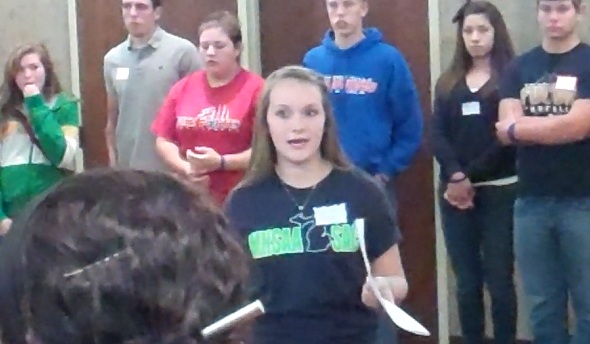
PHOTO: Swan Valley's Kiersten Mead helps direct a session at Monday's MHSAA Sportsmanship Summit. Tune in to Second Half later this week for video detailing the Sportsmanship Summit experience.