


Council Approves Winter Start, Guidance
October 23, 2020
By Geoff Kimmerly
Second Half editor
The Representative Council of the Michigan High School Athletic Association confirmed during its meeting Thursday (Oct. 22) that 2020-21 Winter sports will begin on time, and also approved a series of guidelines for those sports that schools must follow as they continue to work toward limiting the spread of COVID-19 while still providing opportunities for athletes to compete.
Most high school sports traditionally begin practice during the first three weeks of November, with competition starting during mid-November and the first weeks of December. The starts of middle school Winter sports seasons are determined by local leagues and conferences; many are slated to begin during the next few weeks.
Sport-specific guidelines for all Winter sports will be posted early next week to their respective sport pages on the MHSAA Website. A number of precautions have been put in place addressing competition limits, numbers of spectators allowed and wearing of face coverings, among a variety of topics. The guidance also specifically addresses equipment and facilities for each sport.
“The Council believes it is safer to begin Winter practices on time, and keep athletes in school programs where safety precautions are always in effect,” MHSAA Executive Director Mark Uyl said. “With the vastly different circumstances faced by schools in different regions all over the state, an on-time start still allows schools to decide when they feel most comfortable beginning activity – and allows all of them to slowly ramp up their frequency of activity and numbers of spectators attending competitions.
“But let’s be clear: Our statewide COVID-19 numbers have to get better. In order for our schools to continue playing sports this winter, and in order for fans to be there to cheer them on, we must continue working to slow down this virus.”
As with Fall sports, scrimmages will not be allowed for Winter sports to limit mixing of communities outside of official competitions. The numbers of teams at regular-season competitions also will be limited, like during Fall, with a maximum of four schools/teams allowed in competitive cheer, gymnastics, swimming & diving and wrestling. Bowling and skiing competitions will be restricted to a maximum of 72 competitors at one event.
There are no school/team limits for basketball and ice hockey, as only two teams are able to play each other at one time and those sports may play only one game per day – with fans leaving after their game is complete. Host sites must strictly enforce spectator capacity limits on a game-by-game basis. The Council approved as part of these guidelines an allowance of two spectators per participant at all contests to begin the regular season. This guideline could be reconsidered by the Council later in the winter season, with a possibility of allowing more spectators later while still staying within possible Emergency Orders from the Michigan Department of Health and Human Services (MDHHS).
As per MDHHS requirements, face coverings must be worn by athletes practicing and competing in basketball, competitive cheer, ice hockey and wrestling. They are not required for athletes practicing and competing in bowling, gymnastics, skiing and swimming & diving, which all allow for appropriate social distancing – but face coverings are required for those athletes when not involved in active participation.
MHSAA Suspends Winter Tournaments
March 12, 2020
By Geoff Kimmerly
Second Half editor
Postseason events sponsored by the Michigan High School Athletic Association have been suspended immediately and indefinitely due to concerns related to COVID-19.
The Ice Hockey, Girls Gymnastics and Lower Peninsula Boys Swimming & Diving Finals had been scheduled for this weekend, while the Girls & Boys Basketball Tournaments are midway through earlier rounds of their playoff progressions.
On Wednesday, Gov. Gretchen Whitmer recommended a stoppage of large gatherings in order to assist in preventing the spread of COVID-19.
“Based on the events of the last 48 hours and with things changing by the minute, we believe we have no choice but to suspend our winter tournaments immediately,” MHSAA Executive Director Mark Uyl said. “This is a suspension until we have a better handle on the situation. The health and welfare of everyone involved is our number one priority.”
Uyl added that more information and updates will be forthcoming over the next few days. No timetable has been determined for possible rescheduling for tournaments.
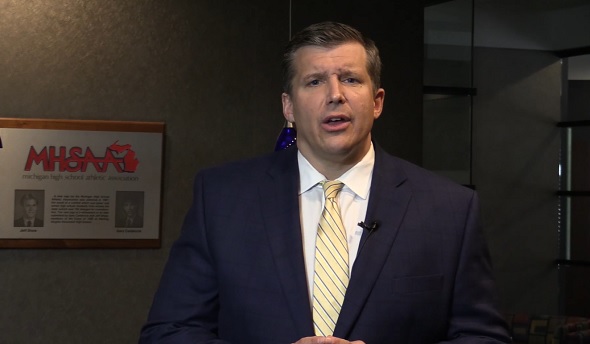
Click for a video statement from Mark Uyl.
The MHSAA is a private, not-for-profit corporation of voluntary membership by more than 1,500 public and private senior high schools and junior high/middle schools which exists to develop common rules for athletic eligibility and competition. No government funds or tax dollars support the MHSAA, which was the first such association nationally to not accept membership dues or tournament entry fees from schools. Member schools which enforce these rules are permitted to participate in MHSAA tournaments, which attract more than 1.4 million spectators each year.