


Fall Athletes: Prepare for Hot Weather
July 26, 2018
By Geoff Kimmerly
Second Half editor
As summer activities wind down with an eye toward the beginning of fall sports next month, the MHSAA advises that student-athletes need to prepare for training in the hot weather that traditionally accompanies the beginning of August and the first practices of the school year.
Each year, the MHSAA provides information to its member schools to help them prepare for hot weather practice and game conditions during the late summer and early fall. Football practice can begin at MHSAA schools August 6, followed by first practices for all other fall sports August 8.
The topic of heat-related injuries receives a lot of attention at this time of year, especially when deaths at the professional, collegiate and interscholastic levels of sport occur, and especially since they are preventable in most cases with the proper precautions.
“This month’s high temperatures across much of Michigan served as a reminder that we all must take a role in making sure our student-athletes are ready for hot weather as practices get underway,” said John E. “Jack” Roberts, executive director of the MHSAA. “At the start of every fall, we point out that with proper precautions and planning, heat illness is almost always preventable. It is imperative that we continue to emphasize this message and teach the best practices for staying safe both to our returning student-athletes and those taking part for the first time.”
Heat, hydration and acclimatization continue to be focuses of the MHSAA’s required preseason rules meetings for coaches and officials. The online presentations discuss the need for good hydration in sports, regardless of the activity or time of year, and informs both how to recognize the early signs of heat illness and the immediate steps to take to respond to those symptoms. The MHSAA requires all head varsity, varsity assistant and subvarsity coaches at the high school level to complete the rules and risk minimization meeting requirement.
The first days of formal practices in hot weather should be more for heat acclimatization than the conditioning of athletes, and practices in such conditions need planning to become longer and more strenuous over a gradual progression of time. Schools also must consider moving practices to different locations or different times of day, or change practice plans to include different activities depending on the conditions. Furthermore, football practice rules allow for only helmets to be worn during the first two days, only shoulder pads to be added on the third and fourth days, and full pads to not be worn until the fifth day of team practice.
Roberts also emphasized that student-athletes should make sure to hydrate all day long – beginning before practice, continuing during and also after practice is done. Water and properly-formulated sports drinks are the best choices for hydration, while energy drinks, high-carbohydrate fruit juices (greater than eight percent carb content), carbonated and caffeinated beverages are among those that should be avoided. The “Health & Safety” page of the MHSAA Website has a number of links to various publications and information including recommendations on proper hydration from the National Federation of State High School Associations (NFHS).
A number of member schools follow the MHSAA’s Model Policy for Managing Heat & Humidity, which while not mandated for member schools was adopted as a rule for MHSAA postseason competition in 2013. The plan directs schools to begin monitoring the heat index at the activity site once the air temperature reaches 80 degrees, and provides recommendations when the heat index reaches certain points, including ceasing activities when it rises above 104 degrees. (When the temperature is below 80 degrees, there is no combination of heat and humidity that will result in a need to curtail activity.)
The model heat & humidity policy is outlined in a number of places on the MHSAA Website, including as part of the publication Heat Ways, also available for download from the “Health & Safety” page.
6 Schools Win First Titles in 2012-13
By
Geoff Kimmerly
MHSAA.com senior editor
June 24, 2013
A total of 101 schools won one or more of the 127 team Finals championships awarded by the Michigan High School Athletic Association during the 2012-13 school year – with six programs winning the first MHSAA team titles in any sport for their respective schools.
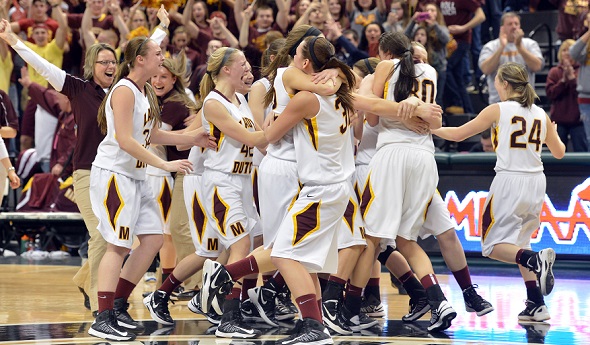
The Manchester girls basketball, Jackson Northwest girls bowling, Portland football, Harbor Beach football, Deckerville football and Hamtramck Frontier International boys soccer teams brought home the first MHSAA team championships in their schools’ histories.
A total of 33 teams won their first MHSAA titles. A total of 46 champions were repeat winners from 2011-12 – and 23 of those won for at least the third straight season. The Bloomfield Hills Brother Rice boys lacrosse team has the longest title streak of nine seasons, while the Battle Creek St. Philip volleyball team has won six straight titles for the second-longest streak overall and longest among girls programs.
Bloomfield Hills Cranbrook-Kingswood claimed the most championships, four, winning in Division 2 boys lacrosse, Lower Peninsula Division 3 girls swimming and diving, Lower Peninsula Division 3 girls tennis and Division 3 ice hockey. Four schools won three titles apiece: Grand Rapids Christian, Grand Rapids South Christian, Marquette and St. Ignace LaSalle.
Sixteen of the MHSAA's 28 championship tournaments are unified, involving teams from the Upper and Lower Peninsulas, while separate competition to determine titlists in both Peninsulas is conducted in remaining sports.
For a sport-by-sport listing of MHSAA champions for 2012-13 - Click Here (PDF)
The MHSAA is a private, not-for-profit corporation of voluntary membership by more than 1,500 public and private senior high schools and junior high/middle schools which exists to develop common rules for athletic eligibility and competition. No government funds or tax dollars support the MHSAA, which was the first such association nationally to not accept membership dues or tournament entry fees from schools. Member schools which enforce these rules are permitted to participate in MHSAA tournaments, which attract approximately 1.6 million spectators each year.
PHOTO: Manchester's girls basketball team celebrates the school's first MHSAA team championship in any sport this March at the Breslin Center. (Click to see more at HighSchoolsSportsScene.com.)