


Fall Sports Practices Begin Next Week
August 3, 2018
By Geoff Kimmerly
Special for Second Half
More than 100,000 student-athletes will begin practices next week in nine sports in which the Michigan High School Athletic Association sponsors postseason tournaments, signaling the beginning of the 2018-19 Fall sports season.
Practice in football may begin Aug. 6 for all schools wishing to begin regular-season games the weekend of Aug. 23-25. Schools must have 12 days of preseason practice at all levels before their first game, over a period of 16 calendar days before the first kickoff.
Practice sessions for all other sports begin Wednesday (Aug. 8). In golf and tennis, competition may commence no earlier than after three separate days of team practice, and not before seven calendar days. The first day competition may take place in golf and tennis is Aug. 15. In all other fall sports, contests can take place after seven days of practice for the team and not before nine calendar days. The first day competition may take place in cross country, soccer, swimming & diving, and volleyball is Aug. 17.
This fall, two football game dates again precede Labor Day, and a number of MHSAA schools will play their first varsity games Thursday, Aug. 23. In Week 1, 146 varsity games will be played on Thursday, 152 contests will be played Friday, and 12 games will be played Saturday. During the second week, one game will be played Wednesday, 245 games will take place Thursday, 62 will be played Friday, and one contest is scheduled for Saturday.
For fall sports, perhaps the most discussed change will concern MHSAA Tournament classification in volleyball. For the first time, volleyball teams are classified in four equal divisions instead of the traditional Class A-B-C-D. Class no longer will be used to organize the postseason for any sport, including girls and boys basketball in the winter. All other sports previously had switched from classes to divisions.
While most fall sports face at least minor rules changes this season, a few of the most noticeable adjustments in fall sports will come in football, volleyball, boys soccer and girls swimming & diving.
• In an effort to improve football pace of play by reducing re-kicks after a free or scrimmage kick (generally kickoffs or punts, respectively), an option has been added allowing the receiving team to accept a penalty and tack on the awarded yardage to the spot where the kick or punt return ended. This option incentivizes the receiving team to forgo a re-kick, and joins three other options after a penalty on the kicking team. The receiving team also may continue to accept a penalty from the previous spot and have the kicking team re-kick; and on kickoffs that travel out of bounds, the receiving team may continue to accept the ball and begin possession 25 yards from where the kickoff occurred or decline the penalty and begin possession where the kick flew out of bounds.
• Additionally for football, players who fail to properly wear required equipment or are missing required equipment during a down shall be replaced for one down rather than incur a yardage penalty. Previously, a penalty was assessed for delay of game in this scenario. If a player’s proper or legal equipment has become improperly worn through use and prompt repair is possible and does not cause a delay in game, that repair may be made without the player being replaced for the next down.
• A change in volleyball will allow teams to substitute for an injured/ill player prior to a replay; previously a replay would take place with no changes on the floor after the point was originally contested.
• Also in volleyball, with an eye on risk minimization, teams will be allowed to warm-up between sets only in their playing area and may not hit volleyballs over the net into the opponents’ playing area.
• For soccer – both boys this fall and girls in the spring – teams may continue to play up to two multi-team events every season, but beginning this fall a multi-team event can include two full 80-minute games the same day and still be counted as only one of a team’s 18 regular-season contests. Teams also may continue to play multi-team events with 30-minute halves and no more than 180 minutes total in one day (for example, three games with 30-minute halves) and call it just one contest of the 18.
• Another significant soccer change will switch the home team to wearing the dark uniform and the away team to wearing the white uniform. The change was made to allow home teams to wear their school colors – it does not require teams to purchase new uniforms, but only switches which team wears dark and which wears white.
• Also for soccer, a change has been made to the penalty when a player is whistled for denying the other team an obvious goal-scoring opportunity. If a player, in the penalty area, commits an infraction while attempting to play the ball, and that infraction results in a penalty kick, that offending player will receive a yellow card – previously this would have been a red card. If the player is not attempting to play the ball when an infraction is called in the penalty area that results in a penalty kick, the offending player still will receive a red card along with the opposing team being awarded the penalty kick.
• In swimming & diving regular-season competition, a pair of changes will provide more opportunities for divers. The diving event in dual, double-dual or other multi-team non-championship competition has been limited to six dives, but now may be expanded to an 11-dive competition – giving divers another opportunity to prepare for the 11-dive competitions at the MHSAA Qualification Meets and Finals levels. Also, while diving traditionally has been placed in the middle of the event order of a dual or other regular-season meet, it may now be conducted first, last or simultaneously with the swimming events. (Both require prior mutual consent by competing teams and officials.)
• Also in swimming & diving, visible 16.4-yard (or 15-meter) marks must be made visible on both sides of the pool deck to assist swimmers during competition.
The 2018 Fall campaign culminates with postseason tournaments beginning with the Upper Peninsula Girls Tennis Finals the week of Oct. 1 and wraps up with the 11-Player Football Playoff Finals on Nov. 23 and 24. Here is a complete list of fall tournament dates:
Cross Country
U.P. Finals – Oct. 20
L.P. Regionals – Oct. 26 or 27
L.P. Finals – Nov. 3
11-Player Football
Selection Sunday – Oct. 21
Pre-Districts – Oct. 26 or Oct. 27
District Finals – Nov. 2 or 3
Regional Finals – Nov. 9 or 10
Semifinals – Nov. 17
Finals – Nov. 23-24
8-Player Football
Selection Sunday – Oct. 21
Regional Semifinals – Oct. 26 or Oct. 27
Regional Finals – Nov. 2 or 3
Semifinals – Nov. 10
Finals – Nov. 17
L.P. Girls Golf
Regionals – Oct. 10 or 11 or 12 or 13
Finals – Oct. 19-20
Soccer
Boys L.P. Districts – Oct. 15-20
Boys L.P. Regionals – Oct. 23-27
Boys L.P. Semifinals – Oct. 31
Boys L.P. Finals – Nov. 3
L.P. Girls Swimming & Diving
Diving Regionals – Nov. 8
Swimming/Diving Finals – Nov. 16-17
Tennis
U.P. Girls Finals – Oct. 3 or 4 or 5 or 6
L.P. Boys Regionals – Oct. 11 or 12 or 13
L.P. Finals – Oct. 19-20
Girls Volleyball
Districts – Oct. 29-Nov. 3
Regionals – Nov. 6 & 8
Quarterfinals – Nov. 13
Semifinals – Nov. 15-16
Finals – Nov. 17
The MHSAA is a private, not-for-profit corporation of voluntary membership by more than 1,500 public and private senior high schools and junior high/middle schools which exists to develop common rules for athletic eligibility and competition. No government funds or tax dollars support the MHSAA, which was the first such association nationally to not accept membership dues or tournament entry fees from schools. Member schools which enforce these rules are permitted to participate in MHSAA tournaments, which attract more than 1.4 million spectators each year.
Bedford's Gandee Honored for 'Spirit'
March 13, 2017
By John Gillis
Special from NFHS
Hunter Gandee, a student-athlete at Temperance Bedford High School, has been selected as the 2017 Section 4 recipient of the “National High School Spirit of Sport Award” by the National Federation of State High School Associations (NFHS).
The National High School Spirit of Sport Award was created by the NFHS to recognize those individuals who exemplify the ideals of the spirit of sport that represent the core mission of education-based athletics.
The mark of a “good big brother” is often to what lengths he might go to assist his younger siblings.
That sense of familial assistance has perhaps never been taken to the extremes that Hunter Gandee has repeatedly done for his younger brother Braden.
A standout student, Hunter is a junior with a 3.92 grade-point average and a member of the National Honor Society.
On the sports side, Hunter is in his third season on the varsity wrestling team, and participates in Greco-Roman and freestyle wrestling during the offseason. He's also a member of the MHSAA Student Advisory Council.
While those accomplishments are unquestionably outstanding, they might pale in comparison to what he has done for Braden.
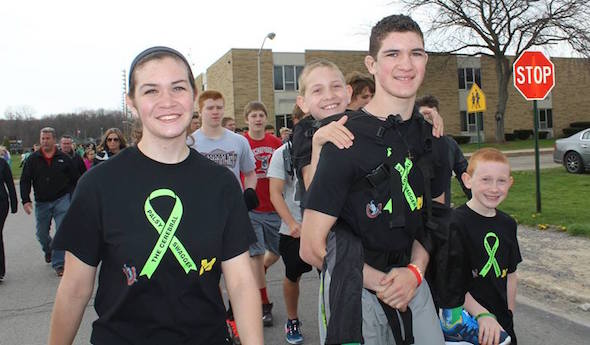
Born with cerebral palsy, Braden has limited use of his legs. Nonetheless, Hunter has taken it upon himself to help Braden know what it feels like to walk long distances – and he’s done it three times. Organized for the purpose of raising awareness of cerebral palsy, Hunter literally carries Braden on his back for long walks known as “CP Swaggers.”
In 2014, Hunter carried Braden 40 miles from the Bedford Junior High School wrestling room to the University of Michigan’s Bahna Wrestling Center. The following year, they upped the trek’s mileage to 57 miles.
However, that couldn’t foreshadow what was to follow in April 2016 when Hunter carried Braden on his back an amazing 111 miles – some 14 miles more than the first two walks combined.
About the Award: The NFHS divides the nation into eight geographical sections. The states in Section 4 are Michigan, Illinois, Indiana, Iowa and Wisconsin.
Nominations for this award were generated through NFHS member state associations and reviewed by the NFHS Spirit of Sport Award Selection Committee composed of state association staff members.
While the national winner will be recognized June 29 at the NFHS Summer Meeting in Providence, Rhode Island, the section winners will be recognized within their respective states and will receive awards before the end of the current school year.
PHOTO: Hunter Gandee, second from right, carries his brother Braden as part of their effort to bring awareness to cerebral palsy. (Photo courtesy of The Cerebral Palsy Swagger.)