


Fall Tournaments to Conclude in January
December 26, 2020
By Geoff Kimmerly
Second Half editor
The concluding rounds of Michigan High School Athletic Association postseason tournaments in football, girls volleyball and girls swimming & diving will be completed during January, as the MHSAA continues to follow all emergency orders from the Michigan Department of Health & Human Services (MDHHS).
Football teams may begin two days of outdoor, non-contact conditioning and drills, wearing helmets and shoulder pads with physical distancing, on Monday, Dec. 28, in advance of the first round of testing Dec. 30 as part of an MDHHS rapid testing pilot program. Schools will test players, coaches and other team personnel, with full-contact practice then allowed after a first round of negative results. The testing program will utilize BinaxNOW antigen tests that produce results within 15 minutes.
For football, 11-Player Regional Finals and 8-Player Semifinals will be played Saturday, Jan. 9. The 8-Player Finals and 11-Player Semifinals will be played Saturday, Jan. 16; and 11-Player Finals will be played during the weekend of Jan. 22-23.
The MDHHS’s current epidemic order – which paused activity beginning Nov. 18 – is set to expire Jan. 15, and if restrictions on non-contact sports are lifted then volleyball and swimming & diving could practice and compete at that time outside of the required rapid testing program. If the MDHHS epidemic order continues, volleyball and swimming & diving could begin practice, but those teams and individuals will have to follow all requirements of the MDHHS rapid testing pilot program to be eligible to participate. Specific plans and dates for volleyball and girls swimming & diving practice resumption and MHSAA tournaments will be finalized and shared with competing schools in early January.
Volleyball competition will restart with Quarterfinals, and Lower Peninsula girls swimming & diving has advanced to its Finals. The championship events in both sports would be completed no later than Jan. 30.
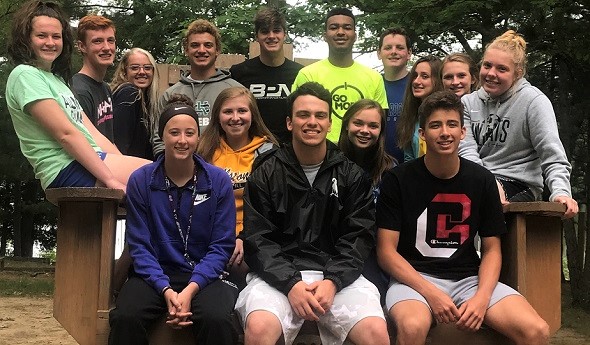
Advisory Council Seeking Class Of '22
By
Geoff Kimmerly
MHSAA.com senior editor
April 9, 2020
The MHSAA is seeking student-athletes to become members of its Student Advisory Council beginning with the 2020-21 school year.
Four boys and four girls from the Class of 2022 will be selected to two-year terms, and will meet on matters related to maintaining and promoting a proper perspective and sensible scope for high school sports in Michigan. Eight members from the Class of 2021 already are serving on the Council, while eight members of the Class of 2020 are leaving the Council this spring.
To be eligible for the committee, candidates must be a member of the Class of 2022, complete the official application including answering the three short-answer questions, submit a letter of recommendation from a school administrator, have a cumulative GPA of at least 3.0 (on a 4.0 scale) and be available for all scheduled meetings.
In addition, candidates should show a history of leadership on athletic teams as well as with other extracurricular activities, community service projects, or in the workplace; and show an understanding of the role of school sports and have ideas for promoting a proper perspective for educational athletics.
Applications are due to the MHSAA by 4:30 p.m. on April 29. Applications can be downloaded from the Student Advisory Council page of the MHSAA Website and must be returned via e-mail.
The Student Advisory Council meets seven times each school year, and once more for a 24-hour leadership camp. In addition to assisting in the promotion of the educational value of interscholastic athletics, the Council discusses issues dealing with the 4 S’s of educational athletics: scholarship, sportsmanship, safety (including health and nutrition) and the sensible scope of athletic programs. A fifth S – student leadership – is also a common topic. Members contribute in planning Sportsmanship Summits, Captains Clinics and other student leadership events, and assist with medal ceremonies at MHSAA championship events. The Council also judges the “Battle of the Fans,” which it created during the 2011-12 school year as a way to promote positive sportsmanship.
Newly-chosen members will join the following from the Class of 2021: Pierre Brooks II, Detroit Douglass; Macy Brown, Cadillac; Lydia Davenport, Ithaca; Freddy Kopplow, Traverse City St. Francis; Colin McAuliffe, Salem; Avery Peters, Mason; Abigail Pheiffer, Novi; and Landen Thompson, Stevensville Lakeshore.
The eight new members of the Student Advisory Council will be notified by May 8. The 2020-21 meetings are tentatively scheduled for Aug. 23, Oct. 4, Dec. 6, Feb. 14, April 18 and May 16. Meetings will take place at the MHSAA Office in East Lansing. Conference call meetings will be held Jan. 10 and Jan. 24. For more information, contact Andy Frushour at the MHSAA – 517-332-5046 or [email protected].
PHOTO: The MHSAA Student Advisory Council takes a minute out of a busy 24 hours during its annual overnight trip in 2019.