


Girls Events Set Attendance Record
September 17, 2015
By Geoff Kimmerly
Second Half editor
Michigan High School Athletic Association girls postseason events enjoyed record attendance for the second straight school year in 2014-15 as nearly 1.4 million fans total took in tournament events for which attendance is recorded.
Total attendance for 2014-15 was 1,389,209 fans, with 926,099 at boys tournaments and 463,110 spectators at girls events. Attendance is kept for all sports except golf, skiing and tennis, for which admission typically is not charged.
That total was down 31,518 fans, or 2.2 percent, from 2013-14. But that decrease was due mostly to a 20 percent drop in football attendance stemming from an uncharacteristically cold and snowy weekend for Pre-District games, and despite a slight uptick in MHSAA Finals attendance (53,494) in the sport for the second straight season to its highest total since 2011.
Attendance for Pre-District football games was down 45,663 fans (33 percent) from the same round of the 2013 Playoffs – although that one-weekend deficit was made up partially by an increase of 28,550 fans (6.6 percent) at girls events over the previous school year.
Two girls sports – competitive cheer and volleyball – plus the combined girls and boys bowling tournament set attendance records during 2014-15. Volleyball set a an overall attendance record for the second straight season, with 110,931 fans, and also set records at the MHSAA District and Regional levels. Cheer set records at the District and Finals levels and overall with 31,284 fans for the tournament – an increase of 20 percent over the 2013-14 season. Bowling set an overall attendance record for the fourth straight season, this time with 13,298 fans.
A number of other sports continued promising trends. The Baseball and Softball Finals, which showed a 29-percent increase from the previous year after moving to Michigan State University in 2014, experienced another boost this spring. The Girls Soccer Finals also moved to MSU, which attracted more fans total to the site that weekend; however, the combined attendance for Baseball, Softball and Girls Soccer Finals (16,310 fans) this spring was 29 percent higher than the 2014 combined total when girls soccer championship games were played at two other sites.
Baseball and Softball Regionals experienced their highest turnouts since the 1995 season, with baseball setting a record for that round with 12,297 fans. Girls Soccer Regionals also set a record with 11,228 in attendance. All three sports saw overall postseason attendance increases from the spring 2014 to 2015 seasons.
Both girls and boys basketball also enjoyed postseason attendance increases for the 2014-15 season; girls basketball had its most fans (171,665) since 2005-06, while the boys (320,908) welcomed the most since 2011-12. Boys soccer postseason games attracted 34,795 fans, up 20 percent from 2013 and the most since the 2008 season, and wrestling experienced upticks at both championship levels – the Team Finals attendance of 29,564 was the highest since 2011, and the Individual Finals total of 49,215 was that event’s highest since 2012. Boys swimming and diving and the combined track and field tournaments also enjoyed increased tournament attendance from the previous school year.
Bedford's Gandee Honored for 'Spirit'
March 13, 2017
By John Gillis
Special from NFHS
Hunter Gandee, a student-athlete at Temperance Bedford High School, has been selected as the 2017 Section 4 recipient of the “National High School Spirit of Sport Award” by the National Federation of State High School Associations (NFHS).
The National High School Spirit of Sport Award was created by the NFHS to recognize those individuals who exemplify the ideals of the spirit of sport that represent the core mission of education-based athletics.
The mark of a “good big brother” is often to what lengths he might go to assist his younger siblings.
That sense of familial assistance has perhaps never been taken to the extremes that Hunter Gandee has repeatedly done for his younger brother Braden.
A standout student, Hunter is a junior with a 3.92 grade-point average and a member of the National Honor Society.
On the sports side, Hunter is in his third season on the varsity wrestling team, and participates in Greco-Roman and freestyle wrestling during the offseason. He's also a member of the MHSAA Student Advisory Council.
While those accomplishments are unquestionably outstanding, they might pale in comparison to what he has done for Braden.
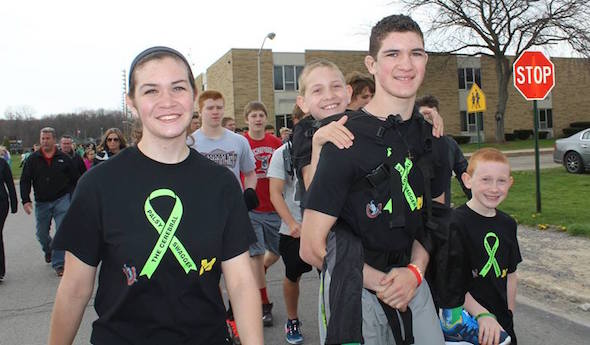
Born with cerebral palsy, Braden has limited use of his legs. Nonetheless, Hunter has taken it upon himself to help Braden know what it feels like to walk long distances – and he’s done it three times. Organized for the purpose of raising awareness of cerebral palsy, Hunter literally carries Braden on his back for long walks known as “CP Swaggers.”
In 2014, Hunter carried Braden 40 miles from the Bedford Junior High School wrestling room to the University of Michigan’s Bahna Wrestling Center. The following year, they upped the trek’s mileage to 57 miles.
However, that couldn’t foreshadow what was to follow in April 2016 when Hunter carried Braden on his back an amazing 111 miles – some 14 miles more than the first two walks combined.
About the Award: The NFHS divides the nation into eight geographical sections. The states in Section 4 are Michigan, Illinois, Indiana, Iowa and Wisconsin.
Nominations for this award were generated through NFHS member state associations and reviewed by the NFHS Spirit of Sport Award Selection Committee composed of state association staff members.
While the national winner will be recognized June 29 at the NFHS Summer Meeting in Providence, Rhode Island, the section winners will be recognized within their respective states and will receive awards before the end of the current school year.
PHOTO: Hunter Gandee, second from right, carries his brother Braden as part of their effort to bring awareness to cerebral palsy. (Photo courtesy of The Cerebral Palsy Swagger.)