

Goorhouse Gives Back at Home
By
Geoff Kimmerly
MHSAA.com senior editor
January 24, 2014
By Geoff Kimmerly
Second Half editor
Three traits have been key in making Holland Christian grad Mike Goorhouse nationally-recognized as a civic leader on the rise.
He’s a strong communicator, which comes in handy when coordinating support for causes all over the state.
He’s a relationship builder, allowing him to develop strong rapport as he explains how everyone can give something back to their communities.
 Finally, Goorhouse is a philanthropist – not just in job, but in life. He is the vice president for donor development at the Community Foundation of the Holland/Zeeland Area, where he works to raise support for nonprofit organizations. He also has served on the boards of directors/trustees for eight organizations, and he and his wife financially contribute to more than 15.
But a fourth quality, nurtured during his tennis and soccer careers, has been an asset as well for the 2003-04 MHSAA Scholar-Athlete Award winner.
“I always loved the competition side of sports. I talk to people who own companies, run companies, run shops. The reason they hire people who were involved in athletics is because of that drive,” said Goorhouse, 27, who was named in 2011 as one of the top 30 civic leaders nationally under the age of 30 by online networking site Splashlife. “Not everyone has that drive to succeed, to win, get a goal.
“Succeeding in the non-profit world looks a lot different. But it takes the same drive.”
 Goorhouse was among scholar-athletes recognized during the winter of 2004 by the MHSAA and Farm Bureau Insurance, which continues to sponsor the Scholar-Athlete Award program that has grown to honor 32 recipients annually. In advance of this March’s 25th celebration, Second Half is catching up with some of the hundreds who have been recognized (see additional links at the bottom of this page).
Earning a Scholar-Athlete Award likely meant more to Goorhouse than many of the other 607 who have been recognized over the quarter century. His grandfather, father and brother all have served as MHSAA officials, and his dad and brother both coach as well.
Mike also is part of a third generation of Goorhouses who annually attend the MHSAA Boys Basketball Finals, during which the Scholar-Athlete winners are recognized. He joined his dad and grandfather starting at 8 or 9 years old, and every year would read the bios of Scholar-Athlete Award winners in the Finals program and watch them line up on the court during halftime of the Class C championship game.
“Honestly, I wanted to be that,” Goorhouse said. “I had a lot of respect for the ability to balance academics and sports, and be good at both."
Goorhouse won the MHSAA Lower Peninsula Division 3 tennis title at No. 4 singles as a sophomore in 2002 and returned to the Finals at the No. 1 flight as a senior. He also played soccer at Holland Christian and then played tennis at Calvin College.
Tennis exposed Goorhouse to handling pressure on an individual basis while building mental toughness. Soccer was more about blending teammates’ skills and developing communication among the group.
“Everyone has his or her own version of the story, and that makes it more true; sports teaches a lot about leadership, and just about life and navigating the ups and downs, emotions, handling yourself under stress,” Goorhouse said. “I was in two way different sports, and it was fun to be able to see how those two things impacted me differently.”
As high school students begin focusing on college and potential occupations, professional giver probably isn’t an option many realize is possible. Goorhouse would’ve been counted in that group while at Holland Christian until becoming a member of the Community Foundation’s Youth Advisory Council. That opportunity joined him with many of his sports opponents from around the Holland area as they assisted the foundation in grant making for youth causes.
The philanthropy bug stuck. After his freshman year at Calvin, Goorhouse interned with the statewide Council of Michigan Foundations, which then hired him parttime as a college sophomore and fulltime once he graduated.
He returned to the Community Foundation in 2012 and works with 1,500 donors who contribute to the Holland/Zeeland area.
As donations grow, so does the foundation’s ability to give grants. But it’s not all about money. An oft-quoted definition of philanthropy is the “giving of time, talent and treasure” – and Goorhouse, as he speaks to various groups, makes sure to emphasize “and” as the most important word of that statement while encouraging donors to give of themselves in all three ways.
“It’s who I am as a person that fits this job so perfectly. It’s hardly work,” Goorhouse said. “When they’re thinking about giving back to the community, they’re at their best. I get to talk about what they care about.”
Goorhouse earned his bachelor’s degree in secondary education and then a master’s in public administration from Grand Valley State University. He’s able to take advantage of his relative youth in the professional world to connect with high school students and explain to them the opportunities to give back as part of the non-profit world. He serves on the boards of generationOn and Learning to Give, which both focus on integrating service into pre-college education.
While the national recognition in 2011 might’ve carried the most significance among honors Goorhouse has received, another he earned in 2009 has been his most meaningful on a personal level.
He was honored with the inaugural Young Philanthropist of the Year award by the Community Foundation. He didn't begin work for that organization until three years later, but giving back in his hometown always has been close to his heart.
“I love this place. It’s not that I can only do this work here, but it’s extra special to do the work you love in the place that you love,” Goorhouse said. “I could’ve lived anywhere because I would be on the road regardless. But to come home where my family and friends are, to the community I know best, it’s special.”
Click to read the series' first installments:
- 25 Years Later, Scholar Athletes Shine On
- On Call as Doctor, Director, Mom
- "Mailloux Management" Goes Global
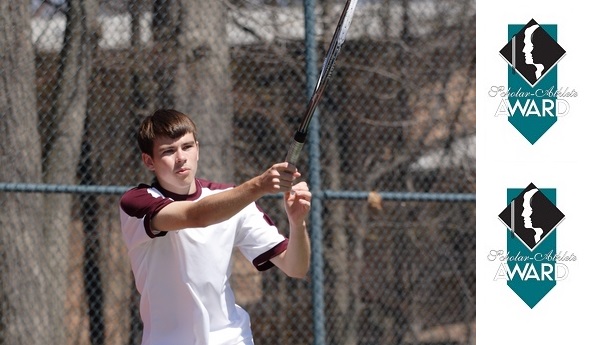
PHOTO: Mike Goorhouse sends a volley while playing tennis for Holland Christian. He won an MHSAA Scholar-Athlete Award in 2004. VIDEO: Goorhouse speaks in 2004 about playing for his high school tennis coach John Knoester.
Performance of the Week: Plainwell's Madison Nieuwenhuis
February 26, 2026
 Madison Nieuwenhuis ♦ Plainwell
Senior ♦ Wrestling
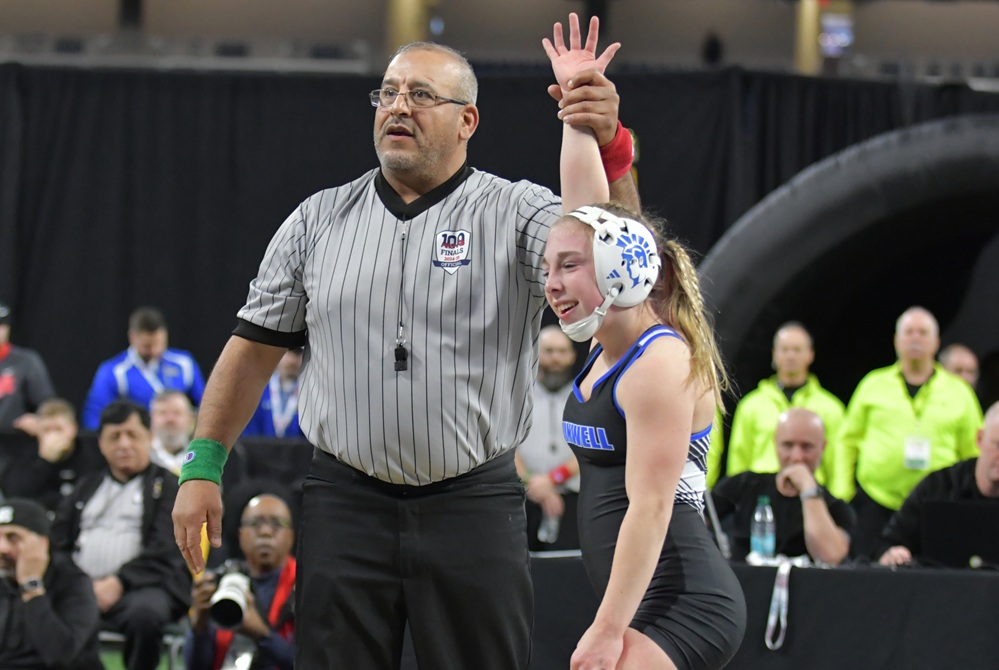
Nieuwenhuis won her fourth Regional individual championship, pinning her opponents last weekend at Portage Northern in 34 seconds, 1:08 and 58 seconds, respectively, to improve to 33-0 this season. She’s one of two girls – joining Westland John Glenn’s Nakayla Dawson – who will pursue a fourth championship at the MHSAA Individual Finals during the weekend of March 6-7 at Ford Field. She’s also 9-0 in matches against boys this season, with a combined 24 pins.
Not surprisingly, Nieuwenhuis is the top seed in her Finals bracket at 105 pounds. She’s 121-9 during her high school career with all nine losses coming against boys and during her first two seasons. She helped the Plainwell girls to a Regional team championship as well last weekend and competed with the boys team at times this winter in part to team up with her brother Dylan, a sophomore and Regional individual champion as well. Madison Nieuwenhuis has signed with top-ranked Iowa and plans to study psychology.
@mhsaasports 🤼♂️POW: Madison Nieuwenhuis #plainwell #wrestling #highschoolsports #performanceoftheweek #MHSAA ♬ Bright and fun upbeat pops, Kids, Animals, Pets, Fun, Cute, Happy, Playful, Upbeat(1465232) - SAKUMAMATATA
@mhsaasports 🤼♂️POW: Madison Nieuwenhuis #funfacts #tiktalk #performanceoftheweek #highschoolsports #MHSAA ♬ Girly and cute synth pop - SAKUMAMATATA
Follow the MHSAA on TikTok.
MHSAA.com's "Performance of the Week" features are powered by MI Student Aid, a division within the Department of Lifelong Education, Advancement, and Potential (MiLEAP). MI Student Aid encourages students to pursue postsecondary education by providing access to student financial resources and information. MI Student Aid administers the state’s 529 college savings programs (MET/MESP), as well as scholarship and grant programs that help make college Accessible, Affordable and Attainable for you. Connect with MI Student Aid at www.michigan.gov/mistudentaid and find more information on Facebook and X @mistudentaid.
Previous 2025-26 honorees
Feb. 20: Sophie Ramey, Allen Park competitive cheer - Report
Feb. 13: Cam Ryans, Grand Rapids Northview basketball - Report
Feb. 6: Melanie Kolnitys, Midland Dow basketball - Report
Jan. 29: Stella Musialowski, Huron Valley United gymnastics - Report
Jan. 22: Baylor Perkins, Grand Blanc swimming - Report
Jan. 15: Delaney Vanier, Flint Kearsley bowling - Report
Jan. 8: Stevie Hall, Detroit Cass Tech basketball - Report
Dec. 18: Ethan Martha, Ishpeming Westwood basketball - Report
Dec. 11: Louis Smith, Three Rivers wrestling - Report
Dec. 4: Traverse Moore, DeWitt football - Report
Nov. 28: Elizabeth Eichbrecht, West Bloomfield swimming - Report
Nov. 20: Brady Kieff, Blanchard Montabella football - Report
Nov. 13: Ella Laupp, Battle Creek Harper Creek swimming - Report
Nov. 7: Hunter Eaton, Charlevoix cross country - Report
Oct. 31: Stephen Gollapalli, Lansing Christian tennis - Report
Oct. 23: Talya Schreiber, Pickford cross country - Report
Oct. 16: Avery Manning, Dexter golf - Report
Oct. 9: Brady Van Laecke, Hudsonville football - Report
Oct. 2: Sarah Giroux, Flat Rock volleyball - Report
Sept. 25: Sam Schumacher, Portage Central tennis - Report
Sept. 18: Kaylee Mitzel, Saline field hockey - Report
Sept. 11: Natasza Dudek, Ann Arbor Pioneer cross country - Report
Sept. 4: Kate Posey, Big Rapids golf - Report