

With HOF Induction, Roberts Again Emphasizes Value & Values of School Sports
By
Geoff Kimmerly
MHSAA.com senior editor
July 14, 2022
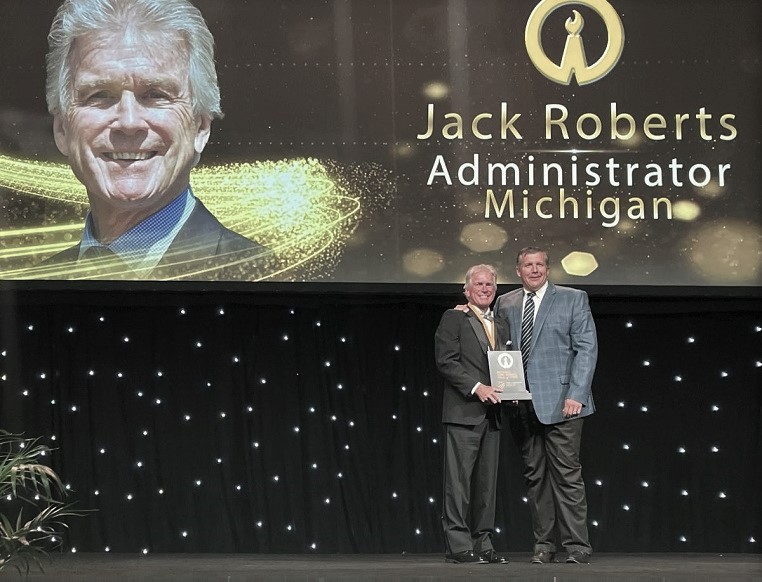
Longtime and now-retired MHSAA executive director John E. "Jack" Roberts was inducted into the National Federation of State High School Associations (NFHS) Hall of Fame on July 1, 2022 – shining a light on high life's work of promoting, supporting and providing a valued national voice on education athletics during 32 years in that role from 1986 until his retirement in 2018.
Roberts was one of 12 honorees inducted during the NFHS summer meeting in San Antonio, Texas.
Roberts began his career serving as an assistant director for the National Federation from 1973-80. He was involved with the implementation of Title IX at the local and state levels and made immense contributions as the NFHS representative to the landmark Amateur Sports Act of 1978, and also played a significant role in the NFHS rules-writing process as the organization started writing and publishing rules for a number of new sports during the 1970s.
At the time of his retirement, Roberts was the nation’s longest-serving executive director of a state high school athletic association. He was the fourth person to serve the MHSAA in that leadership role full time, following Charles E. Forsythe (1931-42, 1945-68), Allen W. Bush (1968-78) and Vern L. Norris (1978-86).
Roberts also followed in the footsteps of his late father, John Roberts, who served as executive director of the Wisconsin Interscholastic Athletic Association from 1957-85 and was inducted into the National High School Hall of Fame in 2000. They are the first father-son team in the Hall of Fame.
The video above was shown as an introduction before Roberts was awarded his Hall of Fame plaque and medal during the induction ceremony. In the photo below, Roberts stands with current MHSAA executive director Mark Uyl.

Marquette, Saginaw, Ann Arbor & Grand Rapids to Host MHSAA Sportsmanship Summits
By
Geoff Kimmerly
MHSAA.com senior editor
October 13, 2026
The MHSAA’s annual Sportsmanship Summit series will return this November with four stops across the Lower Peninsula, providing training on sportsmanship topics affecting students both on and off the field of play.
The MHSAA has conducted Sportsmanship Summits across Michigan for 30 years. This year’s series kicks off Nov. 9 in Marquette and finishes Nov. 18 in Grand Rapids.
MHSAA staff, with assistance from school administrators and the MHSAA Student Advisory Council, conduct Sportsmanship Summits. Up to 800 students are expected to take part in the four workshops, where they will discuss the line that separates good from bad sportsmanship, both as athletes during competition and while participating in off-field activities including as spectators at sporting events.
Workshop sessions will include discussions and hands-on activities on topics including working with game officials, building appropriate student cheering sections, social media behavior and parent conduct at school sports events. Summits also will feature a session developed and instructed by members of the Student Advisory Council. At the end of the day the delegation from each participating school will meet to develop a school sportsmanship campaign.
Sessions will take place at the following:
• Marquette – Nov. 9 – Northern Center at NMU – 9 a.m. - 1:30 p.m.
• Saginaw – Nov. 12 – The Conference Center at Saginaw Valley State University – 9 a.m. - 1:30 p.m.
• Ann Arbor – Nov. 16 – Sheraton Ann Arbor – 9 a.m. - 1:30 p.m.
• Grand Rapids – Nov. 18 – Sheraton Grand Rapids – 9 a.m. - 1:30 p.m.
The Sportsmanship Summit schedule rotates locations every year. In 2025, MHSAA staff conducted summits in Lansing, Troy, Traverse City and Kalamazoo.
Schools are welcome to bring as many as 10 total representatives, including two administrators. For additional registration information, contact Andy Frushour at the MHSAA office – [email protected] or (517) 332-5046. Registration information also is available on the Sportsmanship Resources page.