

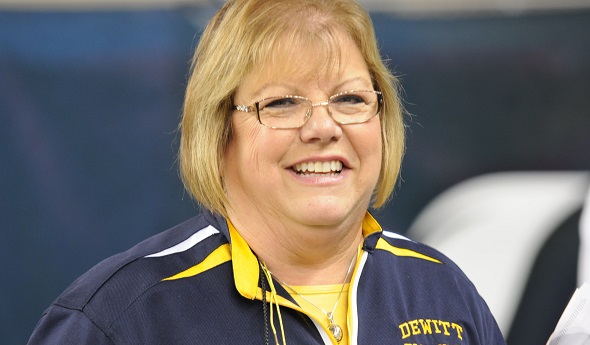
Honoree Leads from Behind the Scenes
January 28, 2014
By Geoff Kimmerly
Second Half editor
Off to the side somewhere, where athletic directors generally reside, Teri Reyburn often enjoys her favorite part of leading DeWitt’s athletic department – watching her school’s athletes shine.
As head of one of the Lansing area’s most successful programs, she has celebrated more often than not. But while her contributions to those successes usually fall outside of fanfare, they hardly go unappreciated by those who understand the inner workings of high school sports.
Reyburn's faithful support of her school and continuous service to Michigan High School Athletic Association programs will be celebrated Sunday, when she receives the MHSAA’s 27th Women In Sports Leadership Award during the WISL banquet at the Crowne Plaza Lansing West.
In addition to heading a department since 1999 that annually produces winning teams, Reyburn was a key voice in the creation and growth of the Capital Area Activities Conference a decade ago and has hosted more than 80 MHSAA tournaments at various levels in various sports.
“I absolutely love the kids. And I take a huge amount of pride in being able to put on and prepare an event, have hundreds or thousands walk in and sit down, enjoy themselves and walk out and leave not knowing the amount of work it took,” Reyburn said. “We have a large amount of volunteers who make that happen. I have some of the most amazing coaches, and the parents support their kids too. It doesn’t get any better than here, and I love what I do.”
Each year, the Representative Council considers the achievements of women coaches, officials and athletic administrators affiliated with the MHSAA who show exemplary leadership capabilities and positive contributions to athletics.
Both DeWitt’s girls and boys golf teams have won two MHSAA Finals championships apiece during her tenure. The football program has played in four Finals and both the boys basketball team and competitive cheer teams have finished MHSAA runners-up.
The Panthers girls basketball team has advanced to three MHSAA Semifinals, and the boys and girls soccer teams and baseball team have combined for five Semifinal appearances during her time guiding the program.
DeWitt has a strong athletic tradition going back decades. But there’s no question Reyburn has played her part well in continuing that legacy.
“DeWitt teams are always hard-working and always the model of good sportsmanship. Many people would assign the credit to the coaches for such behavior,” wrote Lansing Catholic athletic director Rich Kimball is recommending Reyburn for the WISL award. “Having been a coach, I know they deserve a lot of credit for how their teams perform and act, but without the leadership from the ‘boss’ those things don’t usually happen. Teri makes sure her program operates with class at all times.”
Her contributions to athletics off the field of play have been similarly significant, if also understated.
Since taking over the DeWitt program as interim athletic director in March 1999, and then fulltime that summer, Reyburn regularly has hosted five MHSAA tournaments per school year plus a total of more than 20 rules meetings and a number of clinics in coordination with statewide coaches and officials associations.
Reyburn, 59, also was among athletic directors who played a significant role in the formation of the CAAC, which combined schools from four leagues into one in 2003. She also was a leading voice in the formation of DeWitt High School’s Hall of Fame, which has inducted 35 athletes and nine teams since 2008.
Reyburn has spoken at WISL conferences on both the role of Title IX in high school athletics and “Tackling the Media Blitz” for young coaches and athletes. She has served on the WISL planning committee as well as on Scholar-Athlete Award, athletic equity, competitive cheer rules, site and officials selection committees.
“Teri Reyburn has provided nearly two decades of quiet, steady leadership in her school district and serves as a mentor for those who are following her in the athletic director role,” said John E. “Jack” Roberts, executive director of the MHSAA. “She’s a role model for not just women, but anyone who aspires to a career in educational athletics. We’re pleased to honor her with the Women In Sports Leadership Award.”
Reyburn graduated from Cedar Springs High School in 1972, the same year as the enactment of Title IX and the first MHSAA tournaments in girls sports. Her school offered three sports, and she played intramural volleyball and was a cheerleader. She also was a championship-caliber horseback rider during high school summers.
Soon after graduation, Reyburn married her high school sweetheart Kris (they will celebrate their 41st anniversary in November). Hers sons were born not long after – Mike, now a lieutenant colonel in the U.S. Army stationed in South Korea, and then D.J., who will begin his first fulltime season as a Major League Baseball umpire this spring.
Reyburn took college classes, worked as a study hall aide at Cedar Springs and later served on the Portland Public Schools board of education for 11 years before her family moved to DeWitt. She had intentions of earning a college degree, and discussed the possibility again after joining DeWitt schools a media specialist, middle school sports coordinator and assistant to the high school athletic director in 1994. But after five years in those roles, a sad circumstance led to her taking over the DeWitt program fulltime.
She was brought into athletics initially by previous director Jim Lutzke, who also worked in the human resources department and served as the Panthers boys basketball coach. He relied on Reyburn to coordinate middle school events and serve as a game manager for many at the high school.
Lutzke was diagnosed with cancer early in the 1998-99 school year, and Reyburn took on additional roles including game setup and equipment ordering. Lutzke died that March, and Reyburn and girls basketball coach Bill McCullen took over the high school athletic director duties on an interim basis. She was then hired as Lutzke’s successor for the following fall – and continues to employ lessons she learned under his mentoring.
“The biggest thing I got from Jim was just learning not to react quickly. To think, to understand a situation and know all of the facts before I do anything,” Reyburn said. “Jim was extremely good at that. He was even keel and level with everything he did.”
Reyburn also received plenty of tutelage and support from local athletic directors including longtime Haslett leader Jamie Gent, Williamston’s Jeff Lynch and then-Fowlerville athletic director Jack Wallace.
Now Reyburn is among those passing the knowledge forward. She’s one of the longest-serving athletic directors in the CAAC and was recognized as her region’s Athletic Director of the Year in 2006 by the Michigan Interscholastic Athletic Administrators Association.
“There are few, if any, athletic directors who are more capable, more organized or more in touch with high school sports than Teri,” Lansing Catholic’s Kimball also wrote. “Teri is the perfect person to win this award – passionate, smart, humorous, organized, but most of all an advocate for educational athletes.”
Past Women In Sports Leadership Award recipients
1990 – Carol Seavoy, L’Anse
1991 – Diane Laffey, Harper Woods
1992 – Patricia Ashby, Scotts
1993 – Jo Lake, Grosse Pointe
1994 – Brenda Gatlin, Detroit
1995 – Jane Bennett, Ann Arbor
1996 – Cheryl Amos-Helmicki, Huntington Woods
1997 – Delores L. Elswick, Detroit
1998 – Karen S. Leinaar, Delton
1999 – Kathy McGee, Flint
2000 – Pat Richardson, Grass Lake
2001 – Suzanne Martin, East Lansing
2002 – Susan Barthold, Kentwood
2003 – Nancy Clark, Flint
2004 – Kathy Vruggink Westdorp, Grand Rapids
2005 – Barbara Redding, Capac
2006 – Melanie Miller, Lansing
2007 – Jan Sander, Warren Woods
2008 – Jane Bos, Grand Rapids
2009 – Gail Ganakas, Flint; Deb VanKuiken, Holly
2010 – Gina Mazzolini, Lansing
2011 – Ellen Pugh, West Branch; Patti Tibaldi, Traverse City
2012 – Janet Gillette, Comstock Park
2013 – Barbara Beckett, Traverse City
PHOTO: DeWitt athletic director Teri Reyburn walks the Ford Field sideline before the Panthers Division 3 Final against Zeeland West this fall. (Click to see more at HighSchoolSportsScene.com.)

Fall Athletes: Prepare for Hot Weather
July 26, 2018
By Geoff Kimmerly
Second Half editor
As summer activities wind down with an eye toward the beginning of fall sports next month, the MHSAA advises that student-athletes need to prepare for training in the hot weather that traditionally accompanies the beginning of August and the first practices of the school year.
Each year, the MHSAA provides information to its member schools to help them prepare for hot weather practice and game conditions during the late summer and early fall. Football practice can begin at MHSAA schools August 6, followed by first practices for all other fall sports August 8.
The topic of heat-related injuries receives a lot of attention at this time of year, especially when deaths at the professional, collegiate and interscholastic levels of sport occur, and especially since they are preventable in most cases with the proper precautions.
“This month’s high temperatures across much of Michigan served as a reminder that we all must take a role in making sure our student-athletes are ready for hot weather as practices get underway,” said John E. “Jack” Roberts, executive director of the MHSAA. “At the start of every fall, we point out that with proper precautions and planning, heat illness is almost always preventable. It is imperative that we continue to emphasize this message and teach the best practices for staying safe both to our returning student-athletes and those taking part for the first time.”
Heat, hydration and acclimatization continue to be focuses of the MHSAA’s required preseason rules meetings for coaches and officials. The online presentations discuss the need for good hydration in sports, regardless of the activity or time of year, and informs both how to recognize the early signs of heat illness and the immediate steps to take to respond to those symptoms. The MHSAA requires all head varsity, varsity assistant and subvarsity coaches at the high school level to complete the rules and risk minimization meeting requirement.
The first days of formal practices in hot weather should be more for heat acclimatization than the conditioning of athletes, and practices in such conditions need planning to become longer and more strenuous over a gradual progression of time. Schools also must consider moving practices to different locations or different times of day, or change practice plans to include different activities depending on the conditions. Furthermore, football practice rules allow for only helmets to be worn during the first two days, only shoulder pads to be added on the third and fourth days, and full pads to not be worn until the fifth day of team practice.
Roberts also emphasized that student-athletes should make sure to hydrate all day long – beginning before practice, continuing during and also after practice is done. Water and properly-formulated sports drinks are the best choices for hydration, while energy drinks, high-carbohydrate fruit juices (greater than eight percent carb content), carbonated and caffeinated beverages are among those that should be avoided. The “Health & Safety” page of the MHSAA Website has a number of links to various publications and information including recommendations on proper hydration from the National Federation of State High School Associations (NFHS).
A number of member schools follow the MHSAA’s Model Policy for Managing Heat & Humidity, which while not mandated for member schools was adopted as a rule for MHSAA postseason competition in 2013. The plan directs schools to begin monitoring the heat index at the activity site once the air temperature reaches 80 degrees, and provides recommendations when the heat index reaches certain points, including ceasing activities when it rises above 104 degrees. (When the temperature is below 80 degrees, there is no combination of heat and humidity that will result in a need to curtail activity.)
The model heat & humidity policy is outlined in a number of places on the MHSAA Website, including as part of the publication Heat Ways, also available for download from the “Health & Safety” page.