


Hoops, Hockey Prep for Playoff Changes
December 12, 2019
By Geoff Kimmerly
Second Half editor
The introduction of limited seeding at the District level for girls and boys basketball, and a shift in the postseason schedule for ice hockey, are among changes that will be noticed most this season by those who compete in and follow the 12 winter sports for which the Michigan High School Athletic Association sponsors postseason tournaments.
Girls basketball’s first games tipped off Dec. 2, followed by boys basketball openers Dec. 9. This winter, for the first time, the top two teams in every basketball District will be seeded and placed on the opposite sides of their bracket, making the District Final the earliest round they could play each other. Those top-seeded teams will be determined using the Michigan Power Ratings (MPR) computer formula based on regular-season results against other MHSAA Tournament-eligible teams and opponents’ strength of schedule. (Games against out-of-state or non-MHSAA opponents will not count in the MPR formula.)
The MHSAA will draw all brackets 15 days before the start of District play. After the top seeds are determined and separated to opposite sides of the bracket, the draw process will place the remaining teams on the bracket based on a randomly-selected order determined earlier in the season. MPR also was used to similarly seed Districts for boys soccer for the first time this past fall and in the spring for boys lacrosse.
Also undergoing a change this winter, the MHSAA Ice Hockey Tournament will be played over three weeks rather than two as in previous seasons. The traditional dates for the start of the regular season and Finals will remain the same, as will the total number of regular-season games allowed. However, the MHSAA Tournament will begin on the third Monday before the Finals instead of two weeks before, and the extended postseason schedule places the maximum of six games that may be played from the start of Regionals through Finals over 20 days instead of the previous 13.
While those changes will affect tournament structures, a handful of others affecting daily competition will be particularly noticeable as well this winter:
• As with Lower Peninsula girls swimming & diving season in the fall, a pair of changes for LP boys and Upper Peninsula girls will take effect this winter. For swimmers, the definition of a legal finish has changed to include a competitor touching any part of the finish end of the lane, not just the touch pad. In diving, the degree of difficulty was adjusted for back and reverse somersaults to provide consistency with difficulty of other dives.
• In hockey, the allowed stick length for a non-goaltender has been extended to 65 inches with a blade no more than 12.5 inches long and between 2-3 inches high. The allowances for a goaltender’s stick also were adjusted – the widened portion up to 28 inches from the heel and to 3.5 inches in width, with a blade at maximum 15.5 inches in length. These changes were made to accommodate the greater average height of today’s athletes.
• In girls competitive cheer, non-braced static inversions will be allowed only with the following stipulations: the original base or spotter maintains constant contact with the flyer, prior to the static inverted position the flyer must originate from below shoulder level, and the inversion must dismount to the cheering surface, cradle, any waist-level position or a non-inverted stunt at shoulder level. Also, twists from inversions and inversions released to extended level are illegal.
• A new rule in wrestling will allow for additional time to evaluate head and neck injuries. If an injury occurs involving the head, neck, cervical column and/or nervous system and an appropriate health care professional is present, that caregiver may request the traditional 90 seconds of injury time be extended up to a maximum of five minutes to evaluate the injury. Before that time expires, the wrestler must be ready and able to continue the match or it will be defaulted.
• Also for wrestling, a new criteria has been added to the tie-breaking system used when a dual meet finishes in a tied score. The new sixth criteria “f” states that the team giving up the fewest forfeits during a match shall be declared the winner.
The 2019-20 Winter campaign culminates with postseason tournaments beginning with Girls & Boys Skiing Regionals on Feb. 10, and wraps up with the Boys Basketball Finals on March 28. Here is a complete list of winter tournament dates:
Girls Basketball
Districts – March 2, 4 & 6
Regionals – March 10 & 12
Quarterfinals – March 17
Semifinals – March 19-20
Finals – March 21
Boys Basketball
Districts – March 9, 11 & 13
Regionals – March 16 & 18
Quarterfinals – March 24
Semifinals – March 26-27
Finals – March 28
Girls & Boys Bowling
Team Regionals – Feb. 28
Singles Regionals – Feb. 29
Team Finals – March 6
Singles Finals – March 7
Girls Competitive Cheer
Districts – Feb. 21-22
Regionals – Feb. 29
Finals: March 6-7
Girls Gymnastics
Regionals – March 7
Team Finals – March 13
Individual Finals – March 14
Ice Hockey
Regionals – Feb. 24-March 4
Quarterfinals – March 7
Semifinals – March 12-13
Finals – March 14
Girls and Boys Skiing
Regionals – Feb. 10-14
Finals – Feb. 24
Girls & Boys Swimming & Diving
U.P. Girls & Boys Finals – Feb. 15
L.P. Boys Diving Qualification Meets – March 5
L.P. Boys Finals – March 13-14
Wrestling
Team Districts – Feb. 12-13
Individual Districts – Feb. 15
Team Regionals – Feb. 19
Individual Regionals – Feb. 22
Team Quarterfinals – Feb. 28
Team Semifinals & Finals – Feb. 29
Individual Finals – March 6-7
2020 Class Honored Together, from Afar
By
Geoff Kimmerly
MHSAA.com senior editor
May 15, 2020
Ishpeming Westwood’s girls basketball team was two hours into a three-hour trip to its Division 3 Regional Final on March 12 when the Patriots were told to turn the bus around and come home.
In an instant, the 2019-20 school year – and with it all MHSAA sports across the state – had come to a halt. And two months later, the high school world and its sports community continue to wait for bits of normalcy to return.
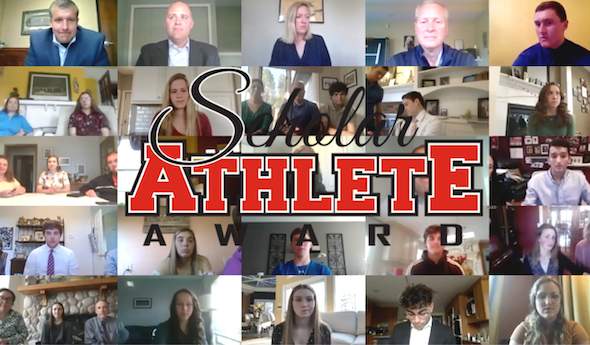
On Wednesday, we were able to enjoy a little bit of normal that’s been part of the annual MHSAA calendar for three decades. A Zoom call brought together 31 families from all over the state along with MHSAA staff and Farm Bureau Insurance CEO Don Simon to celebrate this year’s MHSAA/Farm Bureau Insurance Scholar-Athlete Award winners.
Living rooms, kitchens and home offices replaced Breslin Center as settings for this “virtual” ceremony. And yet, this ceremony may be remembered more than any other because of its necessity – due to the COVID-19 pandemic – and because of how it brought so many together, remotely, while the coronavirus has forced all of us to remain apart.
Below is the ceremony, in full, including words from Simon, MHSAA Executive Director Mark Uyl and Assistant Director Andy Frushour and, for the first time, a student speaker from the class – Ishpeming Westwood senior Madelyn Koski, who was part of that basketball team destined for Sault Ste. Marie. A brief Q&A with Koski follows.
Koski was an all-stater on the court who would’ve finished her high school career with four varsity letters each for hoops, tennis and softball. She will continue at Ferris State University, where she’ll pursue a degree in pharmacy and continue her basketball career.
Second Half: How did you decide what you wanted to say? Was there a message you wanted to get across?
It was easy to write the sad part, because I know what happened – I was there. But it was hard for me to make a positive spin at the end because I don’t think anyone’s over it yet. I was glad to be able to turn it into something that was bigger than sports … more about our whole lives and less about our time in high school.
Second Half: It’s been two months. How have you been navigating the disappointment, the sadness? And is there advice you’d give to other people your age trying to do it?
As time went on, it got a little bit better. The day after was pretty sad; that’s all I could think about. Now there’s so many other things to do – the weather’s nicer, we can go outside. And I’m playing college basketball – not everyone has that chance – but at least I have that to practice for, look forward to.
I guess, it’s just … time heals.
Second Half: Even though you can’t be with them and hang out with them, I’m sure you’re talking a lot of your friends and teammates. What kind of conversations are you having? Is it looking ahead? Is it still thinking about, “We’d be playing softball right now?"
I think we kinda tried to leave the basketball stuff in the past because it was too sad to talk about. We made sure we do talk, obviously not in person, but on social media or FaceTime, we just talk about our memories and everything. That helped. It didn’t close the chapter, but it was nice to talk to them when we were all alone. And now we just don’t talk about that anymore. Nobody really wants to talk about it. We see memories popping up on Facebook and all these other things about, “Oh, we had a softball game last year at this time.” And it’s pretty sad. But no one else is playing. So it’s like we’re all in the same boat.
 Second Half: You can turn on the news and you can see what every adult has to say about what’s going on right now. … You’re 17, you’re finishing your last year of high school, you’re going through something no one has gone through in more than 100 years. How do you see everything that’s happening in the world right now, as you look at it from a 17-year-old’s point of view and see seasons end and school end?
I know we can’t help what happened. But obviously I think it’s unfair that it happened to our class. It stinks for every grade, but (as seniors) we’re missing out on our best parts of high school right now and it’s pretty horrible. We’ve been waiting years for our senior proms and graduations, banquets and award ceremonies, like the MHSAA one. So that kinda stinks.
Ever since March 12, I’ve been staying optimistic. But I’m proved wrong every time because things just keep getting canceled and canceled. … (But) I’m a pretty optimistic person, so I still have some left.
Second Half: What happens next? What does your summer look like? What happens for people who are in your shoes?
I’ll keep working out, and one of the girls on my high school basketball team is going to play at Michigan Tech so (eventually) we can work out together. … I think the biggest thing to do this summer, that I think I’ll do, is appreciate time with my family. I have gotten to spend a lot of time with them. And then maybe once summer rolls around and we’re allowed to be in bigger groups, I’ll be able to be with people other than my mom and dad, like my grandparents and cousins and my aunts and uncles. … (My sister Jillian and I) have been playing the same varsity sports for the last couple of years, and she’s been really successful. It’s been fun to win all these championships and stuff with her.
Second Half: What do you think you’re going to remember from this in five years, 10 years, when people ask you what your experience was like?
I’m probably going to say it’s a pretty bad experience. I guess it was an eye-opener that life can change at any moment. That’s kind’ve it. It didn’t change in a good way.
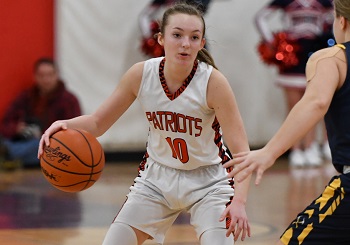
PHOTO: Westwood's Madelyn Koski sets up a play as Negaunee's Breanne Giotto defends her during their Jan. 24 game. (Photo by Cara Kamps.)