

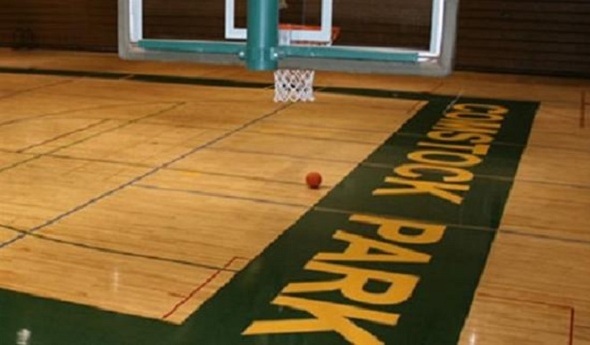
The House Gillette Helped Build
February 1, 2012
Maribeth Johnston’s description made it easy to imagine the bustling activity that was Janet Gillette’s Comstock Park athletic office for 20 years.
Gillette and her secretary’s desks, piled with shelves of labeled and color-coded binders. A wall-sized white board calendar marked with sports activities for the next two months. Floor to ceiling shelf units, labeled cubbies and a copy machine loaded with paper of various colors. Trophies on shelves awaiting their turn in the school’s display case.
And then there were the two most telling images of Gillette’s legacy during four decades as a part of Comstock Park schools. On other walls were hundreds of pictures of students, athletes, coaches and staff. And in the center of the athletic office were two large work tables, usually occupied by student volunteers stuffing envelopes, organizing and counting uniforms or taking any on other task to help out.
“Her attention to detail, service for others and devotion to make every event ‘special’ is what endears her to the people in our school system,” wrote Johnston, who recently finished her 24th season as the school’s volleyball coach, in a letter of recommendation for the MHSAA’s Women in Sports Leadership Award. “The athletic office is a wonderful place. But the person who makes it all happen is Jan Gillette.”
Gillette attended Comstock Park, came back as a teacher and coach, and retired in 2010 after spending her final 19 school years as athletic director. She is the 25th woman to be recognized with the WISL Award for exemplary leadership capabilities and positive contributions to athletics. The award will be presented during Sunday’s Women In Sports Leadership Conference banquet at the Lexington Lansing Hotel.
“One of my quotes that people always hear is there’s no greater privilege in life than to have an impact on a young person. I got to do that every day,” Gillette said. “And they impacted my life as well."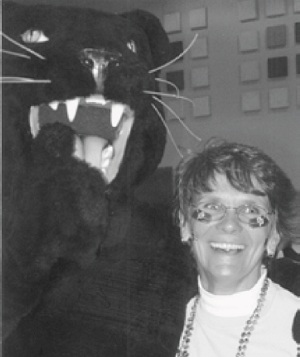
A 1973 graduate of Comstock Park, Gillette began coaching at the school just a year later. A four-sport athlete in high school, she eventually coached girls tennis, softball, volleyball and middle school basketball while also joining the district’s teaching staff in 1977 after attending Grand Rapids Community College and Grand Valley State (playing two sports at the former). Gillette then served as the high school athletic director beginning in 1990.
Under her leadership, Comstock Park served host to numerous MHSAA postseason tournaments, including 15 Lower Peninsula Track and Field Finals and multiple Girls Competitive Cheer Finals. Gillette also was active with the Michigan Interscholastic Athletic Administrators Association, serving as a presenter at numerous conferences and developing a coaches handbook.
“Few administrators have such a long record of hosting MHSAA Finals, evidence again of Janet Gillette’s drive to contribute not only at Comstock Park, but to high school sports on a larger scale,” said John E. “Jack” Roberts, executive director of the MHSAA. “Her involvement with female athletics dates back nearly to their inception. Jan’s impact will continue to be felt for years to come, and her contributions set a high standard for administrators in the future. We’re proud to honor her with the Women In Sports Leadership Award.”
Girls sports have evolved the most since Gillette first joined the athletic scene. Back then, seasons were only eight weeks, and volleyball, bowling and softball were not yet sponsored by the MHSAA. “To see what we have now, it’s just awesome,” Gillette said.
She is a member of the Comstock Park Athletic Hall of Fame, and has been recognized as Regional Athletic Director of the Year by the MIAAA, Athletic Director of the Year by the Michigan Competitive Cheer Coaches Association and the West Michigan Basketball-Football Association, and Comstock Park Employee of the Year in 2004. She also received the MHSAA’s Allen W. Bush Award in 2006 for her service to high school athletics.
In the community, Gillette has served as a coach in the Northwest Little League and been active with the Alpine Baptist Church as an AWANA Director and a Sunday School teacher.
“Mrs. G” hardly has disappeared from the school scene. She still manages the school’s volleyball tournaments and cheer invitationals, and the 250-person effort that makes the Division 3 Track and Field Final happen each spring.
She’s the first to credit all of those helpers, as well as the school boards, principals and superintendents who led the district during her career.
“I love Comstock Park. I love the community. I grew up there, and my dream was always to become a coach and a teacher,” Gillette said. “I didn’t want to do anything else because of the impact my teachers and the staff had on me, and the coaches.
“To go back to your own home town, what better could there be?”
Past Women In Sports Leadership Award recipients
1990 – Carol Seavoy, L’Anse
1991 – Diane Laffey, Harper Woods
1992 – Patricia Ashby, Scotts
1993 – Jo Lake, Grosse Pointe
1994 – Brenda Gatlin, Detroit
1995 – Jane Bennett, Ann Arbor
1996 – Cheryl Amos-Helmicki, Huntington Woods
1997 – Delores L. Elswick, Detroit
1998 – Karen S. Leinaar, Delton
1999 – Kathy McGee, Flint
2000 – Pat Richardson, Grass Lake
2001 – Suzanne Martin, East Lansing
2002 – Susan Barthold, Kentwood
2003 – Nancy Clark, Flint
2004 – Kathy Vruggink Westdorp, Grand Rapids
2005 – Barbara Redding, Capac
2006 – Melanie Miller, Lansing
2007 – Jan Sander, Warren Woods
2008 – Jane Bos, Grand Rapids
2009 – Gail Ganakas, Flint; Deb VanKuiken, Holly
2010 – Gina Mazzolini, Lansing
2011 – Ellen Pugh, West Branch; Patti Tibaldi, Traverse City
PHOTOS courtesy of Comstock Park High School.

Athletic Directors Deliver
June 27, 2013
By John E. “Jack” Roberts
MHSAA Executive Director
During the past year I have had some interesting speaking engagements that took me to some other states and even to a far-away nation; but the two speaking assignments I have every year that I look forward to the most and work on the hardest are here in Michigan – at the large mid-winter conference and smaller mid-summer workshop for athletic directors.
After more than a quarter century of these two-a-year addresses, I wouldn’t be surprised if the audience is tiring of listening to me; but I have not tired of preparing to do my best for them ... which is a function of my great respect for them.
Athletic directors serve school sports where the rubber meets the road; and the road is routinely rough.
Athletic directors operate where policy and people meet – in fact, where they often collide.
Athletic directors are called on to administer rules and apply penalties. They are expected to enforce codes of conduct and the consequences for violations.
Athletic directors are told they must uphold standards – attendance, academic, behavioral. And when they do what they’ve been asked to do, and sometimes have done at great cost personally, athletic directors are subjected to criticism by students and parents and, too frequently, receive less than full backing by their superiors and school boards.
Because I know this, I am humbled to be in their company, much less allowed to address them.
On just such an occasion, March 16, 2008, this is how I described my role, and my great respect for the interscholastic athletic administrators of this state:
“Sometimes after I hear a song over and over, and I begin to really listen to the words, I might write those words down. Especially if it’s a song by Springsteen or John Fogerty or Jackson Browne.
“But after I do this, and I read the words on paper or even recite the words aloud, I’m always disappointed. The words, without the music, lose something. The lyrics are neither as moving nor as powerful without the melody.
“On occasion I have been complimented for my words about educational athletics, but I’ve come to appreciate that without the music, my words don’t work. And I’ve come to appreciate that you folks provide the music.
“Sometimes I may be the words of school sports in Michigan, but all the time you are the music of school sports in Michigan. You make the words meaningful, you make the words memorable, you make the words powerful, you make the words really happen. I don’t, and I get that."
During the summer, Second Half will publish a series of features describing how athletic directors deliver daily all over the state. Among those who will be featured are pictured above, clockwise from top left: Detroit Cass Tech's Edward Tomlin, Cedar Springs' Autumn Mattson, Croswell-Lexington's Rick Jakacki and Houghton Lake's Maureen Whidden.