

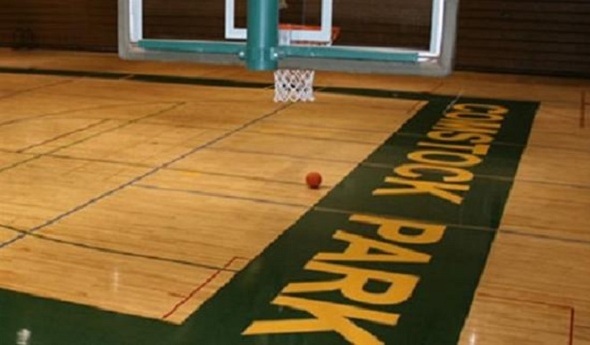
The House Gillette Helped Build
February 1, 2012
Maribeth Johnston’s description made it easy to imagine the bustling activity that was Janet Gillette’s Comstock Park athletic office for 20 years.
Gillette and her secretary’s desks, piled with shelves of labeled and color-coded binders. A wall-sized white board calendar marked with sports activities for the next two months. Floor to ceiling shelf units, labeled cubbies and a copy machine loaded with paper of various colors. Trophies on shelves awaiting their turn in the school’s display case.
And then there were the two most telling images of Gillette’s legacy during four decades as a part of Comstock Park schools. On other walls were hundreds of pictures of students, athletes, coaches and staff. And in the center of the athletic office were two large work tables, usually occupied by student volunteers stuffing envelopes, organizing and counting uniforms or taking any on other task to help out.
“Her attention to detail, service for others and devotion to make every event ‘special’ is what endears her to the people in our school system,” wrote Johnston, who recently finished her 24th season as the school’s volleyball coach, in a letter of recommendation for the MHSAA’s Women in Sports Leadership Award. “The athletic office is a wonderful place. But the person who makes it all happen is Jan Gillette.”
Gillette attended Comstock Park, came back as a teacher and coach, and retired in 2010 after spending her final 19 school years as athletic director. She is the 25th woman to be recognized with the WISL Award for exemplary leadership capabilities and positive contributions to athletics. The award will be presented during Sunday’s Women In Sports Leadership Conference banquet at the Lexington Lansing Hotel.
“One of my quotes that people always hear is there’s no greater privilege in life than to have an impact on a young person. I got to do that every day,” Gillette said. “And they impacted my life as well."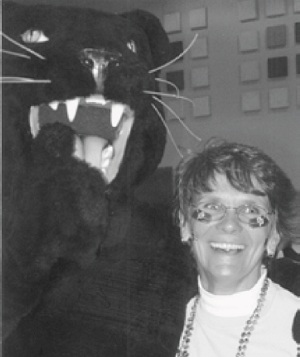
A 1973 graduate of Comstock Park, Gillette began coaching at the school just a year later. A four-sport athlete in high school, she eventually coached girls tennis, softball, volleyball and middle school basketball while also joining the district’s teaching staff in 1977 after attending Grand Rapids Community College and Grand Valley State (playing two sports at the former). Gillette then served as the high school athletic director beginning in 1990.
Under her leadership, Comstock Park served host to numerous MHSAA postseason tournaments, including 15 Lower Peninsula Track and Field Finals and multiple Girls Competitive Cheer Finals. Gillette also was active with the Michigan Interscholastic Athletic Administrators Association, serving as a presenter at numerous conferences and developing a coaches handbook.
“Few administrators have such a long record of hosting MHSAA Finals, evidence again of Janet Gillette’s drive to contribute not only at Comstock Park, but to high school sports on a larger scale,” said John E. “Jack” Roberts, executive director of the MHSAA. “Her involvement with female athletics dates back nearly to their inception. Jan’s impact will continue to be felt for years to come, and her contributions set a high standard for administrators in the future. We’re proud to honor her with the Women In Sports Leadership Award.”
Girls sports have evolved the most since Gillette first joined the athletic scene. Back then, seasons were only eight weeks, and volleyball, bowling and softball were not yet sponsored by the MHSAA. “To see what we have now, it’s just awesome,” Gillette said.
She is a member of the Comstock Park Athletic Hall of Fame, and has been recognized as Regional Athletic Director of the Year by the MIAAA, Athletic Director of the Year by the Michigan Competitive Cheer Coaches Association and the West Michigan Basketball-Football Association, and Comstock Park Employee of the Year in 2004. She also received the MHSAA’s Allen W. Bush Award in 2006 for her service to high school athletics.
In the community, Gillette has served as a coach in the Northwest Little League and been active with the Alpine Baptist Church as an AWANA Director and a Sunday School teacher.
“Mrs. G” hardly has disappeared from the school scene. She still manages the school’s volleyball tournaments and cheer invitationals, and the 250-person effort that makes the Division 3 Track and Field Final happen each spring.
She’s the first to credit all of those helpers, as well as the school boards, principals and superintendents who led the district during her career.
“I love Comstock Park. I love the community. I grew up there, and my dream was always to become a coach and a teacher,” Gillette said. “I didn’t want to do anything else because of the impact my teachers and the staff had on me, and the coaches.
“To go back to your own home town, what better could there be?”
Past Women In Sports Leadership Award recipients
1990 – Carol Seavoy, L’Anse
1991 – Diane Laffey, Harper Woods
1992 – Patricia Ashby, Scotts
1993 – Jo Lake, Grosse Pointe
1994 – Brenda Gatlin, Detroit
1995 – Jane Bennett, Ann Arbor
1996 – Cheryl Amos-Helmicki, Huntington Woods
1997 – Delores L. Elswick, Detroit
1998 – Karen S. Leinaar, Delton
1999 – Kathy McGee, Flint
2000 – Pat Richardson, Grass Lake
2001 – Suzanne Martin, East Lansing
2002 – Susan Barthold, Kentwood
2003 – Nancy Clark, Flint
2004 – Kathy Vruggink Westdorp, Grand Rapids
2005 – Barbara Redding, Capac
2006 – Melanie Miller, Lansing
2007 – Jan Sander, Warren Woods
2008 – Jane Bos, Grand Rapids
2009 – Gail Ganakas, Flint; Deb VanKuiken, Holly
2010 – Gina Mazzolini, Lansing
2011 – Ellen Pugh, West Branch; Patti Tibaldi, Traverse City
PHOTOS courtesy of Comstock Park High School.

MHSA(Q&)A: Gibraltar Carlson cheer coach Christina Wilson
February 17, 2012
 After cheering through middle and high school, Gibraltar Carlson competitive cheer coach Christina Wilson started coaching the Marauders’ middle school team the season after she graduated from Carlson High in 2001. She took over the varsity team in 2007 – and has accomplished in a short time what many coaches hope for over decades.
Carlson has won three of the last four MHSAA Division 2 championships – also finishing runner-up in 2010 – and is ranked No. 1 in its division heading into District competition this weekend. The Marauders have had a strong program throughout the history of competitive cheer as an MHSAA sport – they won the Class B championship in 1995 under Pat Christiansen and finished runners-up three straight seasons after that – but are on a run unequaled over the last five seasons.
Bowling Green, Eastern Michigan and Oakland’s cheer teams now boast former Carlson athletes, and all of this success could be just the start – Wilson may have accomplished a lot early in her career, but she said she hopes to keep the Marauders rolling for years to come.
What kind of things did you learn from your high school coach that you still teach today?
As soon as I started coaching middle school – we also got a new coach at the varsity level as well, so we had new coaching throughout the program at that time – I took and got the resources from our former coach in ’95 (Pat Christiansen) and started using all her resources. Everything she implemented and used for her teams, I took and continue to use today
Her daughter (Tami) coached with her in ’95 when we won the state championship, and she recently came back in 2010 as one of our assistants. She brought back that mentality of ’95 of working hard … the harder the practices the more successful you’ll be … make practices count enough so on Saturdays you can be as prepared as you can be … and the importance of making of making good decisions, in practice and outside sports as well.
Your program had success previously. But what happened to take Gibraltar Carlson to the next level?
I started coaching middle school, and by the time I moved up to varsity all (my) rules and procedures, the kids were used to it and it was (the same) throughout the program. It was becoming a program-wide thing to become excellent. It wasn’t just team by team, and I think that helped. We hold our kids to really high standards, and we’re expected to reach our goals and expectations.
What is the one big thing your athletes take away after four years of being part of your program?
We have the mementos and the championship rings and those things. But I think it’s a sense of pride. It gives them a sense of self. They know they can have goals, and if they work hard they can achieve those goals. If they put their minds to something, it’s something they can grasp if they work hard. I think that whole mentality of working hard, pursuing goals and teamwork is instilled right from the get-go, and something they take with them when they leave the program.
How do you stay ahead of the competition?
It’s not easy. We go to several camps; there’s a champion cheerleading camp we go to every summer. We work with college teams too; they come and show us things they do and teach us things. We take some kids every once in a while to out-of-state clinics (Kentucky, Bowling Green, etc.). We really try a diversity of things to get the girls out there and experiencing things. The techniques and ideas, it’s all about seeing something and then adding that to imagination to come up with whatever knows what.
Why are your teams so consistent?
We hold them to high expectations. We have gymnastics classes that they regularly attend, and on their own they go to the gymnastics facility once or twice a week extra on top of that to stay on top of their skills stay among the best athletes in state. One thing we do every year is we create a huge goal board. What we do after we start competing, is every Monday we check off what we’ve completed on the goal board. It’s not just a mental aspect, but it’s visual. Every week focus on something we try to achieve.
What do you enjoy most about coaching?
I love working with the kids. They’re funny. Practice is something new every day; you never know what you’re going to get. It’s so much fun. (And) competing is fun. I like the aspect of competition, the intensity of it. That’s lots of fun too. Winning is fun.
This is the sport Gibraltar Carlson has become known for, the one in which it’s had the most success lately.
It’s starting to grow. People look at cheerleading like, “Oh, it’s cheerleading.” We are definitely gaining the respect of other coaches and other programs, other sports and teachers and the student body. The really cool thing is when people start to look at the sport and realize how physically demanding it is. It makes us feel good to hear when other coaches say they think maybe the cheerleaders might be some of the best athletes in this school.
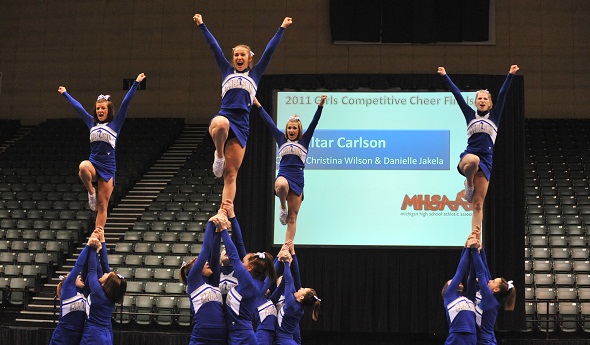 PHOTO from last season's MHSAA Division 2 Final at the Grand Rapids DeltaPlex.