

Legacy Speaks for Allen's Service
January 31, 2014
By Geoff Kimmerly
Second Half editor
Randy Allen was a face seen and a voice heard by thousands during the first two decades of his career in athletics, when he worked as a TV sports anchor and radio play-by-play personality.
But it’s fair to assume his son Dean has watched his dad at work more than anyone over the latter’s most recent 20-plus years serving high school athletic associations, including the last 13 as an assistant director at the MHSAA.
Dean Allen, now an assistant athletic director at Pontiac Notre Dame Prep, remembers many trophy presentations over the years and how his dad would step back and make sure the tournament manager or athletic director was the one handing the hardware to those who deserved the spotlight.
Randy Allen embraced a behind-the-scenes role after joining the high school association side in 1992. And as he retired from the MHSAA on Friday, it was no doubt the athletic directors, officials and coaches who worked with him behind the scenes over the last 13 years who most appreciated his many contributions to making his seasons run smoothly.
“The biggest smile you’d see on him was when the tournament was over and the kids were out there tackling each other, the excitement, the smiles on their faces when they get their medals and raise the trophy,” Dean Allen said. “For him, that’s most worth it. To see it run well, and when it’s over, seeing the kids and the community and parents and coaches, celebrating the successes they’ve had. Seeing the smiles on kids’ faces is really what it’s all about.”
Randy Allen’s name surely isn’t as recognizable to sports fans in Michigan as it was during the 1970s and 80s in Wisconsin.
That was by design.
Allen set that tone almost immediately at his first meeting as a member of the MHSAA staff – during the Michigan Interscholastic Athletic Administrators Association annual summer retreat.
“I remember telling them how glad I was to be here, and how much I looked forward to serving the membership. I just felt that was our main focus here, was to serve schools,” Allen said. “I’ve kept that thought in mind day in and day out.”
Allen knew only a handful of Michiganders when he joined the MHSAA staff. But he knew the job – and was ready for the challenges of fulfilling an aspiration while gaining knowledge of his new home on the fly.
His roots in high school athletics already dug deep.
Allen officiated baseball and softball for 25 years and also some of both at the college level. He also worked as a TV sports anchor at multiple stations near Madison, Wis., for 15 years while radio broadcasting high school football, basketball, baseball and hockey games on three networks and University of Wisconsin hockey games during the era of legendary coach Bob Johnson.
Allen went on to work in various other media roles as a producer, director and station manager, and broadcasted and produced Wisconsin high school tournament games – which led in part to his joining the Wisconsin Interscholastic Athletic Association staff as communications director in 1992.
In 2000, Allen became a seven-state regional director for iHigh.com. But an opportunity at the MHSAA two years later allowed him to pursue a goal going back to his days at the WIAA.
“I had always hoped I would get a chance to manage a sport in a state association,” Allen said. “When I came here, I went to heaven. I got to manage sports, and they were sports I knew like the back of my hand.”
Allen joined the MHSAA staff as assistant director in charge of baseball, softball, hockey and team wrestling. But that was just a start; Allen later traded in baseball and team wrestling for golf and played a leading role in the addition of bowling, which he has directed since its inception.
Allen also coordinated the junior high/middle school and MHSAA awards committees and served as staff liaison to the MIAAA, among other duties.
“Randy has been a perfect fit for his major sport responsibilities here,” MHSAA executive director Jack Roberts said. “He is a very hard worker, and he is very well liked by the coaches, officials and administrators he has served so well.”
It was during a trip to visit potential Hockey Finals sites roughly a decade ago that Roberts first brought up to Allen the possibility of bowling becoming the next MHSAA tournament addition – and the question of who on staff could run it. Roberts asked if Allen had experience in the sport.
Allen had an uncle in the bowling business and had been rolling since he was 4. “Bowling has been in my DNA since I was (a child),” Allen said. “I speak their language.”
He directed the MHSAA’s first Bowling Finals in 2004. Participation in the sport has continued to grow to 6,700 students in 2012-13.
Bowling also played a big part in making Allen something of an ambassador for the MHSAA, in that he reached out to an entire group of sports people who had not been in MHSAA conversations before.
He played a similar key role in serving others who also often work under the radar, providing training to the athletic department secretaries and middle school athletic directors during MIAAA conferences. And his experience in multiple states allowed him to provide a valuable and varied perspective.
“He always was willing to talk to someone – answer an MHSAA rules or regulation question, provide a quick fix to a school/league issue, give an anecdote to make a bad day better with a smile,” said Bear Lake athletic director Karen Leinaar, who also serves on the MHSAA Representative Council and is assistant to the executive director of the MIAAA. “And he always was a welcoming voice on the phone. No question, no person was ever a bother. He always took time and provided some type of direction.”
He’ll continue to do so.
Allen will begin Monday as commissioner of the Capital Area Activities Conference, the 27-school league that includes most of the biggest in the Lansing and Jackson areas.
“My entire life has been school sports. Not college sports, not professional sports. School sports,” Allen said. “It was my passion, what I was comfortable with as an official; I coached a little bit, I played a little bit (and) as a broadcaster.”
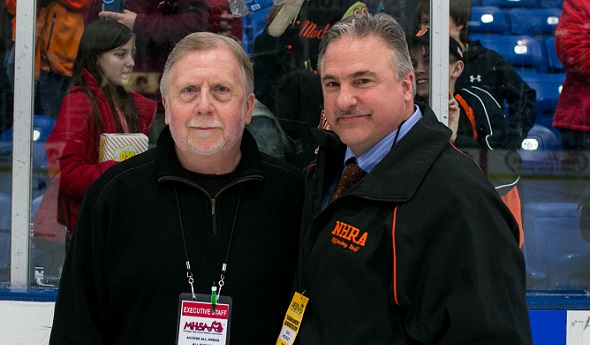
PHOTO: Retired MHSAA assistant director Randy Allen (left), with official Dan Dicristofaro, managed his final Hockey Finals in 2013.

Advisory Council Names Class Of 2020
By
Geoff Kimmerly
MHSAA.com senior editor
April 26, 2018
By Geoff Kimmerly
Second Half editor
Eight student-athletes who will be juniors at their schools during the 2018-19 academic year have been selected to serve two-year terms on the Michigan High School Athletic Association’s Student Advisory Council.
The Student Advisory Council is a 16-member group which provides feedback on issues impacting educational athletics from a student’s perspective, and also is involved in the operation of Association championship events and other programming. Members of the Student Advisory Council serve for two years, beginning as juniors. Eight new members are selected annually to serve on the SAC, with nominations made by MHSAA member schools. The incoming juniors will join the group of eight seniors-to-be appointed a year ago.
Selected to begin serving on the Student Advisory Council in 2018-19 are: Grace Beardsley, Gladwin; Kaitlyn Bricker, Pellston; Nathan Eccles, Port Huron Northern; Jack Fairman, Bloomfield Hills Cranbrook Kingswood; Alexis Mohney, Mattawan; Trevin Phillips, Caro; Isabella Santiago-Lindsay, North Muskegon; and Lance Wiltse, Saginaw Michigan Lutheran Seminary.
The first Student Advisory Council was formed for the 2006-07 school year. With the addition of this class beginning this summer, members will have represented 102 schools from 43 leagues plus independent schools that do not play in a league. Combined, the new appointees have participated in 13 MHSAA sports, and six of the eight will be the first SAC members from their respective schools.
The Student Advisory Council meets seven times each school year, and once more for a 24-hour leadership camp. In addition to assisting in the promotion of the educational value of interscholastic athletics, the Council discusses issues dealing with the 4 S’s of educational athletics: scholarship, sportsmanship, safety (including health and nutrition) and the sensible scope of athletic programs. There also is a fifth S discussed by the group – student leadership.
This school year, the Council revamped its annual “Battle of the Fans” contest to allow more schools to contend for the title, and selected the 2017-18 champion. Council members also presented Sportsmanship Summits in front of more than 1,000 students from across the state, handed out championship trophies at Finals events and provided feedback to the MHSAA Representative Council on proposed rule changes.
The new additions to the SAC will join the Class of 2019 members who were selected a year ago: Taylor Adams, Allendale; Neil Bazaj, Ann Arbor Greenhills; Megan Corbe, St. Joseph; Shane Dolan, Clarkston Everest Collegiate; Chloe Idoni, Fenton; William Jontz, Brighton; Pierce Morrissey, Big Rapids; and Abigail Nelson, Negaunee.