

Legacy Speaks for Allen's Service
January 31, 2014
By Geoff Kimmerly
Second Half editor
Randy Allen was a face seen and a voice heard by thousands during the first two decades of his career in athletics, when he worked as a TV sports anchor and radio play-by-play personality.
But it’s fair to assume his son Dean has watched his dad at work more than anyone over the latter’s most recent 20-plus years serving high school athletic associations, including the last 13 as an assistant director at the MHSAA.
Dean Allen, now an assistant athletic director at Pontiac Notre Dame Prep, remembers many trophy presentations over the years and how his dad would step back and make sure the tournament manager or athletic director was the one handing the hardware to those who deserved the spotlight.
Randy Allen embraced a behind-the-scenes role after joining the high school association side in 1992. And as he retired from the MHSAA on Friday, it was no doubt the athletic directors, officials and coaches who worked with him behind the scenes over the last 13 years who most appreciated his many contributions to making his seasons run smoothly.
“The biggest smile you’d see on him was when the tournament was over and the kids were out there tackling each other, the excitement, the smiles on their faces when they get their medals and raise the trophy,” Dean Allen said. “For him, that’s most worth it. To see it run well, and when it’s over, seeing the kids and the community and parents and coaches, celebrating the successes they’ve had. Seeing the smiles on kids’ faces is really what it’s all about.”
Randy Allen’s name surely isn’t as recognizable to sports fans in Michigan as it was during the 1970s and 80s in Wisconsin.
That was by design.
Allen set that tone almost immediately at his first meeting as a member of the MHSAA staff – during the Michigan Interscholastic Athletic Administrators Association annual summer retreat.
“I remember telling them how glad I was to be here, and how much I looked forward to serving the membership. I just felt that was our main focus here, was to serve schools,” Allen said. “I’ve kept that thought in mind day in and day out.”
Allen knew only a handful of Michiganders when he joined the MHSAA staff. But he knew the job – and was ready for the challenges of fulfilling an aspiration while gaining knowledge of his new home on the fly.
His roots in high school athletics already dug deep.
Allen officiated baseball and softball for 25 years and also some of both at the college level. He also worked as a TV sports anchor at multiple stations near Madison, Wis., for 15 years while radio broadcasting high school football, basketball, baseball and hockey games on three networks and University of Wisconsin hockey games during the era of legendary coach Bob Johnson.
Allen went on to work in various other media roles as a producer, director and station manager, and broadcasted and produced Wisconsin high school tournament games – which led in part to his joining the Wisconsin Interscholastic Athletic Association staff as communications director in 1992.
In 2000, Allen became a seven-state regional director for iHigh.com. But an opportunity at the MHSAA two years later allowed him to pursue a goal going back to his days at the WIAA.
“I had always hoped I would get a chance to manage a sport in a state association,” Allen said. “When I came here, I went to heaven. I got to manage sports, and they were sports I knew like the back of my hand.”
Allen joined the MHSAA staff as assistant director in charge of baseball, softball, hockey and team wrestling. But that was just a start; Allen later traded in baseball and team wrestling for golf and played a leading role in the addition of bowling, which he has directed since its inception.
Allen also coordinated the junior high/middle school and MHSAA awards committees and served as staff liaison to the MIAAA, among other duties.
“Randy has been a perfect fit for his major sport responsibilities here,” MHSAA executive director Jack Roberts said. “He is a very hard worker, and he is very well liked by the coaches, officials and administrators he has served so well.”
It was during a trip to visit potential Hockey Finals sites roughly a decade ago that Roberts first brought up to Allen the possibility of bowling becoming the next MHSAA tournament addition – and the question of who on staff could run it. Roberts asked if Allen had experience in the sport.
Allen had an uncle in the bowling business and had been rolling since he was 4. “Bowling has been in my DNA since I was (a child),” Allen said. “I speak their language.”
He directed the MHSAA’s first Bowling Finals in 2004. Participation in the sport has continued to grow to 6,700 students in 2012-13.
Bowling also played a big part in making Allen something of an ambassador for the MHSAA, in that he reached out to an entire group of sports people who had not been in MHSAA conversations before.
He played a similar key role in serving others who also often work under the radar, providing training to the athletic department secretaries and middle school athletic directors during MIAAA conferences. And his experience in multiple states allowed him to provide a valuable and varied perspective.
“He always was willing to talk to someone – answer an MHSAA rules or regulation question, provide a quick fix to a school/league issue, give an anecdote to make a bad day better with a smile,” said Bear Lake athletic director Karen Leinaar, who also serves on the MHSAA Representative Council and is assistant to the executive director of the MIAAA. “And he always was a welcoming voice on the phone. No question, no person was ever a bother. He always took time and provided some type of direction.”
He’ll continue to do so.
Allen will begin Monday as commissioner of the Capital Area Activities Conference, the 27-school league that includes most of the biggest in the Lansing and Jackson areas.
“My entire life has been school sports. Not college sports, not professional sports. School sports,” Allen said. “It was my passion, what I was comfortable with as an official; I coached a little bit, I played a little bit (and) as a broadcaster.”
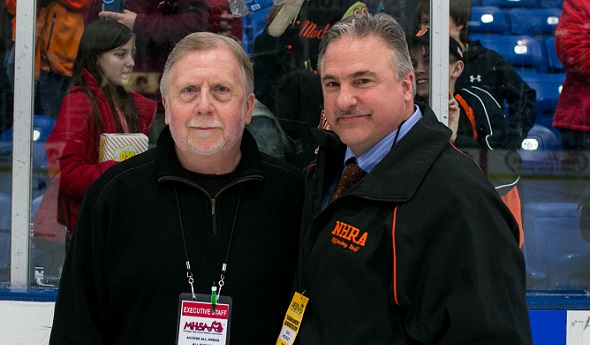
PHOTO: Retired MHSAA assistant director Randy Allen (left), with official Dan Dicristofaro, managed his final Hockey Finals in 2013.
Scholars & Athletes 2018: Class C & D
By
Geoff Kimmerly
MHSAA.com senior editor
February 4, 2018
By Geoff Kimmerly
Second Half editor
The Michigan High School Athletic Association has selected 10 student-athletes from Class C and D member schools to receive scholarships through the MHSAA/Farm Bureau Insurance Scholar-Athlete Award program.
 Farm Bureau Insurance, in its 29th year of sponsoring the award, will give $1,000 college scholarships to 32 individuals who represent their member schools in at least one sport in which the Association sponsors a postseason tournament. The first 30 scholarships are awarded proportionately by school classification and the number of student-athletes involved in those classes; also, there are two at-large honorees who can come from any classification.
Students applying for the Scholar-Athlete Award must be carrying at least a 3.5 (on a 4.0 scale) grade-point average and have previously won a letter in a varsity sport in which the Michigan High School Athletic Association sponsors a postseason tournament. Other requirements for the applicants were to show active participation in other school and community activities and produce an essay on the importance of sportsmanship in educational athletics.
Each of the scholarship recipients will be honored at a halftime ceremony during the Class C Boys Basketball Final game March 24 at the Breslin Student Events Center in East Lansing. Commemorative medallions will be given to the finalists in recognition of their accomplishments.
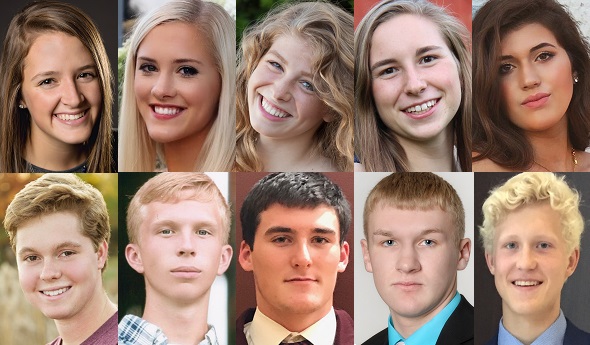
The Class C Scholar-Athlete Award honorees are Ellen Charlotte Laurenz, Breckenridge; Rachel Nesburg, Charlevoix; Emma Pachulski, Saranac; Jack Avery Harris, Ann Arbor Greenhills; Parker Hayes, Beaverton; and Bryant Kieft, Watervliet.
The Class D Scholar-Athlete Award recipients are: Laura Lyons, Lake Linden-Hubbell; Sophie Ruggles, Mount Pleasant Sacred Heart; Aaron Jacob Fahrner, Owendale-Gagetown; and Peter Kalthoff, Hillsdale Academy.
Overviews of the scholarship recipients of the Class C Scholar-Athlete Award follow. A quote from each recipient's essay also is included:
 Ellen Charlotte Laurenz, Breckenridge
Playing her third season of varsity basketball, ran four seasons of varsity cross country and will compete in her fourth season of varsity track & field this spring. Earned all-state athletic and academic honors in track and helped the cross country team to three top-seven MHSAA Finals finishes. Served as captain of varsity teams for both cross country and basketball. Serving second year as student council president and vice president for Future Farmers of America chapter. Participated in a number of leadership endeavors as part of FFA, earning a number of awards. Also named a Good Citizens Award recipient by the Daughters of the American Revolution. Participating in third year of National Honor Society and this year as her chapter’s historian; also participates in German student exchange club and as part of her church youth group. Will attend Alma College and study communications.
Essay Quote: “The season in which I was unable to participate (because of injury) gave me a new perspective on sportsmanship. It was during that time that I learned to appreciate every athlete for the effort they put into their sport, regardless of how fast or slow, talented or not they may be.”
 Rachel Nesburg, Charlevoix
Playing fourth season of varsity basketball, ran four of varsity cross country and will play her fourth of varsity soccer and participate in her second of varsity track & field this spring. Earned all-league honors in basketball and soccer and all-state in soccer and track; also earned multiple academic all-state awards. Served as captain of basketball and soccer teams and owns multiple school records in track and soccer. Participating in second year of National Honor Society and served three years as class president. Also has served as president and vice president of local Zonta Club and co-founded her community’s Junior Main Street Committee. Volunteered in a number of efforts including production of videos for local theaters to raise awareness of substance abuse. Also participates in Girl Scouts, her church youth group and SAFE Northern Michigan, and as a youth sports official and coach. Will attend University of Michigan and study pre-physical therapy.
Essay Quote: “Sometimes a little motivation is all it takes to make someone’s situation better. Sportsmanship is about helping others grow and succeed when they get knocked down. In addition, when we lift others up, we raise our own confidence levels, which can create unlimited potential for success and achievement.”
 Emma Pachulski, Saranac
Played three seasons of varsity volleyball and will participate in her fourth of varsity track & field this spring. Served as captain of both teams; earned all-conference, all-region and academic all-state honors in volleyball and all-county in track. Participating in second year of National Honor Society and attended American Legion Auxiliary Girls State. Also plays in school band; has served as percussion section leader and first chair clarinet and helped band to highest possible “1” rating at district competition. Participates in her school’s drama productions, earning lead female roles and serving as assistant director and lead choreographer. Serves as lead photographer on yearbook staff. Earned Sportsmanship Award, the highest honor, from local 4-H and also participates as part of her church’s youth group. Walked and raised funds to honor cancer survivors as part of Relay for Life. Will attend Grand Rapids Community College and study theatre & media arts.
Essay Quote: “High school athletics is a place for students to learn life lessons. Practicing sportsmanship through athletics prepares youth for challenges they’ll encounter in adulthood. You know what they say – perfect practice makes for a perfect performance. If high school is the practice, life is the performance.”
 Jack Avery Harris, Ann Arbor Greenhills
Played three years of varsity tennis, earning three Lower Peninsula Division 4 Finals No. 1 doubles championships and helping his team to the 2015 title. Earned all-state honors all three years, served as a team captain and is among nominees for the Detroit Catholic League Scholar-Athlete Award for graduating seniors. Also has contributed to school chess club and forensics team state championships and played in the top jazz ensemble for three years. Served as chess club captain, head Gryphon Ambassador for school’s open house program and producer for ACTivate the Cure fundraiser performance for cancer research. Also has been involved in school drama productions all four years of high school. Is undecided what he will study, but will attend University of Michigan.
Essay Quote: “As a tennis player, there is nothing more frustrating than feeling like your opponents have less respect for your enjoyment than you do for theirs. But, from this seemingly flawed system, the greatest kind of student athlete is able to be formed. The greatest competitor in tennis calls every line as he sees it, cheating neither himself, nor an opponent. The measure of a great student athlete therefore relies not on one’s skill, but one’s character.”
 Parker Hayes, Beaverton
Ran four years of varsity cross country and will participate in fourth season of varsity track & field this spring; also played subvarsity basketball. Earned all-state in cross country and also academic all-state while earning multiple cross country and track league championships. Served as captain of the cross country team and earned multiple conference Sportsmanship Awards. Participating in third year of National Honor Society and carries a 4.0 grade-point average after also taking classes from Mid-Michigan Community College for three years. Participating in third year of Business Professionals of America and has served as vice president while earning a regional championship and making state and national finals. Holds rank of Eagle Scout and has served as senior patrol leader, certified instructor and certified lifeguard and earned membership in the Order of the Arrow. Participates in his church’s youth group and serves as Sunday School secretary. Will attend Northwood University and study accounting.
Essay Quote: “My hope is that when others see me do the ‘right things’ in the middle of a competition, they may see my example and consider their own actions. I would love to see future competitions where every spectator and athlete shows good sportsmanship, where even the last-place finisher feel like a champion.”
 Bryant Kieft, Watervliet
Played three years of varsity football, is playing his second of varsity basketball and will play his third of varsity baseball this spring; also wrestled as a freshman. Earned all-state in football while setting his school’s receiving yards record and has earned all-league recognition in both basketball and baseball; earned academic all-state in baseball as a sophomore. Helped football team to multiple league titles and football and baseball teams to District titles. Captained all three varsity teams. Serving fourth year as class’ co-president and this year as National Honor Society chapter vice president. Also has served as school’s representative at the Southwestern Athletic Conference Leadership Summit. Earned regional first place and state honorable mention at Michigan Industrial Technology Education Society competitions. Served two years on Watervliet Principal’s Committee and is in second of training in Whirlpool Apprenticeship Program. Will attend Northwood University to study entertainment and sports promotion management.
Essay Quote: “No matter the situation, I strive to set an example that displays the respect I have for my opponents, my teammates, my coaches, the officials and the game itself. We athletes are privileged to play a game we love, so we must treat it with the respect it deserves by displaying good sportsmanship at all times.”
Other Class C girls finalists for the Scholar-Athlete Award were: Shelby Trevino, Beal City; Kendall Gassman, Bloomfield Hills Academy of the Sacred Heart; Kelleigh Keating, Bloomfield Hills Academy of the Sacred Heart; Morgan Hartline, Marcellus; Clara Johnson, Negaunee; Emily Spitzley, Pewamo-Westphalia; Halie Robinson, Royal Oak Shrine Catholic; Kendahl Grace Overbeck, Saranac; and Melody Antel, Saugatuck.
Other Class C boys finalists for the Scholar-Athlete Award were: Matthew Harazin, Bridgman; Ilhan Onder, Calumet; Joseph R. Claramunt, Harbor Springs; Thomas Kelbel, Harbor Springs; Evans Brown, Kalamazoo Hackett; Eric Vandefifer, Montrose; Luke Skewis, Negaunee; Colton Yesney, Negaunee; and Ben Hogan, North Muskegon.
Overviews of the scholarship recipients of the Class D Scholar-Athlete Award follow. A quote from each recipient's essay also is included:
 Laura Lyons, Lake Linden-Hubbell
Played three seasons of varsity volleyball, four of varsity basketball and will participate in her fourth of both softball and track & field this spring. Earned all-league honors for volleyball, softball and track and helped the volleyball team to league and District titles and the track team to league, Regional and 2017 Upper Peninsula Division 3 Finals championships. Participating in second year of National Honor Society and serving as her chapter’s president as well as student council president; served two terms as her class president. Also is serving as her marching band drum major, physics club president and previously served as bowl team captain. Has volunteered for a number of efforts, taught Sunday School at her church and worked as an official for youth volleyball, softball and basketball. Earned Gold and Bronze awards from the Girl Scouts. Will attend Michigan State University and study biochemistry.
Essay Quote: “Little things often go unnoticed – but are the essence of who we are and what we become. As athletes we mirror our community and set a model for future generations. When we step out on the field or court, we represent not only ourselves, but our school, community and parents.”
 Sophie Ruggles, Mount Pleasant Sacred Heart
Playing fourth season of varsity basketball after completing her third of varsity volleyball during the fall; also ran track as a sophomore. Earned all-state first-team honors in both basketball and volleyball and academic all-state in both. Helped volleyball team to three league, four District and four Regional titles and basketball team to three league, District and Regional titles heading into this season plus a Class D runner-up finish in 2016. Participating in fourth year of forensics and helped that team to a conference championship while earning all-conference honors. Also helped quiz bowl and Model United Nations teams to conference titles. Serving fourth year as a Thrive Kids group leader and participating in second year of National Honor Society. Is undecided on what she will study, but will attend Michigan State University.
Essay Quote: “Sportsmanship is a tricky thing to define. Is it determined by a list of rules of things you have to do: Shake everyone’s hand. Never argue with a call. Always help someone up when they fall. It can be all of these things, yes; but it is what is behind the actions that embodies these words.”
 Aaron Jacob Fahrner, Owendale-Gagetown
Played four seasons of varsity football, is playing his fourth of varsity basketball and will play his fourth of varsity baseball this spring. Earned all-conference honors in all three sports and has captained both the football and basketball teams; helped his three teams to a combined five league championships heading into this winter. Serves on MHSAA Student Advisory Council. Carries a 4.0 grade-point average and will enter college with 39 credits. Serving third year as class president and also this year’s National Honor Society chapter president, his school band’s president and as yearbook editor for the second year. Also serving third year as part of the Huron County Youth Advisory Committee and has taken part in multiple volunteer efforts. Will attend Michigan State University and study agri-business management.
Essay Quote: “In high school athletics, students are all put on a team together; each must be willing to work with one another to achieve a common goal, putting their differences aside to be competitive and to succeed. An athlete with good sportsmanship respects teammates, coaches and officials. Sometimes you may not always see eye to eye, but when it comes to the game you have to be willing to play as a team and respect the coach’s and officials’ decisions.
 Peter Kalthoff, Hillsdale Academy
Played four seasons of varsity soccer and is playing his fourth of varsity basketball; also intends to participate in his second season of varsity track & field this spring. Started all four seasons of both soccer and basketball, helping both teams to District titles and the soccer team to a league title. Scored his 1,000th career basketball point as a junior. Earned all-state in multiple events in track & field, and also earned all-state recognition in soccer and basketball. Participating in fourth year of National Honor Society and his school’s service club, and served as president of the latter. Also participating in his fourth years of drama, chamber choir and vocal band and previously participated in string quartet, high school orchestra and Michigan Youth Symphony Orchestra. Selected to participate in Cambridge International and Center Stage strings festivals as violinist, and served as part of the Governor’s Honor Guard for Boy Scouts. Achieved black belt in Tae Kwon Do. Will attend University of Michigan or Hillsdale College and study music performance.
Essay Quote: “Even off the court or playing field, our words and deeds will leave impressions. The good sportsman, even in day-to-day life, will dependably seek to give the impression he wants others to take.”
Other Class D girls finalists for the Scholar-Athlete Award were: Katelyn Smith, Akron-Fairgrove; Corra Hamilton, Athens; Madison Kadlec, Bellaire; Ciera Weber, Fowler; Stephanie Schuman, Lawrence; and Ellie Haan, McBain Northern Michigan Christian.
Other Class D boys finalists for the Scholar-Athlete Award were: Nicholas Burlingame, Ashley; Brendan Delaney, Gaylord St. Mary; Andrew Pechette, Kinde-North Huron; Andrew Hager, Mio; Jeremiah Torrey, Onekama; and Thomas Hursey, Suttons Bay.
The Class B scholarship award recipients will be announced Feb. 13, and the Class A honorees will be announced Feb. 20.
Farm Bureau Insurance of Michigan was founded in 1949 by Michigan farmers who wanted an insurance company that worked as hard as they did. Those values still guide the company today and are a big reason why it is known as Michigan’s Insurance Company, dedicated to protecting the farms, families, and businesses of this great state. Farm Bureau Insurance agents across Michigan provide a full range of insurance services — life, home, auto, farm, business, retirement, Lake Estate®, and more — protecting nearly 500,000 Michigan policyholders.
The MHSAA is a private, not-for-profit corporation of voluntary membership by more than 1,500 public and private senior high schools and junior high/middle schools which exists to develop common rules for athletic eligibility and competition. No government funds or tax dollars support the MHSAA, which was the first such association nationally to not accept membership dues or tournament entry fees from schools. Member schools which enforce these rules are permitted to participate in MHSAA tournaments, which attract more than 1.4 million spectators each year.