

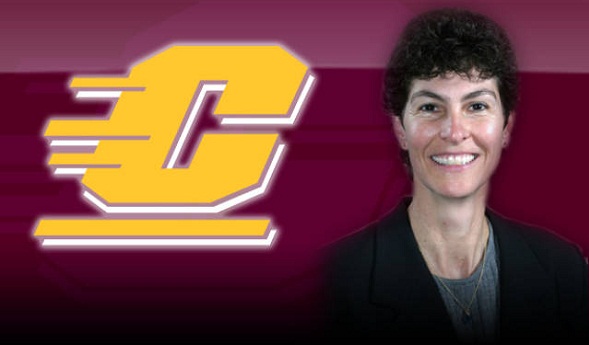
Lessons Learned Keep Paying Off
February 8, 2013
By Terri Finch Hamilton
Reprinted with permission of CMUChippewas.com
Gina Mazzolini's parents taught her to be a good person first, a good student second, and a good athlete after that. But Mazzolini says her involvement in sports at CMU taught her things that went way beyond the classroom.
"At Central, I learned women are just as good as men -- or better," says Mazzolini, assistant director at the Michigan High School Athletic Association. "I learned that if we put our minds to it, we can do anything."
A star athlete in volleyball and basketball at CMU from 1974 to 1978, Mazzolini says college sports helped her soar after the limitations for girls in high school sports in the early 1970s.
"In high school, women were always taking the back seat to men," says Mazzolini, 57. "I didn't see women in leadership positions in high school. Girls couldn't use the weight room -- we had to sneak in, then we'd get kicked out. They'd look at me and say, 'Why would you want to lift weights?'
"When the guys were done with the gym, then we could use it."
As an athlete at St. Johns High School, Mazzolini was just starting to compete competitively, she says. She won the school's first ever female athlete of the year award.
"Then I went to Central Michigan, and my teammates were all the best kids from their high school teams. Suddenly, everybody was good. And everybody we played against was good."
It was eye opening, she says.
"You learn a lot about yourself," she says. "If you can survive a practice, if you can survive playing Michigan State, you get confidence. I realized I was good. I learned how to be competitive, in a good way."
In basketball, she led the Chippewas in scoring and rebounding three straight seasons - averaging in double figures in both categories. After graduating from CMU, Mazzolini went on to teach and coach at the high school and college levels. She was inducted into the CMU Athletic Hall of Fame in 1992.
A few years later, Mazzolini received the 2009-10 Women In Sports Leadership Award by the Representative Council of the MHSAA.
So much of what she learned on the college volleyball and basketball courts prepared her for later success, Mazzolini says.
"In athletics, you can't worry about what just happened," she says. "You control your emotions, you take a deep breath, you move forward."
Good advice on any day, she says.
"You learn that you don't always win, and you learn to take defeat gracefully," she says. "Later, in your business life, you're not going to win everything, either. Sports teaches you how to deal with setbacks, how to work hard and rearrange your goals so that you do better next time.
"You learn if you work together, you can achieve amazing things."
CMUChippewas.com is running a series of stories to celebrate the 40th anniversary of Title IX legislation. Click to see more of the series.

Soccer Hall of Famer Seitz, NFL Analyst Pereira Headline Officiate Michigan Day 2026
By
Geoff Kimmerly
MHSAA.com senior editor
July 14, 2026
Officiate Michigan Day 2026 will welcome more than 1,000 Michigan High School Athletic Association-registered game officials July 25 to DeVos Place in Grand Rapids, where they will receive knowledge and instruction from several high-profile voices headlined by recent National Soccer Hall of Fame inductee Kari Seitz – a Brighton High School graduate – and one of television’s most recognizable rules analysts, Mike Pereira.
Officiate Michigan Day is designed to benefit officials with any level of experience, veteran to beginner. High-profile clinicians representing several sports and all levels including the NFL, NBA, MLB, NCAA, FIFA and the National Women’s Soccer League (NWSL) will provide face-to-face training during four sport-specific breakout sessions throughout the conference.
Pereira, a past collegiate and NFL football official who also has served as the NFL’s vice president of officiating, will present the opening address at 9 a.m. He has provided his knowledge during FOX Sports football broadcasts since 2010, explaining rules scenarios on-air as situations unfold in-game.
Seitz, also a graduate of Michigan State University, refereed Women’s World Cups in 1999, 2003, 2007 and 2011 and Olympics tournaments in 2004, 2008 and 2012, and will deliver the conference’s closing message. She’s currently the vice president of refereeing for U.S. Soccer and formerly served as FIFA’s heading of refereeing.
This will be the third Officiate Michigan Day, joining events in 2013 and 2018. OMD 2026 will accompany the annual National Association of Sports Officials (NASO) Summit that will take place July 26-28, also at DeVos Place.
Officials may continue to register on the Officials page. Cost is $50. Additional details, including the full lineup of speakers and clinicians, also is available at that link.